Bringing Prescription Medication into Denmark: Schengen Certificates
Navigating the border with a suitcase full of pills is one of those "invisible" anxieties that hits you right before you board your flight to Copenhagen. I remember standing in line at customs, wondering if my asthma inhalers and allergy meds would be seized because I didn't have the right stamp on a piece of paper. This guide explains how to legally bring your prescription medication into Denmark without the stress.
Understanding the Danish Border Rules for Medication
When you first arrive in Denmark, whether you are coming from a neighboring EU country or flying in from across the globe, the rules regarding medication are governed by the Danish Medicines Agency (Lægemiddelstyrelsen). The most important distinction to make is between regular prescription medication and those containing "euphoriant" substances—essentially narcotics or psychotropic drugs. If you are carrying standard antibiotics or blood pressure medication, the process is relatively straightforward, but for anything controlled, the paperwork becomes your lifeline.
The Legal Framework for Personal Use
Danish law is quite clear: you are generally allowed to bring medication for your own personal use. However, the definition of "personal use" is strictly enforced. For non-narcotic medications, you can typically bring a three-month supply if you are coming from a non-EU country, or a one-year supply if you are arriving from within the EU/EEA. Some people try to bring in years' worth of supplies thinking they were saving money, only to have them confiscated at Kastrup because they exceeded the legal limit for personal importation.
If you are a resident and find yourself waiting for your documentation to process, you might worry about running out. This is where Expat Health Insurance: Coverage Before You Get Your CPR Number becomes vital, as it ensures you can see a local doctor to get a Danish prescription before your foreign supply vanishes. It is always better to have a bridge plan than to risk bringing a massive, illegal quantity through customs.
Distinguishing Between Narcotic and Non-Narcotic Drugs
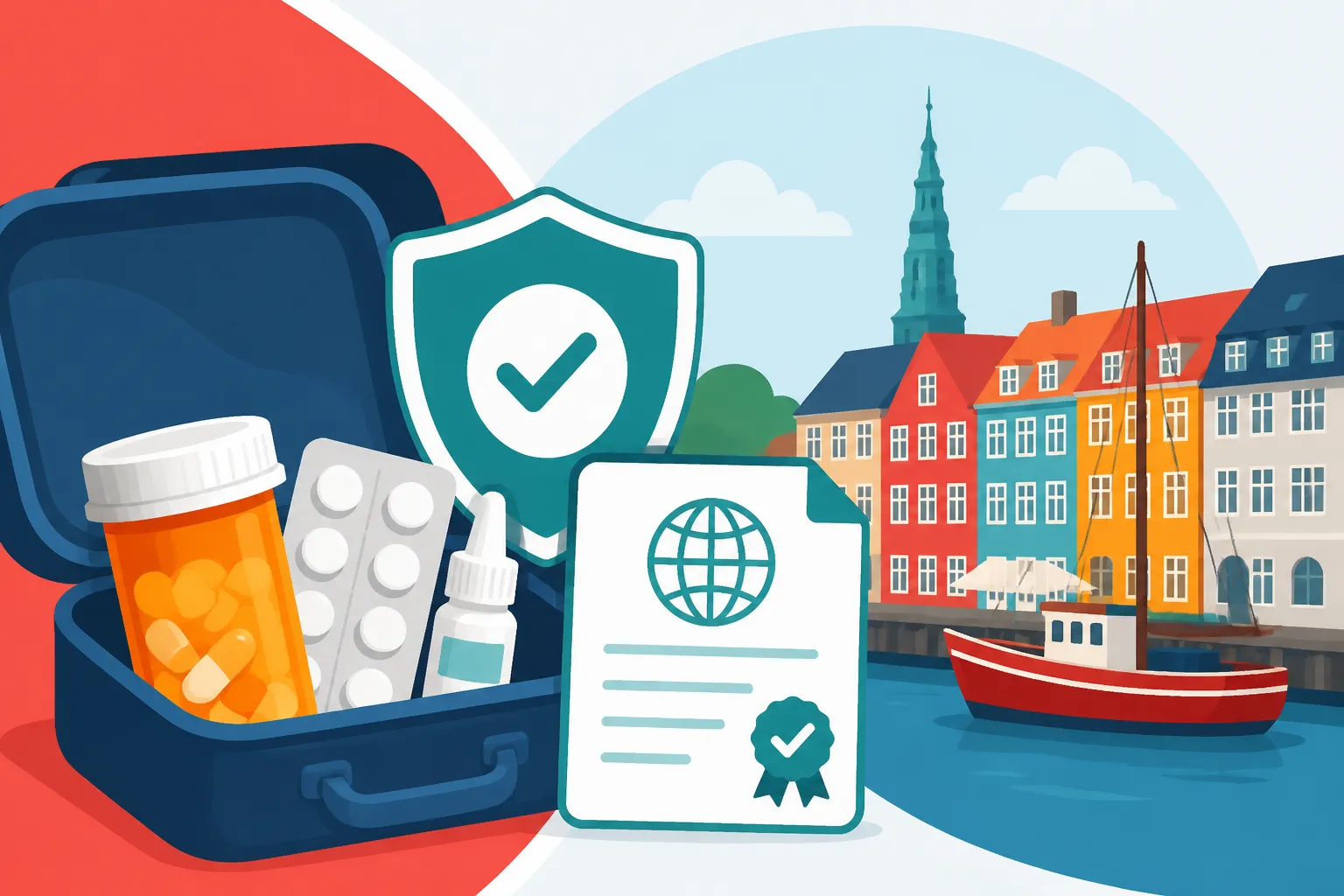
The real complexity begins when your medication is classified as a controlled substance. This includes many common treatments for ADHD, severe pain, or anxiety. If your medication contains ingredients like methylphenidate, codeine, or diazepam, you cannot simply pack them and hope for the best. For these, the Danish authorities require specific documentation, most notably the Schengen Certificate, often referred to as a "pill passport."
Understanding the difference is critical because the penalties for "smuggling" controlled substances, even if they are for your own health, can be severe. This isn't just about a fine; it can impact your future residency status. While you are getting settled, checking The Yellow Health Card (Sundhedskort): Your Key to Danish Healthcare will help you understand how the system will eventually take over your long-term medication needs.
Documentation Requirements for the Border
Even for non-controlled substances, it is wise to carry a copy of your original prescription and a letter from your doctor written in English. The letter should state your name, date of birth, the condition being treated, the dosage, and the total quantity you are carrying. In my experience, Danish customs officers are incredibly efficient and reasonable, but they have no patience for ambiguity. If they can’t read the label or the prescription, they will err on the side of caution and take the meds.
If you are moving from a country with very different medical standards, you might even consider Translating Foreign Vaccination Records into the Danish System along with your prescriptions to ensure your new Danish GP has a full picture of your medical history. Having a clear, organized folder of medical documents is the hallmark of a prepared expat.
The Schengen Certificate: What It Is and Why You Need It
If you live in a Schengen country and need to travel to Denmark with medication that contains narcotic or psychotropic substances, the Schengen Certificate is mandatory. This document proves that the drugs you are carrying have been prescribed by a doctor for your personal medical treatment. Without it, carrying something as common as certain cough syrups or ADHD medication can lead to a very long afternoon in a windowless room at the airport.
Which Medications Require a Pill Passport
The list of substances requiring a Schengen Certificate is longer than most people realize. It’s not just "heavy" drugs; it includes many sleep aids, strong painkillers, and stimulants. If you are unsure, you should check the list of controlled substances on the Danish Medicines Agency website or ask your local pharmacy back home. Most pharmacies in the Schengen area are well-versed in issuing these certificates and can tell you immediately if your specific brand requires one.
For those who are just starting their journey and perhaps haven't secured long-term coverage, brands like SafetyWing can provide a safety net for travel-related medical issues, but they won't be able to issue your Schengen Certificate; that must come from your prescribing physician and be validated by the health authorities in your country of origin.
The Application Process in Your Home Country
To get the certificate, you usually need to visit your prescribing doctor first. They fill out their portion of the form, and then you must take it to the relevant national health or pharmaceutical authority in your home country for an official stamp. This process can take anywhere from a few days to two weeks, so don't leave it until the day before your flight. I remember a friend who had to delay their move to Aarhus by a week because they forgot that their local health office was closed for a public holiday.
Once you arrive, you will eventually transition to the local system, and knowing How to Choose and Change Your General Practitioner (GP) in Denmark will be your next priority. Your new GP will be the one responsible for continuing these prescriptions, and they will want to see that you followed the correct legal procedures when bringing your initial supply into the country.
Validity and Travel Duration Limits
A Schengen Certificate is only valid for a maximum of 30 days. This is a crucial point that many expats miss. If you are moving to Denmark permanently, the certificate covers your initial month of residency, giving you just enough time to get your CPR number and register with a local doctor. If you anticipate that it will take longer to get your paperwork in order, you need to be very strategic about your initial supply.
The 30-day rule is strict because Denmark expects residents to use the local healthcare infrastructure. To speed up the transition, make sure you understand Sundhed.dk and MitID: Navigating Denmark’s Digital Health Portals as early as possible. Once you have MitID, managing your health becomes significantly easier, but during that first month, your Schengen Certificate is your only legal protection.
Moving from Outside the Schengen Area
If you are moving to Denmark from the US, Canada, Australia, or any other non-Schengen country, the "pill passport" doesn't exist for you. Instead, you are governed by the general rules for personal importation from "third countries." This is often a more stressful experience because there isn't a standardized form like the Schengen Certificate, so you have to be extra diligent with your paperwork.
The 30-Day Rule for Non-EU Residents
For residents coming from outside the EU/EEA, you are generally allowed to bring a 30-day supply of medication containing controlled substances. For regular, non-controlled medication, this limit is usually extended to three months. The logic here is that 30 days should be sufficient time for an expat to visit a Danish doctor and get a local equivalent. However, we all know that the administrative wheels in Denmark can sometimes turn slowly.
If you are worried about the gap between your 30-day supply and getting your first appointment, you might look into Private Health Insurance (Sygeforsikring "danmark"): Is It Worth It? or maintain a policy with Cigna Global. Cigna Global is particularly popular among non-EU expats because they offer high-tier international coverage that can help you access private specialists faster than the public system might allow during your first few months.
Essential Documentation for Non-Schengen Arrivals
Since you can't get a Schengen Certificate, you must carry a comprehensive medical certificate from your doctor. This certificate must be in English or Danish. It needs to clearly state the illness being treated, the name of the medicine, the dosage, and the quantity you are carrying. Crucially, it should also include the doctor's contact information and their medical license number.
I’ve found that it helps to keep the medication in its original packaging with the pharmacy label clearly visible. If the name on the pharmacy label matches the name on your passport and the name on the doctor's letter, customs officers will rarely give you a hard time. If you are struggling with chronic issues, you may also want to read about Managing Chronic Conditions (Diabetes, Asthma) in the Danish System to see how your specific needs will be handled long-term.
Customs Declarations: Red vs. Green Channel
A common question is whether you should walk through the "Nothing to Declare" green channel or the "Goods to Declare" red channel. If you are carrying controlled substances from a non-Schengen country, even with your paperwork, it is often safer to go through the red channel and proactively show your documents. This prevents any accusation of trying to hide the substances.
The officers will check your quantities against your medical certificate. If everything matches, you’ll be on your way in minutes. If you choose the green channel and are stopped for a random check, and they find a 90-day supply of a narcotic without a clear declaration, the situation can escalate quickly. During this transition, having reliable coverage from SafetyWing can give you peace of mind regarding any sudden medical emergencies that might arise while your status is being verified.
| Medication Category | Source Country (EU/Schengen) | Source Country (Non-EU) | Required Document |
|---|---|---|---|
| Non-Controlled | Up to 1 year supply | Up to 3 months supply | Doctor's Letter/Prescription |
| Controlled (Narcotic) | Up to 30 days supply | Up to 30 days supply | Schengen Certificate |
| Controlled (Narcotic) | N/A | Up to 30 days supply | Detailed Medical Certificate |
| Over-the-Counter | Unlimited (personal use) | Up to 3 months supply | None (keep in packaging) |
Navigating the Danish Pharmacy System Upon Arrival
Once you have cleared customs and settled into your new home, your focus shifts from "importing" to "maintaining." The Danish pharmacy (Apotek) system is highly regulated and probably functions differently than what you are used to back home. You cannot simply walk in with a foreign prescription and expect it to be filled.
The Role of the Danish GP in Renewals
In Denmark, the GP is the gatekeeper. You must visit a local doctor to have your foreign prescriptions converted into Danish ones. This is why Finding Medical Care in Denmark: GPs, Specialists, and Referrals is one of the first things you should do after getting your CPR number. The doctor will evaluate your foreign medical records and issue a Danish prescription that is then uploaded to a central digital system.
Don't be surprised if the GP wants to re-evaluate your diagnosis, especially for controlled substances like ADHD meds. Danish doctors are often more conservative with certain medications than doctors in the US or UK. They might want to run their own tests or refer you to a specialist before continuing a high-dosage prescription. Understanding The Role of the GP: Why You Cannot Go Directly to a Specialist will help manage your expectations during this process.
Using Digital Tools for Prescriptions
Denmark is one of the most digitized countries in the world. Once a doctor issues a prescription, it isn't a piece of paper; it’s an entry in a national database. You can see all your active prescriptions by Using the Medicinkortet App: Managing Your Prescriptions Digitally. This app is incredibly convenient—you can even request renewals directly through it once you have an established relationship with your GP.
When you go to the Apotek, you just scan your yellow card, and they can see everything you are entitled to. It eliminates the risk of losing a paper script. For those arriving from countries where pharmacy errors are common, this digital trail provides a massive sense of security. If you are still waiting for your physical card, you can learn How to Download the Sundhedskort App on Your Phone to have a digital version ready.
Costs, Subsidies, and Insurance
Medication in Denmark is subsidized, but it isn't free. The more you spend on prescriptions in a calendar year, the higher the percentage the state covers. This is a rolling scale that resets every year. It’s a bit complex at first, but the pharmacy’s computer system tracks it all automatically for you. For those with high medication costs, Pharmacies in Denmark: Apotek Rules, Prescriptions, and Subsidies provides a deep dive into how these calculations work.
This is also where Cigna Global or Private Health Insurance (Sygeforsikring "danmark"): Is It Worth It? comes into play. While the state covers a portion, "danmark" (the private insurance association) can provide additional reimbursements, often making the out-of-pocket cost negligible. Most expats find that joining "danmark" is one of the smartest financial moves they make in their first year.
Special Cases: Controlled Substances and Narcotics
Certain medications are treated with extra scrutiny in Denmark. If you are on stimulants for ADHD, strong opioids for chronic pain, or certain benzodiazepines, you need to be prepared for a more rigorous process both at the border and within the healthcare system.
ADHD Medication and Stimulants
The use of Ritalin, Concerta, or Elvanse is strictly controlled. If you are bringing these from abroad, the Schengen Certificate is non-negotiable. Once you are in the system, you will likely need to be seen by a psychiatrist to have your prescription maintained. A GP can often renew these once a specialist has "stabilized" you, but the initial Danish prescription usually requires a specialist's signature.
This can lead to long wait times. If you know you are moving, it is wise to check How Long is the Wait for a Psychologist Referral in Denmark? or similar specialist wait times. This is another scenario where having a robust international policy like Cigna Global can be a lifesaver, as it may allow you to bypass the public waitlists by seeing a private psychiatrist.
Managing Strong Pain Relief
If you suffer from a condition that requires chronic opioid therapy, you should be aware that Danish medical culture is very focused on "de-escalation." Doctors may be hesitant to continue the same high dosages prescribed in other countries without a thorough review. Bringing your full medical history and perhaps a summary from your previous pain specialist is essential.
You should also look into Managing Chronic Conditions (Diabetes, Asthma) in the Danish System even if your condition is pain-based, as the multi-disciplinary approach in Denmark often involves physical therapy. Getting a Physiotherapy in Denmark: Getting GP Referrals and Managing Costs plan in place might be part of the requirement for continuing your medication.
Dealing with Customs Emergencies
What happens if your medication is lost, stolen, or seized at the airport? First, don't panic. You should immediately contact Emergency Medical Care in Denmark: Calling 112, Lægevagten, and ERs. If it is an emergency, you can visit an Akutmodtagelse (ER). They can provide a small emergency supply if you can prove your medical need.
However, they will not give you a full month's supply of a narcotic. They will give you enough to survive until the next business day when you can see a GP. This is a stressful situation that is easily avoided by having your Schengen Certificate or medical certificate in your carry-on bag—never in your checked luggage. If you find yourself without coverage during such a crisis, SafetyWing is an excellent option for handling the resulting medical bills.
Financial and Insurance Considerations for Medication
The cost of medication can be a significant part of an expat's budget, especially in the first few months before the Danish subsidy system fully kicks in. Being strategic about your insurance can save you thousands of kroner.
Bridging the Gap with SafetyWing
When you first arrive, you are in a "grey zone." You might not have your CPR number yet, which means you aren't yet covered by the Danish public health system. SafetyWing is specifically designed for this period. While it is primarily travel insurance, it covers unexpected medical visits and some associated costs. It’s an affordable way to ensure that if you get a lung infection or lose your meds, you aren't paying the full "tourist price" for a doctor's visit.
However, remember that SafetyWing is not a replacement for long-term health insurance. It won't cover your routine, pre-existing prescription renewals. It's the "buffer" you use while you wait for your yellow card to arrive in the mail. For more on this timeline, see How Long Does It Take to Receive the Yellow Card in the Mail?.
Long-Term Security with Cigna Global
For those who want a higher level of service or who have complex medical needs, Cigna Global offers a level of continuity that the public system sometimes lacks. With a private international policy, you often have access to a wider range of brand-name medications that the Danish public system might replace with generics.
Furthermore, Cigna Global can be particularly helpful if you travel frequently outside of Denmark. While the yellow card covers you in Denmark and the blue card covers you in the EU, neither provides much protection if you are traveling back to the US or Asia. Having an international policy ensures that your medication and health needs are met regardless of which border you are crossing.
The Value of Sygeforsikring "danmark"
Once you have your CPR number, you should almost certainly apply for Private Health Insurance (Sygeforsikring "danmark"): Is It Worth It?. It is a member-owned association that provides reimbursements for dental work, glasses, and, most importantly, prescription medication. They have different "groups" (levels) of coverage. Even the most basic level provides a significant discount on many medications.
Just be aware that "danmark" does have rules about pre-existing conditions. You usually have to be healthy when you join to get full coverage for medicines related to chronic issues. This is why many expats join the moment they get their CPR number, even if they don't think they need it yet. It’s an investment in your future Danish life.
Healthcare and Medication Disclaimer
This guide is intended for informational purposes only and is based on personal experience and current regulations. It does not constitute legal or medical advice. Regulations regarding the importation of medication and controlled substances can change without notice. Always verify your specific situation with the Danish Medicines Agency (Lægemiddelstyrelsen) or the Danish Embassy in your home country before traveling. The author and publisher are not responsible for any legal issues, confiscations, or medical complications that may arise from following this guide. Always consult with a qualified medical professional regarding your treatment plan.