Translating Foreign Vaccination Records into the Danish System
One of the most jarring realizations for new arrivals in Denmark is that despite having a lifetime of medical history, the Danish digital health system initially sees you as a blank slate. I remember sitting in my new doctor's office with a crumpled paper record from my home country, only to be told that none of it "existed" in the system yet. This guide explains exactly how to bridge that gap and ensure your foreign vaccination history is correctly translated and uploaded into the Danish registers.
The Digital Void and Why Your Records Matter Immediately
When you first receive The Yellow Health Card (Sundhedskort): Your Key to Danish Healthcare, you might assume that your medical history somehow follows you across borders. Unfortunately, there is no global database for immunizations. In Denmark, your vaccination status is central to everything from childhood school enrollments to travel requirements and even emergency room triage. If you step on a rusty nail in Aarhus, the first thing the doctor will check is your digital record for a tetanus shot. If that record is empty because your foreign data wasn't "migrated," you are getting a needle in the arm whether you’ve had the shot recently or not.
The Danish system relies heavily on the "Det Danske Vaccinationsregister" (DDV). This is a centralized database that your General Practitioner (GP), hospitals, and even you can access. However, until a Danish medical professional manually verifies and enters your foreign data, the DDV will show you as completely unvaccinated. This can cause significant headaches when trying to figure out Vaccinations in Denmark: The Childhood Immunisation Programme for your children or when you need to prove your immunity status for certain jobs or travel visas.
Beyond just "having the record," the Danish system uses specific intervals and combinations of vaccines that might differ from your home country. For example, the MMR vaccine is known as the MFR vaccine here. Without a proper translation and entry into the system, you might find yourself stuck in a loop of administrative "Nej" when trying to access follow-up boosters or specialized care.
Step One Gathering and Preparing Your International Documents
Before you even book an appointment with your GP, you need to play detective with your own history. Danish doctors are highly efficient, but they are not translators or international record experts. If you show up with a stack of handwritten notes in a language other than English, Danish, German, or Swedish, you will likely be sent away.
First, locate your original "International Certificate of Vaccination or Prophylaxis" (the yellow WHO booklet) or your national health service printouts. If your records are in a language that isn't widely understood in Scandinavia, you must get a certified translation. Don't just rely on Google Translate; the names of vaccine strains and manufacturers need to be precise so the Danish doctor can match them to the equivalent Danish "ATC code" in their software.
Second, check for "batch numbers" or "lot numbers." While not always strictly required for historical entries, having these details makes your record much more credible and easier for the doctor to verify. If you are still in the process of moving and haven't received your CPR number yet, you should ensure you have Expat Health Insurance: Coverage Before You Get Your CPR Number like SafetyWing or Cigna Global. These providers can be a lifesaver if you need medical consultations regarding your records before the state system fully kicks in. SafetyWing is particularly popular for the "bridge" period, while Cigna Global often appeals to those looking for more permanent, comprehensive private coverage alongside the public system.
Navigating the GP Consultation for Record Translation
In Denmark, your GP is the gatekeeper of your digital health identity. You cannot simply upload a PDF to a government website and expect it to be approved. A medical professional must "vouch" for the data. This starts with knowing How to Choose and Change Your General Practitioner (GP) in Denmark to find a doctor who is comfortable handling international patients.
When you book the appointment, do not just select "standard consultation." Many GP offices have an online booking system where you can write a short note. State clearly: "Registration of foreign vaccination records for the DDV." This alerts the staff that they may need a longer time slot or that they need to prepare the "Indlæsning" (upload) interface in their system.
During the appointment, be prepared for the following:
- The doctor will cross-reference your foreign shots with the Danish equivalent.
- They will look at the dates to see if they align with the Danish recommended intervals.
- They will manually type each entry into the Det Danske Vaccinationsregister.
I learned the hard way that you should ask the doctor to show you the screen or print out a summary before you leave. It is much easier to fix a typo in a date while you are sitting there than it is to book a new appointment three months later when you realize your 2015 polio booster was entered as 2005. Since The Role of the GP: Why You Cannot Go Directly to a Specialist is a core tenet of Danish healthcare, having this record correctly updated at the GP level is the only way it will ever be seen by a specialist or a hospital later on.
Comparing the Danish Schedule with Foreign Records
One of the biggest points of confusion for expats is the difference in timing for childhood shots. Denmark’s schedule is streamlined but strict. If your child was vaccinated in the UK, US, or India, they likely received more frequent doses at different ages than a Danish child.
| Vaccine Type | Danish Schedule (Ages) | Common Foreign Differences |
|---|---|---|
| DTaP-IPV-Hib-HBV | 3, 5, and 12 months | Often given at 2, 4, 6 months in US/UK |
| Pneumococcal (PCV) | 3, 5, and 12 months | Often 4 doses (2, 4, 6, 12-15 months) |
| MMR / MFR | 15 months and 4 years | Often 12-15 months and 4-6 years |
| HPV | 12 years | Some countries start earlier or use different brands |
| Tetanus/Diphtheria Booster | 5 years | Intervals vary widely by country |
As you can see, the "3, 5, 12" month rhythm is uniquely Danish. If your child had their shots at 2, 4, and 6 months, the GP will have to decide if that "counts" as a full series or if a supplementary dose is needed to align with the Danish school-age requirements. This is why having a clear, translated record is vital; the doctor needs to see the exact number of months between doses to calculate your "protection window."
Digital Access Using Sundhed.dk and MitID
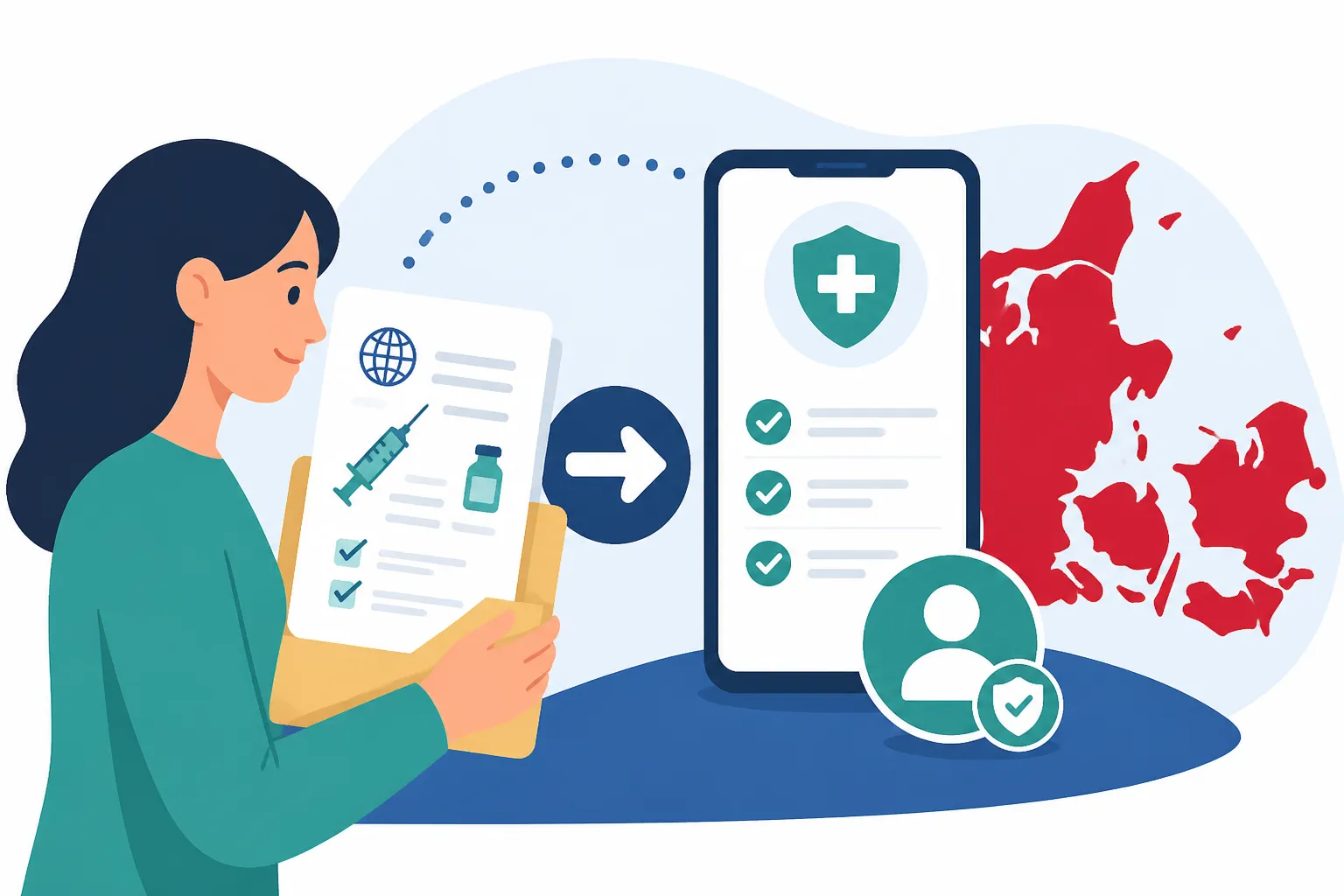
Once your doctor has confirmed they have entered the data, the magic of Danish digitalization begins. You don't have to carry your paper records anymore. You can access everything through Sundhed.dk and MitID: Navigating Denmark’s Digital Health Portals. Once you log in with your MitID, look for the "Vaccinationer" tab.
It can take anywhere from a few hours to a couple of days for the GP’s entry to sync with the national portal. Once it does, you can see a full list of your history. This is also where you can find your "Vaccination Passport" for international travel. If you are an expat who frequently travels back home or to other EU countries, having this digital proof is essential.
If you find that your records are missing after the appointment, don't panic. Check How to View Your Medical Records and Lab Results on Sundhed.dk to see if the consultation itself was logged. If the consultation is there but the vaccinations aren't, it usually means the doctor "saved" the note but didn't "publish" it to the DDV. A quick phone call to the clinic secretary can usually resolve this without another visit.
Insurance Considerations During the Transition
If you are a non-EU citizen, the period between your arrival and your CPR registration can be a bit of a "grey zone." You are technically required to have coverage, and this is exactly when you might be trying to get your records sorted for school or work. Using providers like SafetyWing can give you the peace of mind to visit a private clinic if your public GP assignment is taking too long. While a private clinic will charge a fee for the consultation, they can still enter data into the DDV as long as they have your temporary "administrative" CPR or eventually your permanent one.
Cigna Global is another excellent option for those who prefer to maintain a relationship with a private healthcare provider who might have more experience with international documentation. They can often provide the necessary "Health Certificate" that some employers require, which relies on the translation of those very vaccination records we are discussing. Remember to check First 90 Days: Health Insurance Requirements for Non-EU Expats to ensure you aren't breaking any residency rules while waiting for your yellow card.
Troubleshooting Common Issues
The most common issue I hear from the expat community is the "missing batch" problem. Danish systems are set up to expect a batch number for every shot. If your home country just wrote "Tetanus – 2018" without a number, the software might throw an error. In these cases, the GP can usually bypass the requirement by using a generic code, but some younger or less experienced doctors might not know how to do this. Be patient and suggest they check the "Manual Entry" or "Historical Data" settings in their system.
Another hurdle is the HPV vaccine. Denmark has a very specific program, and if you or your children received a brand of HPV vaccine that isn't used in Denmark (like an older 4-valent version when Denmark uses the 9-valent), the system might flag you as "partially vaccinated." You’ll need to discuss with your GP whether it’s worth "topping up" with the Danish version.
Finally, keep your original paper records in a safe place. Even after they are digitized in Denmark, if you ever move to a third country, the Danish system doesn't always provide an "easy-to-export" English PDF that every other country will accept. The original "yellow booklet" remains the gold standard for global mobility.
Final Thoughts for the New Arrival
Getting your foreign vaccinations into the Danish system is one of those "boring" administrative tasks that feels like a mountain until you do it. My advice? Don't wait until you're sick or until the school is breathing down your neck. Take an hour to organize your papers, book that GP slot, and get your digital identity secured. It makes your life in Denmark significantly smoother and ensures that the next time a doctor asks, "When was your last MMR?" you can simply pull up an app on your phone and show them.
Disclaimer
This guide is provided for informational purposes only and does not constitute professional medical or legal advice. Healthcare regulations and digital systems in Denmark are subject to change. Always consult with a licensed Danish medical professional (GP) or the Danish Health Authority (Sundhedsstyrelsen) for specific guidance regarding your health records and vaccination requirements. Use of third-party insurance providers should be evaluated based on your individual needs and visa conditions.