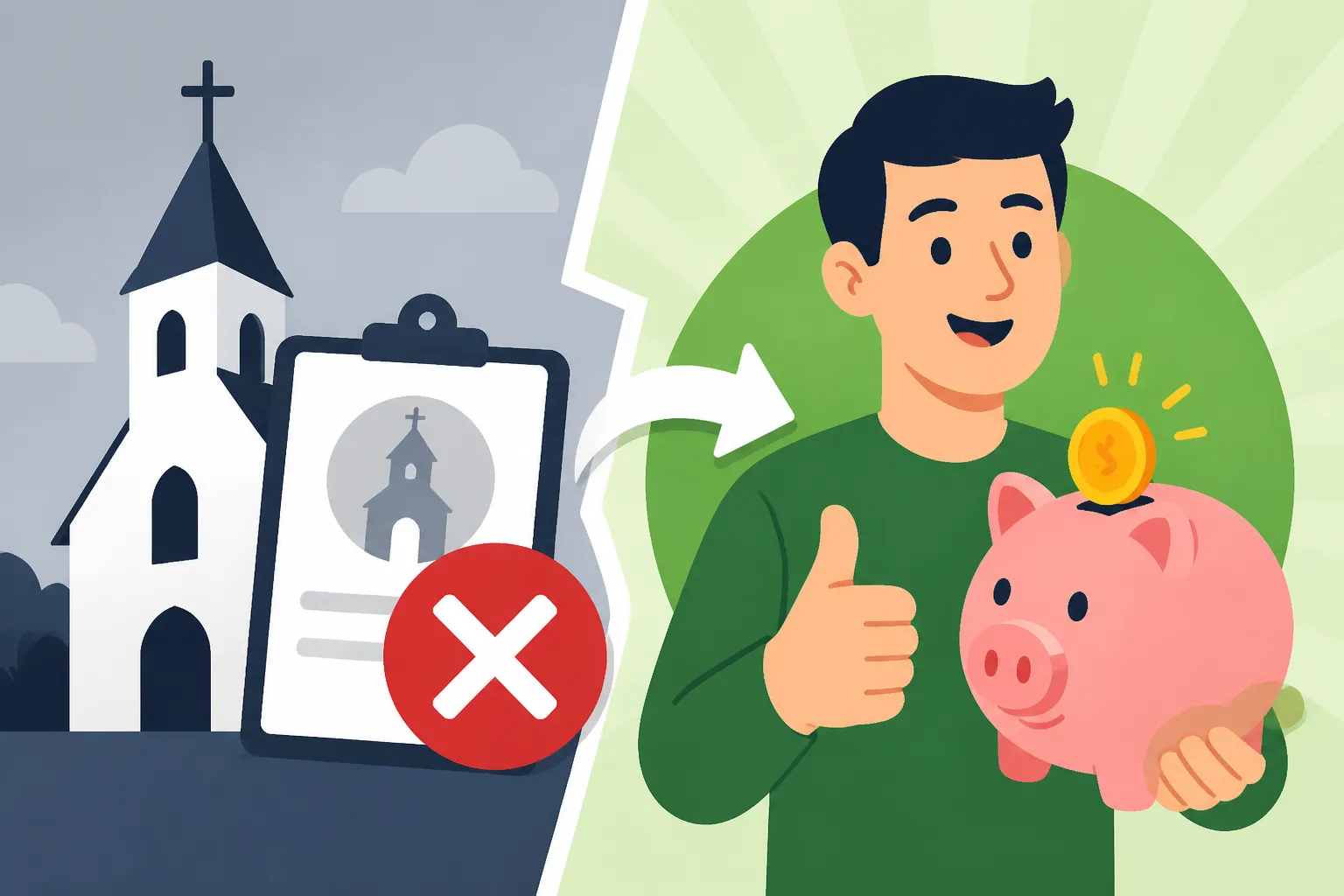
Church Tax (Kirkeskat): How to Opt Out and Save Money Annually
You just received your first Danish paycheck, and after the initial shock of the high income tax wears off, you notice a small, recurring deduction labeled "Kirkeskat." For many expats, this is the first time they realize they are paying a membership fee to a church they may have never stepped foot in. This guide provides a detailed walkthrough of what the Danish Church Tax is, why you are likely paying it by default, and the exact administrative steps required to opt out and keep that money in your own pocket.
Understanding the Kirkeskat System in Denmark
When you first arrive in Denmark and navigate the labyrinth of the International Citizen Service (ICS), you are focused on getting your CPR number and your tax card. In the flurry of paperwork, there is a small box or a verbal question about your religious affiliation. Many of us, coming from countries where "Are you a Christian?" is a purely social or spiritual question, answer "Yes" without realizing we have just signed a financial contract with the state.
The Kirkeskat, or Church Tax, is a voluntary tax paid by members of the Danish National Church (Folkekirken). The Folkekirken is an Evangelical Lutheran church, and while Denmark enjoys complete religious freedom, this specific institution is subsidized through this dedicated tax. Unlike other charities or religious organizations where you might choose to donate, the Kirkeskat is collected directly by the Danish tax authorities (SKAT) alongside your income tax.
The Evangelical Lutheran Church (Folkekirken)
The Folkekirken is more than just a place of worship; it is a fundamental pillar of Danish cultural history. It manages most of the country’s cemeteries and maintains thousands of historic buildings. However, membership is not mandatory for residents. If you are not Lutheran, or if you simply prefer to manage your charitable giving privately, you are under no legal obligation to contribute. Many expats find that Understanding Your Danish Payslip (Lønseddel): Deductions Decoded is the only way to catch this deduction early before it drains thousands of kroner over several years.
How the Tax is Calculated
The rate for Kirkeskat is not a flat fee; it is a percentage of your taxable income. The specific percentage varies depending on which municipality (kommune) you live in. On average, the rate hovers around 0.6% to 0.9%. While that might sound negligible, if you are a high-earner or on a specialized visa, this can amount to several hundred kroner every single month. Over a five-year stay, we are talking about the price of a very nice vacation or a significant deposit on a new apartment.
To get a clear picture of your overall tax burden, you should look into Taxes in Denmark Explained: A-Skat, AM-bidrag, and Marginal Rates to see how the church tax sits on top of your existing obligations. For many, the realization that they are paying for a service they don't use is a major catalyst for looking into financial optimization. If you are using services like Taxes for Expats to manage your cross-border filings, they will often flag this as a "low-hanging fruit" for increasing your take-home pay in Denmark.
Why Foreigners are Automatically Enrolled
The most common frustration I hear from fellow veterans in the expat community is the "accidental enrollment." You didn't ask to be a member, you didn't attend a service, and yet, there it is on your Preliminary Tax Assessment (Forskudsopgørelse): Avoiding Tax Debt statement. This usually happens during your initial registration at the Folkeregister (Civil Registration Office).
The CPR Registration Trap
When you apply for your CPR number, the administrative system asks for your religion. In many cultures, stating "Christian" is a matter of identity. In Denmark, stating "Christian" is often interpreted by the clerk—rightly or wrongly—as "Member of the Danish National Church." Because the system is built for Danes who are mostly baptized into the church by default, the software often defaults to "Yes" for membership unless you explicitly state otherwise.
It is a classic administrative mismatch. You think you are being asked about your faith; the system thinks it is asking about your tax status. This is why it is so crucial to monitor your Money in Denmark: Banking, Payments, and Financial Setup for Expats right from the first month. If you see "Kirkeskat" on your payslip and you aren't a practicing member of the Lutheran church, you are effectively paying for a membership you didn't intentionally buy.
The Default "Yes" Mentality
Danish bureaucracy is incredibly efficient, but it operates on a set of assumptions. One of those assumptions is that if you are from a Western country and don't specify a different religion, you probably belong to the National Church. This isn't done with malice; it's simply the way the legacy databases were designed.
Some expats have lived here for a decade before realizing they had contributed over 40,000 DKK to the church. They assumed it was just part of the high Danish tax system. This is why newcomers should always check their The Annual Tax Assessment Notice (Årsopgørelse): Claiming Deductions carefully. If you catch it late, getting a refund is notoriously difficult because the state argues that you "enjoyed the benefits of membership" (like the right to a church wedding) during that period, even if you never used them.
A Step-by-Step Guide to Opting Out
If you’ve decided that paying the Kirkeskat isn't for you, don't expect a simple "Unsubscribe" button on the SKAT website. Because the church and state are intertwined, the process actually involves the religious authorities, not just the tax office.
Identifying the Tax on Your Lønseddel
The first step is verification. Open your digital payslip (usually found in your Setting Up Your NemKonto: How to Link It to Receive Salary and SU associated bank portal or e-Boks). Look for the line item "Kirkeskat." If the amount is anything other than 0.00, you are currently enrolled.
Once you’ve confirmed you’re paying, you need to find out which "Sogn" (parish) you belong to. Your parish is determined by your home address. You can find your local parish by entering your address on the official Sogn.dk website. This is the office you will need to communicate with. Using a service like Wise to manage your international transfers might help you see your net savings more clearly once this tax is removed, especially if you are sending money back home.
Contacting the Sogn (Parish)
To leave the church (udtrædelse), you must send a written request to the parish clerk (kirkebogsfører) of the parish where you live. While you can sometimes do this via a physical letter, the most efficient way is through "Digital Post" or a secure email.
Your request doesn't need to be a long theological treatise. A simple statement in Danish or English is sufficient. You should include:
- Your full name
- Your CPR number
- Your current address
- A clear statement that you wish to withdraw from the Danish National Church (Folkekirken).
A typical sentence would be: "Jeg ønsker at udtræde af den danske folkekirke." Once they process your request, they will send you a certificate of withdrawal (udtrædelsesattest). Keep this document safe! If SKAT ever accidentally re-enrolls you (which can happen when you move municipalities), this certificate is your "get out of jail free" card.
Confirming via Borger.dk and SKAT
After you receive your certificate, the church should automatically notify the civil registry. However, in my experience, things can get lost in the digital ether. Wait about two to three weeks, then log in to your Preliminary Tax Assessment (Forskudsopgørelse): Avoiding Tax Debt on the SKAT website.
Check the section for "Member of the National Church." It should now say "No." If it still says "Yes," you may need to manually update your Forskudsopgørelse to reflect the change. This ensures that your employer’s payroll system stops deducting the tax immediately rather than waiting for the end-of-year reconciliation. If you are overwhelmed by the Danish tax interface, consulting with experts like Taxes for Expats can ensure your overall profile remains compliant while maximizing your deductions.
The Financial Impact: Is It Worth the Effort?
You might be wondering if it's worth the administrative headache to save less than 1% of your income. For most people working in Denmark, the answer is a resounding yes. Let's look at the numbers.
Average Rates by Municipality
The tax rate varies significantly. In Copenhagen, it tends to be lower (around 0.8%), while in more rural parts of Jutland, it can exceed 1.0%. Below is a comparison of what you might pay annually based on an average expat salary of 45,000 DKK per month (540,000 DKK per year).
| Municipality | Church Tax Rate (Approx) | Annual Cost (DKK) | 5-Year Total (DKK) |
|---|---|---|---|
| Copenhagen | 0.8% | 4,320 | 21,600 |
| Aarhus | 0.86% | 4,644 | 23,220 |
| Gentofte | 0.44% | 2,376 | 11,880 |
| Læsø | 1.30% | 7,020 | 35,100 |
As you can see, over a standard 5-year expat stint, the savings are substantial. This is money that could be better used toward Opening a Bank Account in Denmark: Document Checklist and Delays fees, investment in an index fund, or simply enjoying more of the Danish lifestyle.
Long-term Savings for Families
If you are a dual-income household, the savings double. For a family where both partners are accidentally enrolled, you could be looking at nearly 10,000 DKK per year in "accidental" contributions. When you factor in the Cost of Living in Denmark 2026: Budgets for Singles and Families, every bit of optimization helps.
Saving this money doesn't just increase your bank balance; it gives you more flexibility. Whether you are using Wise to pay off student loans back home or saving for a down payment on a Danish home, opting out of the church tax is one of the easiest ways to give yourself an immediate "raise" without having to negotiate with your boss.
Cultural and Social Implications of Opting Out
Before you send that email to the parish clerk, it is important to understand what you are actually giving up. The Danish National Church provides specific services to its members that are not available to non-members (or are available only at a high cost).
What You Lose (Weddings and Funerals)
The most immediate impact is on "life events." If you are a member, you have the right to be married in a beautiful historic Danish church for free (or a very nominal fee). If you opt out, you lose this right. You can still have a civil ceremony at the City Hall, which is what many expats choose anyway, but the "fairytale church wedding" becomes much more complicated and expensive to arrange as a non-member.
More importantly for some, membership covers the "grave rent" and services for funerals. In Denmark, the church manages the cemeteries. If you are not a member, your estate or your family will be charged significantly higher fees for a burial plot and the use of the chapel. If you plan on staying in Denmark permanently, this is a conversation worth having with your partner. However, for the majority of expats who plan to move on after a few years, these long-term benefits rarely outweigh the immediate annual costs.
Cultural Support vs. Personal Faith
Some expats choose to keep paying the tax as a form of "cultural contribution." They enjoy the sound of the church bells on Sundays, they appreciate the maintenance of the historic buildings, and they see the Folkekirken as a social safety net that provides counseling and community groups.
If you view the tax as a contribution to the Danish "social fabric," then by all means, stay enrolled. But if you are someone who prefers to direct your charitable giving to specific causes—like climate change, poverty, or your own local religious community—then opting out of the state church tax allows you to be more intentional with your money. You can take the 5,000 DKK you save and donate it via Wise to a charity that aligns more closely with your personal values.
Common Pitfalls and FAQ
Even after you think you've opted out, the Danish system can sometimes pull you back in. Being a veteran expat means knowing where the tripwires are hidden.
Moving Addresses and Re-enrollment
One of the most common issues occurs when you move from one municipality to another. When you update your address on Borger.dk, your file is transferred to a new local authority. Occasionally, during this digital handoff, the "Church Member" status can default back to "Yes."
Always check your Preliminary Tax Assessment (Forskudsopgørelse): Avoiding Tax Debt after a move. It only takes thirty seconds to verify, but it can save you thousands. If you find you've been re-enrolled, you don't necessarily have to go through the whole "Sogn" process again if you still have your withdrawal certificate. You can often just upload the certificate to SKAT via their secure messaging system and ask them to correct the error.
Retroactive Refunds
Can you get your money back if you've been paying for years by mistake? The short answer is: rarely. The Danish tax authorities and the church generally take the stance that the tax was paid in exchange for membership rights that were available to you during that time. Unless you can prove that there was a clear clerical error (for example, if you have a document from your first day in Denmark showing you ticked "No" but they entered "Yes"), they will not issue a refund.
This is a bitter pill to swallow for many who realize they’ve "donated" 20,000 DKK to a church they don't belong to. This is why I emphasize checking your The Dankort: Denmark’s National Debit Card and Why You Want One transactions and payslips early. Use the tools available to you, like Taxes for Expats, to audit your historical filings. While you might not get a refund, you can at least stop the bleeding for future years.
The Role of MitID in Your Financial Health
Everything in this process—from checking your payslip to messaging the tax office—requires a functioning MitID. If you are having trouble with the process, it usually starts with a digital access issue. Make sure you are comfortable using the system. If you lose access, How to View Your Medical Records and Lab Results on Sundhed.dk or checking your taxes becomes impossible. Stay proactive, keep your digital keys updated, and don't let a small administrative box dictate where your hard-earned money goes.
Disclaimer
This guide is for informational purposes only and does not constitute legal, financial, or tax advice. Tax laws and church tax rates in Denmark are subject to change annually. While we strive to provide the most accurate and up-to-date information for the 2026 tax year, you should always consult with a professional tax advisor or the Danish Tax Agency (Skattestyrelsen) regarding your specific situation, especially if you have complex income streams or are covered by the Expat Tax Scheme.