Variable vs. Fixed Rate Mortgages (Fastrente) in the Danish Market
One of the most daunting realizations for any newcomer in Denmark is that the rental market can feel like a bottomless pit for your hard-earned salary. You eventually reach a point where you want to stop paying a landlord and start building equity, but then you are hit with a wall of Danish financial jargon. Terms like Fastrente, F-kort, and bidragssats start flying across the table, leaving you wondering if you are about to make a massive financial mistake. This guide is designed to peel back the layers of the Danish mortgage market, specifically focusing on the differences between fixed and variable rates, so you can navigate your home-buying journey with the confidence of a local.
The Foundation of Danish Real Estate Financing
Before you can decide between a fixed or variable rate, you have to understand that Denmark does not use a typical banking model for home loans. Instead, we have the Realkredit system. When you take out a mortgage, the mortgage institution (Realkreditinstitut) issues bonds on the stock exchange to match your loan. Essentially, investors are lending you the money, and the bank acts as the middleman. This is why you will often hear that Realkreditinstitut vs. Bank: Understanding the Danish Mortgage Model is a crucial distinction to make before you even sign a purchase agreement. The bank provides the "bank loan" (the 15% on top of your 5% deposit), but the 80% bulk of your financing comes from these bond-backed mortgage institutions.
The Bidragssats: The Hidden Fee
One thing that often catches expats off guard is the bidragssats. This is an administrative fee you pay to the mortgage institution. It is not part of your interest rate, but it is a recurring cost. Interestingly, this fee is often higher for variable-rate loans than for fixed-rate loans because the banks view variable loans as "riskier" for the system. When you are calculating your monthly budget, you cannot just look at the interest rate; you have to factor in this fee, which can vary depending on how much equity you have in the home.
The 80-15-5 Rule
In Denmark, the standard financing structure is 80% mortgage (Realkredit), 15% bank loan, and 5% cash deposit. As a foreigner, you might find that some banks are hesitant to let you in with only 5% if you haven't been here long or don't have a permanent contract. I remember my first meeting with a Danish advisor where they looked at my foreign savings and seemed more confused than impressed. To make the process smoother, many expats use services like Wise to transfer their initial 5% deposit into a Danish account. This ensures the funds are visible and ready in DKK when the bank starts its "financial robustness" check. If you are coming from outside the EU, be prepared for extra scrutiny on where that money originated.
Why Your Credit History Starts at Zero
Even if you had a perfect credit score in London, New York, or Berlin, you are essentially a ghost in the Danish financial system until you have a CPR number and a few months of payslips. It is vital to understand Building Credit in Denmark: RKI Registry and Debt Defaulters because even a single unpaid bill can ruin your chances of getting a mortgage. Banks will look at your "Rådighedsbeløb" (disposable income) with a magnifying glass. They want to see that after all your bills and mortgage payments are made, you still have enough to live a "standard" Danish life.
Fixed-Rate Mortgages (Fastrente) and the Security of the Known
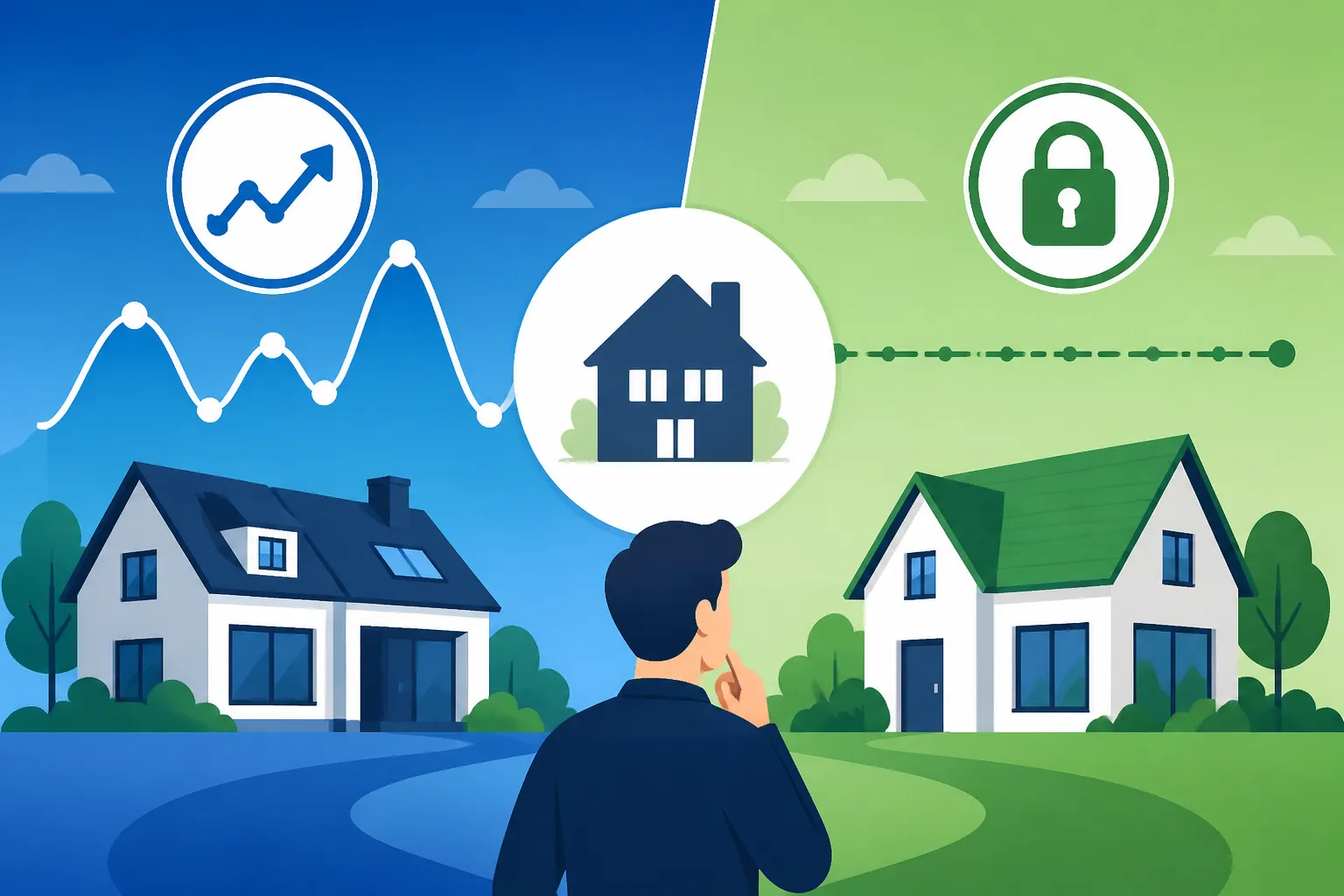
The Fastrente is the gold standard for many Danish families and risk-averse expats. This is a loan where the interest rate is locked in for the entire duration of the loan, usually 30 years. If you sign for a 4% fixed-rate mortgage today, it will be 4% in twenty years, regardless of what happens in the global economy. This provides a level of psychological peace that is hard to overstate, especially when you are already dealing with the stress of moving countries and learning a new language.
Protection Against Rising Rates
The magic of the Danish fixed-rate mortgage lies in its "convertibility." Because your loan is backed by bonds, if market interest rates rise, the price of your bonds falls. This means you can actually "buy back" your debt at a discount. Imagine you owe 3 million DKK, and interest rates suddenly spike. You might be able to pay off your loan for only 2.5 million DKK by converting to a new loan with a higher rate. It sounds counterintuitive to want a higher interest rate, but it allows you to shave off a massive chunk of your principal debt. This is a unique feature of the Danish market that many foreigners find hard to grasp initially.
Predictability for Tax Purposes
When you have a fixed-rate mortgage, your tax deductions become very predictable. In Denmark, interest expenses are tax-deductible, which is managed through your Preliminary Tax Assessment (Forskudsopgørelse): Avoiding Tax Debt. With a fixed rate, you know exactly what your interest will be for the year, making it much easier to update your tax card and ensure you aren't hit with a massive bill in April. If you are a US citizen living in Denmark, you will also need to consider how these foreign mortgage interest deductions play into your US tax filings, a specialty of firms like Taxes for Expats, who help navigate the complex dual-taxation treaties.
The Downside of Fixed Rates
The obvious downside is that you pay for this security. The interest rate on a Fastrente loan is almost always higher than the starting rate of a variable loan. Additionally, if interest rates fall, you don't benefit automatically. You would have to pay a fee to "refinance" your loan to the lower rate. While this is common, it involves administrative costs and a new trip to the bank. For many, the "insurance premium" of a higher rate is worth the knowledge that their monthly housing cost will never increase.
| Feature | Fixed-Rate (Fastrente) | Variable-Rate (Rentetilpasning) |
|---|---|---|
| Interest Rate | Locked for 30 years | Changes every 6 months to 5 years |
| Predictability | Very High | Low to Moderate |
| Initial Cost | Usually Higher | Usually Lower |
| Risk | Low (Rate is protected) | High (Rates can spike) |
| Principal Reduction | Possible if rates rise | Not usually possible via rate changes |
| Best For | Long-term stays, families | Short-term stays, high risk tolerance |
Variable-Rate Mortgages: F-kort, F3, and F5 Explained
If the Fastrente is a sturdy shield, the variable-rate mortgage (Rentetilpasningslån) is more like a calculated bet. These loans are also bond-backed, but the bonds have much shorter lifespans. This means the interest rate is reset at regular intervals. For the last decade, variable rates in Denmark were incredibly low—sometimes even negative—which made them a favorite for those looking to maximize their monthly cash flow.
F-kort: The Six-Month Pulse
The F-kort is currently one of the most popular variable options. The interest rate is adjusted every six months based on a short-term reference rate (usually CITA6). This is the "purist" variable loan. If rates go down, your next mortgage payment drops almost immediately. If they go up, you feel the sting quickly. For expats who are only planning to stay in Denmark for 3–5 years, an F-kort can save a significant amount of money in interest, provided the market remains stable.
F3 and F5: The Mid-Term Compromise
Then there are the "F-category" loans with longer intervals. An F3 loan locks your rate for three years, and an F5 locks it for five. This gives you a bit of breathing room. You get the lower interest rate associated with variable loans but with the peace of mind that your payment won't change for a few years. When the "refinancing" period approaches, you have to decide whether to stick with the variable rate or switch to something else. Many expats find the F5 a comfortable middle ground when they are first Buying Property in Denmark: Mortgage Options and 20% Down Payments because it covers the typical duration of an initial work contract.
The Risk of the "Refinancing Shock"
The biggest danger with variable rates is the refinancing shock. If you have an F5 loan and the five years are up during a period of high global inflation, your interest rate could jump from 1% to 5% overnight. Unlike the fixed-rate holders, you have no "bond protection" to lower your principal. You simply have to pay the higher monthly cost. This is why Danish banks are legally required to "stress test" your finances. They won't approve you for a variable loan unless you can prove you could still afford the house if the interest rate rose to a much higher level.
Practical Considerations for the Foreign Buyer
Choosing between fixed and variable isn't just about the numbers; it’s about your life strategy in Denmark. Are you here for the long haul, or is this a five-year stepping stone? Your residency status and your long-term goals play a massive role in what the bank will actually allow you to sign.
Residency and Loan Approval
One of the harshest realities is that Mortgages for Foreigners: Do You Need Permanent Residency to Buy a House? is a question with a "maybe" answer. While it is legally possible to buy without permanent residency, many Realkreditinstitutter are wary of granting 30-year fixed-rate loans to someone on a temporary work visa. They fear you might leave the country and leave them with a complex foreclosure. If you are on a temporary visa, you might find the bank nudges you toward a variable rate or demands a higher down payment. Using Wise to demonstrate a history of saving and moving money can help, but it doesn't replace the security of a long-term residence permit in the bank's eyes.
Interest-Only Periods (Afdragsfrihed)
Another uniquely Danish feature is Afdragsfrihed, or interest-only periods. You can choose to not pay back the principal of your loan for up to 10 years, paying only the interest and the bidragssats. This is available for both fixed and variable loans. Many expats use this to keep their monthly costs extremely low so they can pay off the more expensive 15% bank loan as fast as possible. Once the bank loan is gone, they start paying off the mortgage principal. It is a smart way to manage your Understanding Your Danish Payslip (Lønseddel): Deductions Decoded and ensure your cash flow is optimized for the first few years of homeownership.
Managing the Paperwork
The process of getting a mortgage involves a mountain of digital paperwork. You will need to provide your Opening a Bank Account in Denmark: Document Checklist and Delays history, your latest payslips, and your annual tax overview. If you have assets or income abroad, the bank might ask for translated documents. For Americans, firms like Taxes for Expats can be a lifesaver here, as they provide the professional tax summaries that Danish banks often struggle to interpret from raw IRS transcripts.
Closing the Deal
Once you've chosen your rate and the bank has issued a "Køberbevis" (Buyer's Certificate), you are ready to bid. Remember that there are Stamp Duty and Registration Fees: Hidden Costs of Buying a Danish Home that aren't included in the mortgage. You’ll need cash on hand to cover the lawyer (advokat) and the state registration fees. This is another moment where having a multi-currency account like Wise can save you a fortune in exchange rate markups when moving thousands of euros or dollars into DKK for the final settlement.
Navigating the Danish mortgage market is a rite of passage. It moves from being an overwhelming puzzle to a powerful tool for financial stability once you understand how the Fastrente protects your future and how variable rates can optimize your present. Take your time, talk to multiple banks, and don't be afraid to ask your advisor to explain the "bond price" one more time. It's your future home, and in Denmark, the system is designed to be transparent, even if it feels a bit foreign at first.
Disclaimer
This guide is for informational purposes only and does not constitute financial, legal, or investment advice. The Danish mortgage market and tax laws, including Taxes in Denmark Explained: A-Skat, AM-bidrag, and Marginal Rates, are subject to change. Always consult with a certified financial advisor and a legal professional before signing any mortgage contract or property purchase agreement in Denmark.