Sick Leave in Denmark: Medical Certificates (Lægeerklæring) and Boss Communication
Waking up with a scratchy throat or a pounding headache is stressful enough, but when you realize you have to notify your Danish employer, the anxiety often hits a whole new level. I remember the first time I had to call in sick here; I was terrified that my boss would think I was slacking or demand a doctor’s note immediately. This guide explains exactly how sick leave works in Denmark, how to communicate with your boss without oversharing, and the specific rules surrounding medical certificates.
The Danish Sick Leave System and the Culture of Trust
In many countries, taking a sick day feels like an admission of guilt, often requiring a formal doctor's note from hour one. Denmark operates on a fundamentally different frequency. The workplace culture here is built on a high level of social trust, known as tillid. When you tell your employer you are unwell, the default assumption is that you are telling the truth. You aren't expected to provide a play-by-play of your symptoms or prove your fever with a photo of a thermometer.
Understanding this cultural nuance is vital for your integration. If you come from a background where you have to "earn" your sick leave or defend your right to rest, the Danish system might feel suspiciously easy. However, it is precisely this ease that requires you to be professional and transparent. Most Danish companies operate under the Employment Rights: Contracts, Holiday Law, and Maternity Leave framework, which ensures that you are protected while you recover, provided you follow the internal protocols of your specific workplace.
The Concept of Tillid in the Workplace
Trust isn't just a buzzword; it’s the mechanical gear that keeps Danish offices running. Because hierarchies are flat, you are often given a high degree of autonomy. This extends to your health. If you wake up and cannot perform your duties, you are expected to make a judgment call. Your boss generally doesn't want you in the office spreading germs or performing at 20% capacity. They would rather you take the day off and return at 100%.
This trust is a two-way street. While your boss trusts you to be sick when you say you are, they also trust you to return as soon as you are able. Abusing this system is one of the fastest ways to sour a relationship with a Danish employer. If you find yourself struggling to communicate effectively or feeling that your Danish isn't quite up to the task of a phone call, using a service like iTalki to practice professional workplace scenarios can be a massive confidence booster.
Sickness Benefit and Your Rights When Off Work
When you are sick, you are generally entitled to receive your salary or a form of compensation. If you are a salaried employee (a funktionær), you usually receive your full salary during illness. This is part of the Sickness Benefit (Sygedagpenge): Your Rights When Off Work Due to Illness structure that protects the Danish labor market. If you are not covered by full salary during sick leave—perhaps because you are a student worker or on a specific hourly contract—the municipality or the state may step in with sygedagpenge after a certain period.
It is important to check your contract to see how long your employer is obligated to pay you directly. For most, the "employer period" is the first 30 days of illness. After that, the municipality usually takes over the financial responsibility, though many collective agreements ensure you still see the same amount in your bank account. If you are navigating these payments and worried about how they affect your filings, consulting with Taxes for Expats can help ensure you aren't hit with a surprise bill later on.
The Role of the GP in Short Term Illness
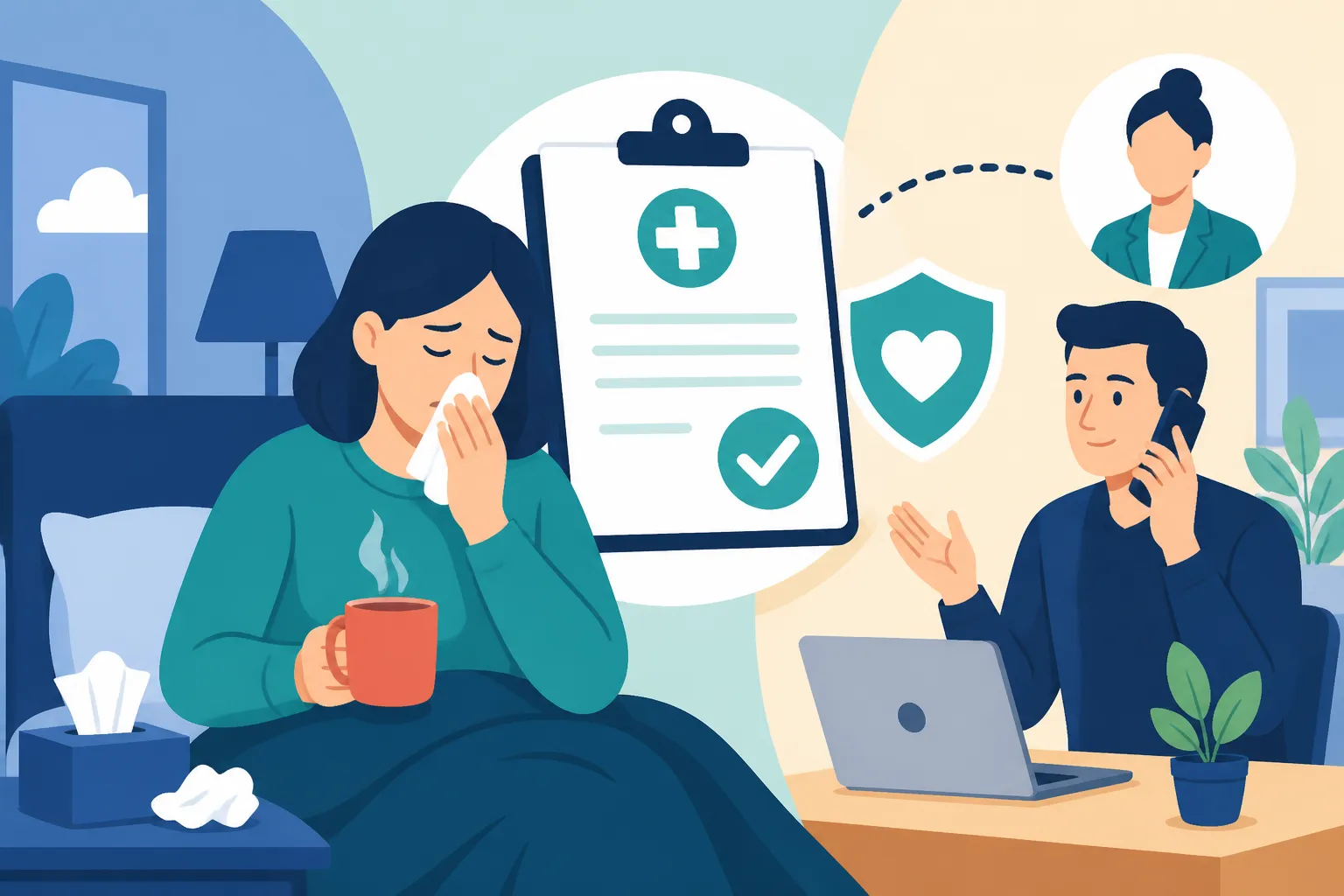
In the Danish system, your General Practitioner (GP) is not an enforcer for your employer. They are there to treat you. For a standard flu or a 48-hour bug, you do not need to contact your GP just to "validate" your absence. In fact, most doctors will tell you to stay home and drink tea rather than coming into the clinic. You only need to involve medical professionals when the illness persists or if your employer specifically requests a How to Request a Lægeerklæring (Doctor’s Note) for Your Employer document.
Communicating with Your Employer: Practical Steps
The way you break the news that you won't be coming in is just as important as the fact itself. Every company has its own "sick call" culture. Some want a phone call by 8:30 AM, while others are perfectly happy with a quick message on Slack or Teams. In some offices a simple "I'm sick today" in the group chat was the gold standard, and others where a formal email to HR was required.
When you first start a job, ask your colleagues or check the employee handbook for the specific procedure. Do not assume that because Denmark is "chill," you can just not show up. Silence is viewed very poorly. Even if you are feeling miserable, a quick "I am sick today and won't be able to work" is the bare minimum required to maintain professional courtesy.
Addressing Your Boss in Denmark: First Names and Flat Structures
When you send that email or make that call, remember the rules of Addressing Your Boss in Denmark: First Names and Flat Structures. You don't need to use formal titles or be overly subservient. Using your boss's first name is standard. A message like "Hi Jesper, I've woken up unwell today and won't be able to come in. I'll keep you posted on tomorrow," is perfectly sufficient.
Avoid the temptation to over-explain. You don't need to mention "stomach issues" or "a migraine." In Danish culture, privacy regarding your specific medical condition is respected. Your boss is legally not allowed to ask what specific disease you have; they can only ask how long you expect to be out and if the illness is work-related (such as an injury sustained on the job).
What You Do Not Have to Disclose
One of the biggest culture shocks for many expats is realizing the boundaries of what an employer can ask. Your medical history is private. While you must state that you are "unwell" (syg), you are under no obligation to provide a diagnosis. This can be tricky if you have a close relationship with your manager, but it is a right worth knowing.
If you are dealing with sensitive issues, perhaps relating to Mental Health in Denmark: Accessing Psychologists and Therapy for Expats, you might feel pressured to explain your absence. You don't have to. You can simply state that you are unable to work due to illness. If the absence becomes long-term, a more nuanced conversation might be necessary, but for the first few days, your privacy is protected by Danish law.
Digital Communication and Expectations
In our hyper-connected world, there is often a feeling that you should be "available" even when sick. In Denmark, when you are sick, you are sick. This means you should turn off your notifications and not check your email. There is no expectation that you will "just answer a few questions" from bed. In fact, many Danish bosses will actively tell you to go offline if they see you popping up on internal systems while you're supposed to be recovering. If you're struggling with the vocabulary to set these boundaries, a few sessions on iTalki focusing on "workplace boundaries" can be incredibly helpful for your professional development.
The Medical Certificate: Lægeerklæring Explained
A lægeerklæring is the formal Danish term for a medical certificate. Unlike in many other countries, this is not a routine document for a three-day cold. It is a formal request that usually carries a cost, and there are specific rules about when and how it is issued.
Most employers will only ask for a medical certificate if you have been out for more than three or four consecutive days. However, under Danish law, an employer actually has the right to ask for one from the very first day of absence. This is rare and usually only happens if there is a pattern of suspicious absences or if the company has a very strict policy.
When Does Your Boss Actually Need a Note?
Usually, the request for a certificate comes during a "sickness interview" or after a week of absence. The most common type of certificate is the Mulighedserklæring (Possibility Certificate). This document is unique to Denmark. It isn't just about what you can't do; it’s about what you can do. The goal is to see if you can return to work partially—perhaps by working fewer hours or doing different tasks that don't aggravate your condition.
| Type of Document | When it is used | Who initiates it |
|---|---|---|
| Friattest | Short-term illness, confirms you are sick | Employer |
| Mulighedserklæring | Long-term illness, focuses on return-to-work | Employer & Employee |
| Varighedserklæring | When the illness is expected to last a long time | Employer |
How to Request a Medical Certificate
If your boss asks for a note, you need to contact your GP. You can often do this via the Booking a Doctor's Appointment in Denmark: MinLæge App Guide or by calling the clinic during their morning phone hours. Tell the receptionist that your employer has requested a lægeerklæring.
You will likely need to go in for a brief consultation. The doctor will ask about your symptoms and your job functions. If it is a mulighedserklæring, you and your employer must first fill out the first part of the form together, describing your limitations, before the doctor fills out the medical portion. This collaborative approach is designed to prevent long-term detachment from the labor market.
Who Pays for the Certificate?
This is a crucial point: if your employer requests a medical certificate, they must pay for it. GPs in Denmark charge a fee for writing these notes because they are considered "administrative work" rather than "medical treatment." The price can range from 300 to 800 DKK. You will usually pay the doctor at the clinic and then submit the receipt to your company’s expense system for reimbursement. Never pay for a work-required medical note out of your own pocket without getting that money back. If you are worried about how these reimbursements look on your tax profile, Taxes for Expats can provide clarity on non-taxable employee benefits.
Long-Term Sickness and Professional Protection
If your illness stretches beyond a couple of weeks, the administrative landscape shifts. You move from "taking a few days off" to a formal "sickness case" managed by your local municipality (kommune). This sounds intimidating, but it is actually a support system designed to ensure you don't lose your job or your income.
In Denmark, the goal of the municipality is "retention." They want to help you get back to work in a way that is sustainable. This might involve a "round-table meeting" with you, your boss, and a case worker from the Jobcenter. These meetings are not disciplinary; they are logistical.
The Role of the Municipality in Long-Term Absence
After 30 days of sickness, your employer will report your absence to the municipality. You will then receive a digital letter in your Navigating the Digital Post (e-Boks/Mit.dk) System for Official Mail. It is vital that you respond to these letters. They will ask you to fill out a "sickness follow-up" form (oplysningsskema). Failure to do so can actually result in your sickness benefits being cut off, which is a headache you definitely don't need while you're trying to recover.
Can Your Employer Call You While You Are on Sick Leave?
Yes, they can, but with limits. According to Can Your Employer Call You While You Are on Sick Leave?, your manager has a duty to stay in touch with you. This is called the "follow-up duty." They are expected to check in to see how you are doing and when you might be able to return. However, these calls should not be about work tasks. They shouldn't be asking you where a specific file is or how to complete a project. The focus must be on your wellbeing and your return-to-work timeline.
If you feel harassed by your employer while you are sick, this is a major red flag. You should contact your trade union immediately. Understanding Trade Unions and A-Kasse: Why Every Expat Must Understand Them is essential here, as they are the ones who will legally defend you if an employer tries to pressure you during a vulnerable time.
The 120-Day Rule
You might hear whispers in the office about the "120-day rule." This is a clause found in many Danish employment contracts. It states that an employer can fire an employee with a shortened notice period (usually one month) if the employee has been sick for a total of 120 days within the last 12 consecutive months.
It is important to note that this rule isn't automatic; it must be written into your specific contract to be valid. Furthermore, the 120 days include weekends and holidays if you are sick on both the Friday and the following Monday. If you are nearing this limit, it is absolutely critical to speak with your union. Managing long-term health issues like Managing Chronic Conditions (Diabetes, Asthma) in the Danish System requires careful navigation of these legal thresholds.
Special Circumstances: Stress and Family Health
Not all illness is physical. Denmark is becoming increasingly aware of the impact of mental health on the workforce. Stress, or stress-sygemelding, is a very common reason for sick leave here. If you find yourself unable to cope with your workload or experiencing symptoms of burnout, you have the same rights to sick leave as someone with a broken leg.
Sick Leave from Work for Stress
If you are taking Sick Leave from Work for Stress (Sygemelding): Steps to Protect Your Job, the process is slightly more complex because the "recovery" isn't always linear. Your GP will be a key ally here. They can help you navigate the initial weeks of total rest and then help you create a "slow start" (gradvis tilbagevenden) plan where you might work 10 hours a week, then 15, then 20, until you are back to full strength.
During this time, practicing your communication skills is vital. Being able to explain your needs to a Danish manager requires a certain level of linguistic nuance. Using iTalki to find a tutor who specializes in Danish "business culture" can give you the phrases you need to advocate for yourself during a stress-related return to work.
Child Sickness Days: Barns Første Sygedag
As an expat parent, one of the best "perks" of the Danish system is Child Sickness Days (Barns Første Sygedag): Your Rights as a Parent. Most collective agreements and many private contracts allow you to stay home with full pay on the first day your child is sick to make arrangements for their care. Some even offer a second day (barns anden sygedag).
This is intended for acute illness—when the daycare calls at 10:00 AM because your toddler has a fever. It is not meant for long-term childhood illnesses, but it provides a necessary cushion for parents. You notify your boss exactly the same way as if you were sick yourself, usually specifying that it is "barns første sygedag."
Handling Frequent Short-Term Absences
If you find yourself frequently taking single days off, your employer might eventually ask for a meeting. This isn't necessarily a "warning," but rather a check-in to see if there is something in the work environment causing the illness. In Denmark, employers have a "duty of care." If you are constantly sick, they might offer ergonomic equipment, changes in responsibilities, or suggest you speak to a specialist.
Being proactive is key. If you know you have an underlying issue, like Tick Bites and Lyme Disease (Borrelia): Summer Health in Danish Forests, communicating that early can prevent misunderstandings. Transparency, within the bounds of your privacy, usually fosters more support from a Danish team.
Administrative Realities and Financial Considerations
While you are focusing on getting better, the Danish digital machine is still whirring in the background. Staying on top of your digital mail and understanding the tax implications of your sick pay will save you a lot of stress once you are back on your feet.
Using Digital Portals for Sick Leave
Everything in Denmark is digital. Your sickness benefits, your correspondence with the municipality, and your medical records are all tied to your CPR number. You will likely use Sundhed.dk and MitID: Navigating Denmark’s Digital Health Portals to view your doctor's notes or lab results.
If the municipality gets involved, you will receive "tasks" in your digital mailbox. These might be forms asking you to confirm your last day of work or to provide details on your job. Do not ignore these. Set up notifications for your e-Boks or Mit.dk so you don't miss a deadline while you're resting.
Tax Implications of Sickness Benefits
If you are receiving your full salary from your employer, your taxes remain the same. However, if you move onto sygedagpenge (state sickness benefits), the tax treatment can change slightly. These benefits are taxable as "A-income," but you don't pay the 8% labor market contribution (AM-bidrag) on them.
This change can sometimes lead to confusion in your Preliminary Tax Assessment (Forskudsopgørelse): Avoiding Tax Debt. If you are on long-term sick leave, it is worth spending twenty minutes updating your tax profile to reflect your lower income or changed tax status. For expats with complex income streams, Taxes for Expats can ensure that your Danish sickness benefits don't create problems with your home country's tax authorities.
Leaving a Job While on Sick Leave
It is a common myth that you cannot be fired while you are sick in Denmark. You can. However, the employer must have a valid reason that isn't just "you are sick." If you are fired while on sick leave, your notice period remains the same as if you were working. Similarly, you can resign while on sick leave, but you must still respect your notice period.
If you are transitioning between jobs and fall ill, the rules of How to Maintain Health Insurance When Transitioning Jobs apply. Your right to healthcare is tied to your residency (your "Yellow Card"), not your specific employer, so you will always be able to see a doctor, even if you are between contracts.
Helpful Resources for Sick Employees
Navigating a foreign healthcare and legal system while you’re feeling under the weather is a tall order. Here is a quick reference table for the most common tools you’ll need:
| Task | Tool/Resource |
|---|---|
| Booking a GP appointment | MinLæge App |
| Reporting sickness to the state | NemRefusion (usually via your boss) |
| Reading official letters | e-Boks or Mit.dk |
| Checking your medical history | Sundhed.dk |
| Professional health advice | Lægevagten (1813) (after hours) |
Remember, the Danish system is designed to be a safety net, not a trap. If you act with integrity, communicate clearly using your first-name-basis relationship with your boss, and follow the digital prompts from the municipality, you will be well-protected. Don't be afraid to ask for help—whether that's from a union representative, a tax consultant at Taxes for Expats, or a language coach at iTalki who can help you master the "I'm sick" phone call.
Disclaimer
This guide is for informational purposes only and does not constitute legal or medical advice. Danish labor laws and municipal practices can change, and specific rules may apply based on your individual employment contract or collective agreement. Always consult with your trade union, legal counsel, or the Danish authorities regarding your specific situation.