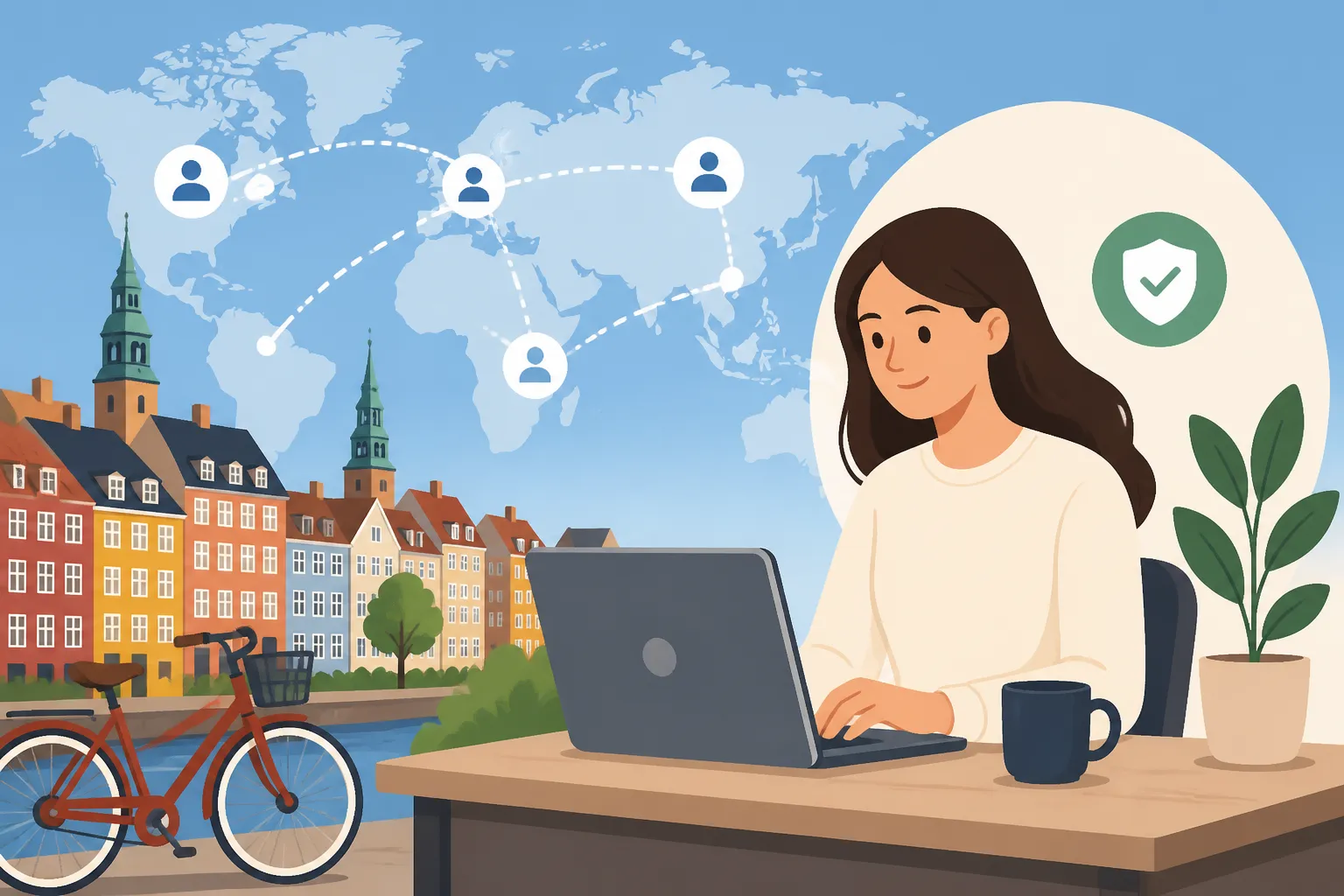
Remote Work for Foreign Companies While Living in Denmark Legally
The dream of sipping a latte by a Copenhagen canal while earning a Silicon Valley or London salary is a common one for many new arrivals. I remember my first month in Aarhus, sitting in a quiet cafe with my laptop, convinced that as long as my money stayed in my home bank account, the Danish authorities wouldn't care. I was wrong, and that misunderstanding nearly cost me thousands in penalties. This guide solves the complex legal, tax, and residency puzzle of working for a foreign entity while living on Danish soil.
The Legal Foundation of Remote Work in Denmark
When you move to Denmark, your global income suddenly falls under the jurisdiction of one of the world's most efficient and persistent tax authorities: SKAT. The fundamental rule is that if you are a resident in Denmark—meaning you have a home here or spend more than 183 days in the country within a 12-month period—you are generally subject to full tax liability on your worldwide income. It does not matter if your employer is in New York, Tokyo, or Berlin; if your "work station" is a desk in a Frederiksberg apartment, that income is earned in Denmark.
Understanding Full Tax Liability and Residency
The concept of residency in Denmark is stickier than most expats realize. The moment you register your address and receive your CPR number, you are signaling to the state that your life is centered here. Understanding CPR Registration and Your Healthcare Entitlement is the first step in this process, but that registration is also what triggers your tax obligations. SKAT operates on the principle that if you are using Danish infrastructure, healthcare, and roads, your income must contribute to the system.
Many remote workers try to fly under the radar by using foreign bank accounts. However, Denmark is part of extensive international data-sharing agreements. If you are living here permanently, SKAT will eventually see those foreign deposits. The 183-day rule is a safeguard for short-term visitors, but for anyone looking to build a life here, you must assume you are a full tax resident from day one.
Navigating Double Taxation Agreements
The fear of paying tax twice—once to your home country and once to Denmark—is enough to keep any freelancer awake at night. Fortunately, Denmark has signed Double Taxation Agreements (DTAs) with dozens of countries. These treaties ensure that you aren't taxed on the same krone twice. Usually, these agreements stipulate that the country where the work is physically performed (Denmark) has the primary right to tax the income.
For Americans, this is particularly complex because the US taxes based on citizenship, not just residency. If you find yourself in this situation, using specialized services like Taxes for Expats can be a lifesaver to ensure your 1040 and your Danish tax return don't conflict. You will often claim a Foreign Tax Credit in the US for the taxes you've paid to Denmark, which are almost certainly higher than your US liability anyway.
The Digital Paper Trail in e-Boks
Everything in Denmark is digital, and your remote work life will be no different. Your tax returns, residency papers, and communications from SIRI (the Danish Agency for International Recruitment and Integration) will arrive in your digital mailbox. Navigating the Digital Post (e-Boks/Mit.dk) System for Official Mail is a non-negotiable skill. You cannot claim you "didn't see the letter" when it was delivered to your secure digital inbox. Remote workers must be proactive in checking these portals to ensure their foreign employer hasn't triggered a red flag in the system.
Visa and Residency Hurdles for Remote Workers
Denmark does not currently offer a specific "Digital Nomad Visa." This is a significant hurdle that many expats overlook. Your right to work remotely is entirely dependent on the type of residency permit you hold. If you are here on a tourist visa, you are technically not allowed to perform any work, even for a company outside of Denmark, as it violates the terms of your stay.
EU and EEA Citizens and the Right of Residence
If you hold an EU passport, your path is much smoother, but it isn't without rules. You have the right to live in Denmark under the EU rules for free movement. However, you must prove you have "sufficient means" to support yourself so you don't become a burden on the Danish welfare state. If you are working remotely for a foreign company, you will register as a "person with sufficient funds" or as a "self-employed person."
EU citizens should also be aware that their remote work status can affect other benefits. For instance, if you are a student, you might be looking into how SU for EU/EEA Citizens: Proving "Worker Status" to Get the Grant works. Working for a foreign company can make proving this status more difficult than having a standard Danish contract, as the Danish authorities require very specific documentation of hours and social security contributions.
Non-EU Citizens and the Pay Limit Scheme Reality
For those from outside the EU (Third Country Nationals), the situation is much stricter. You cannot simply move to Denmark and work for a US company on a standard work visa because most Danish work permits, like the Pay Limit Scheme, require a Danish employer with a Danish CVR number. If your foreign company doesn't have a legal entity in Denmark, they cannot sponsor your visa.
Most non-EU remote workers find their way to Denmark through other means, such as being a trailing spouse. If you are here on a family reunification permit, you generally have the right to work, including remote work for a foreign company. It is vital to check your specific permit; for example, people often ask Can I Work Remotely for a US Company on a Danish Spouse Visa? and the answer is usually yes, provided the tax and social security aspects are handled correctly.
The Self-Employment Route for Non-EU Residents
If you don't have a spouse or a Danish employer, your only real option to work remotely is the "Start-up Denmark" visa or the "Positive List" if you can convince a Danish entity to hire you as a consultant. The Start-up Denmark route requires your business plan to be approved by a panel of experts. Simply being a remote "consultant" for one foreign company usually isn't enough to qualify; the state wants to see innovation and potential for local job creation.
Structural Options for Remote Employment
Once you have the legal right to reside in Denmark, you must choose a structure for your remote work. You cannot simply have your foreign employer wire money to your bank account as if you were still sitting in your home country. This is where most expats get into trouble with "Social Sikring" (Social Security).
Setting Up as a Freelancer (Enkeltmandsvirksomhed)
The most common path for remote workers is to become a "contractor" for their foreign employer. To do this legally and professionally in Denmark, you should register a sole proprietorship, known as an Enkeltmandsvirksomhed. This gives you a CVR number (Central Business Register number), which is essential for professional life here.
When you operate this way, you invoice your foreign employer for your time. Working as a Freelancer (Enkeltmandsvirksomhed): Tax and VAT Basics involves understanding that you are now responsible for your own tax payments. You will not have tax withheld at the source. Instead, you will pay your taxes via "B-skat" (B-tax) using girokort or bank transfers throughout the year. You also need to be careful with VAT (MOMS). If you are selling services to a company outside the EU, you usually don't charge VAT, but you still must register for it if your turnover exceeds 50,000 DKK in a 12-month period.
Using an Employer of Record (EOR)
If your foreign employer wants to treat you like a traditional employee with benefits, vacation days, and pension, but they don't want to set up a Danish office, an Employer of Record (EOR) is the "Hero" solution. Companies like Remote, Deel, or Boundless have Danish entities. They "hire" you in Denmark on behalf of your foreign employer.
In this scenario, you get a local Danish contract that complies with The Danish Holiday Act (Ferielov): Earning and Spending Vacation Days. You get a standard Danish payslip, your taxes are withheld automatically, and you are covered by Danish labor laws. This is by far the most "compliant" way to work remotely, as it handles the thorniest issue: Social Security contributions. Danish law requires that if you work in Denmark, social security must be paid here, which is nearly impossible for a foreign company to do without a local representative.
The Direct Foreign Employment Model
Technically, a foreign company can register as a "Foreign Employer" (RUT register) without a full branch office. However, this is an administrative nightmare for the company. They must still adhere to Danish work environment standards and contribute to Danish social security schemes like ATP (the labor market supplementary pension). Most foreign HR departments will refuse to do this because of the complexity. If they do agree, you must ensure you are not accidentally creating a "Permanent Establishment" for them in Denmark, which could make the company liable for Danish corporate tax.
| Feature | Freelance (CVR) | Employer of Record (EOR) | Direct Foreign Hire |
|---|---|---|---|
| Tax Filing | Manual (B-tax) | Automatic (A-tax) | Manual/Complex |
| Holiday Pay | You save yourself | Guaranteed by law | Often disputed |
| Social Security | You pay via tax | Handled by EOR | Very difficult to sync |
| Ease for Employer | High | High | Very Low |
| Compliance Risk | Moderate | Very Low | High |
Managing Your Danish Tax Obligations
Tax in Denmark is high, but it is also transparent. As a remote worker, you are your own accountant unless you hire one. The first thing you must do upon arrival is update your Preliminary Tax Assessment (Forskudsopgørelse): Avoiding Tax Debt. If you don't tell SKAT how much you expect to earn from your foreign source, they will either guess (badly) or apply a default 55% tax rate to your income.
AM-bidrag and the Total Tax Burden
Regardless of whether you are an employee or a freelancer, the first 8% of your income goes to the Arbejdsmarkedsbidrag (AM-bidrag), which is the labor market contribution. After that, your personal tax allowance (personfradrag) is applied, and then you pay municipal and state taxes. For a remote worker earning a decent salary, you should expect your total effective tax rate to sit between 35% and 45%.
Understanding the breakdown of Taxes in Denmark Explained: A-Skat, AM-bidrag, and Marginal Rates is essential. If you are a freelancer, you also have to consider the "beskæftigelsesfradrag" (employment deduction), which is calculated automatically but requires you to correctly categorize your income as "earned income" rather than "capital income."
Reporting Foreign Income via the Annual Assessment
Every March, SKAT releases the Årsopgørelse (Annual Assessment). For remote workers, this is the moment of truth. You must manually enter your foreign income in the specific boxes for "Udenlandsk indkomst." If you have already paid some tax abroad, this is also where you claim relief under the Double Taxation Agreements. Failure to report this correctly can lead to heavy fines or even the revocation of a work permit if SIRI determines you haven't been truthful about your financial situation.
Setting Up Your Financial Infrastructure
To receive your salary and pay your taxes, you need a Danish bank account linked to your NemKonto. Setting Up Your NemKonto: How to Link It to Receive Salary and SU is the bridge between your private finances and the Danish state. Even if your employer pays you in USD or EUR into a Wise or Revolut account, you should ideally move that money into a Danish bank to handle your local expenses and tax payments. Be prepared for the bank to ask a lot of questions about the source of the funds; they are legally required to perform anti-money laundering checks on all large foreign transfers.
Practical Life and Integration for Remote Workers
The biggest challenge of remote work in Denmark isn't the tax—it's the isolation. Danish work culture is built on the "fredagsbar" and the office "hygge." If you are working for a company in a different timezone, you miss out on the vital social fabric that makes living in Denmark rewarding.
Combatting the "Home Office" Blues
I found that my first six months were incredibly lonely because I didn't have Danish colleagues. To counter this, I highly recommend joining a coworking space. In Copenhagen, places like Soho or Republica, or in Aarhus, Lynfabrikken, provide a sense of community. You won't just get a desk; you'll get a network of people who understand the quirks of the Danish system.
Integration also requires effort on the language front. While your work might be in English, your life will be in Danish. I used iTalki to get a head start on my speaking skills before even arriving, which made the first trip to the supermarket much less intimidating. Once you are here, you are entitled to subsidized classes. Learning Danish: Sprogcenter, FVU, and the Importance of the Language is your ticket to actually feeling like a local rather than a long-term tourist.
Navigating the Time Zone Trap
If you are working for a US-based company while living in Denmark, you are looking at a 6 to 9-hour time difference. This means your "workday" might start at 3:00 PM and end at 11:00 PM. This can be devastating for your social life in Denmark, where most people finish work at 4:00 PM and head to their "foreninger" (clubs) or home to their families.
Make sure to set strict boundaries with your foreign employer. If you are always available for midnight meetings, you will burn out and fail to integrate into the Danish lifestyle. Most Danish employers value work-life balance above all else; try to import some of that mindset into your remote contract. Explain to your boss that in Denmark, the "after-work" hours are sacred.
Healthcare and the Yellow Card
One of the perks of being a tax-paying resident is access to the healthcare system. Once your remote work is registered and your CPR is active, you will receive your "Sundhedskort." The Yellow Health Card (Sundhedskort): Your Key to Danish Healthcare is what allows you to visit a GP, get prescriptions, and access hospitals for free. It is the ultimate proof that you are part of the system. Even if you are working for a company that offers "global health insurance," you will find that having the yellow card is much more practical for daily life in Denmark.
Avoiding Common Pitfalls
The Danish system is built on trust, but it is also built on strict documentation. If you attempt to "fudge" the numbers or delay your registration, the consequences eventually catch up.
- The "Freelance" vs. "Employee" Misclassification: If you work for only one company, have a company email, and they tell you exactly when to work, SKAT may view you as an employee rather than a freelancer. If they decide you are an employee, they might demand the foreign company pay Danish social security back-taxes.
- Forgetting the Pension: In Denmark, pension contributions are often 12-15% of your salary. If your foreign remote salary doesn't include a pension component, you are effectively earning 15% less than your Danish peers. You should manually set up a private pension to ensure you aren't left behind.
- Missing the 14-Day Rule: When you move, you must register your address within 14 days. If you are working remotely from an Airbnb while looking for a permanent place, this can get complicated. The Catch-22: Getting a CPR Number Without a Permanent Address is a real struggle that requires careful planning.
Remote work in Denmark is entirely possible and can offer an incredible lifestyle, provided you respect the local laws. By setting up the right structure—whether it's a CVR or an EOR—and being transparent with SKAT, you can enjoy the safety and beauty of Denmark while maintaining your international career.
Disclaimer
This guide is for informational purposes only and does not constitute legal or financial advice. Danish tax laws and immigration rules are subject to frequent change. Always consult with a qualified Danish accountant or immigration lawyer before making significant financial or residency decisions.