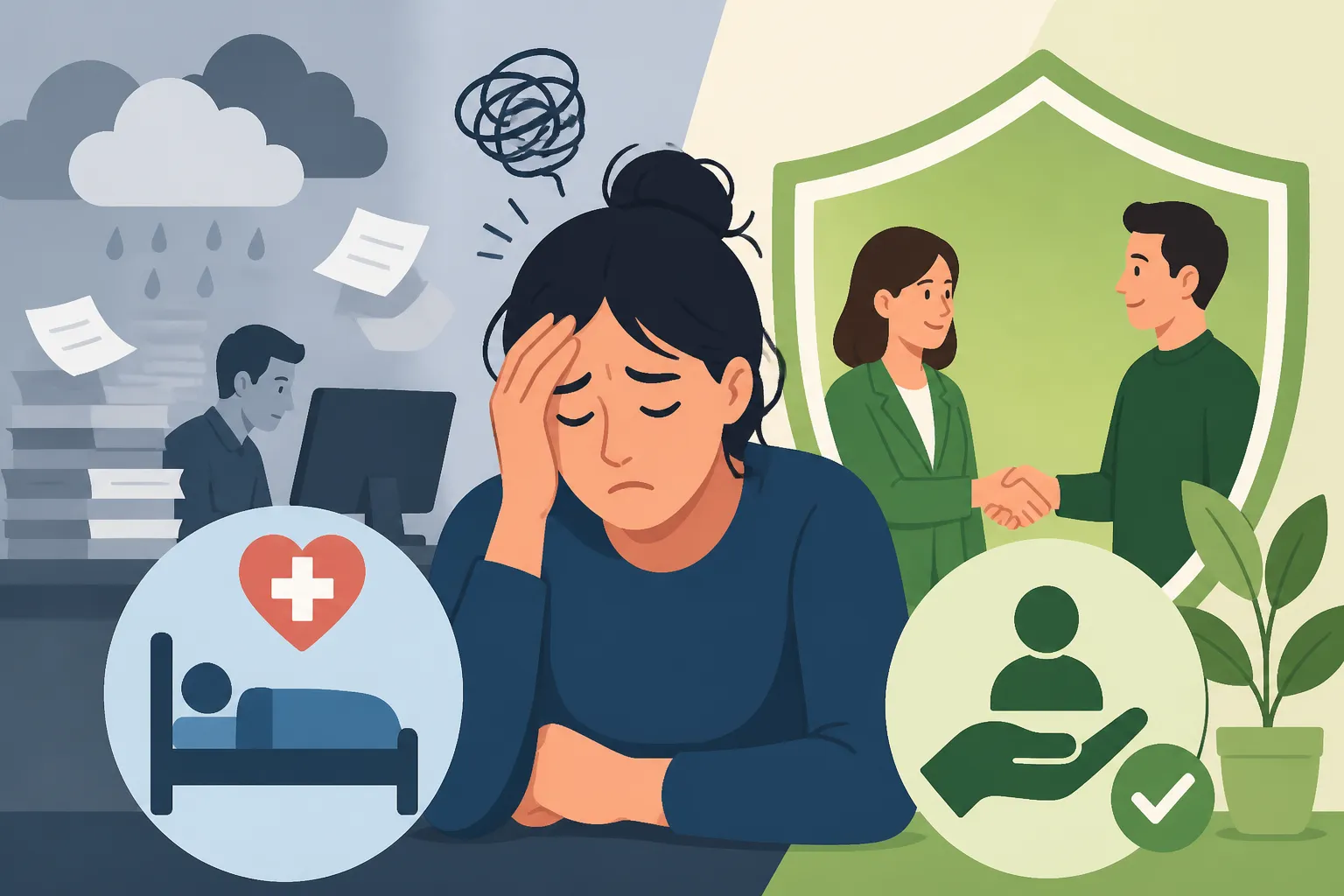
Sick Leave from Work for Stress (Sygemelding): Steps to Protect Your Job
The dark, damp winters combined with the high-performance expectations of a Danish office can lead to a specific type of burnout that feels incredibly isolating when you are far from home. I remember sitting at my desk in Nordhavn, staring at a spreadsheet for three hours without processing a single cell, feeling my heart race for no reason. This guide walks you through the legal, medical, and administrative steps of taking a stress-related sygemelding to ensure you recover without risking your residency or your livelihood.
The Breaking Point: Recognizing Stress in the Danish Workplace
Danish work culture is often praised for its flat hierarchy and work-life balance, but for many expats, this creates a "responsibility trap." Without a clear boss constantly breathing down your neck, you might feel the need to over-deliver to prove your worth, especially if your visa depends on your employment. Stress in Denmark is taken very seriously by the healthcare system, yet the transition from "coping" to "sick-listed" is a path paved with bureaucratic nuances that can be daunting when you are already mentally exhausted.
In my second year in Aarhus, I realized that the "flat structure" actually meant I was managing three different projects with no clear priority list. I was terrified that admitting I couldn't handle it would lead to a quick dismissal. However, the Danish system is designed to catch you before you fall, provided you follow the rules. It starts with recognizing that stress isn't just "being busy"; it is a clinical condition that requires a professional medical diagnosis.
If you are feeling the physical manifestations—insomnia, heart palpitations, or cognitive "fog"—you need to understand how the system views your health. Your first touchpoint is always your Yellow Card (Sundhedskort): Your Key to Danish Healthcare. Without this card, the process of getting a formal sick leave becomes significantly more expensive and complicated.
The Legal Framework: Your Rights Under Funktionærloven
Most white-collar expat jobs in Denmark are governed by the Salaried Employees Act, known as Funktionærloven. This law provides a safety net, but it also contains clauses that can be weaponized if you aren't careful. Under this law, illness is generally considered a "lawful absence," meaning you cannot be fired simply because you are sick. However, stress is a "gray" illness compared to a broken leg, which is why documentation is your best friend.
One of the most important things to check is whether your contract includes the "120-day rule." This rule allows an employer to dismiss an employee with a shortened notice period if they have been sick for 120 days within a rolling 12-month period. When you are dealing with stress, 120 days can disappear faster than you think. Understanding Employment Rights: Contracts, Holiday Law, and Maternity Leave is vital before you send that first email to your HR department.
If you are a freelancer or on a more precarious contract, you might not have the same protections. This is where private supplements like SafetyWing or Cigna Global can be a lifesaver, providing a cushion if you find yourself outside the traditional Danish "flexicurity" model. Many expats rely on Cigna Global for faster access to private psychiatric evaluations when the public waiting times were too long.
The Step-by-Step Sygemelding Process
Taking sick leave for stress is not as simple as just not showing up. It is a proactive process that requires coordination between you, your employer, your doctor, and eventually the municipality (Kommune).
Notifying Your Employer
You must notify your employer as soon as possible on your first day of absence. Most companies have a specific policy—some require a phone call by 9:00 AM, while others accept an email to HR. You do not legally have to tell your employer that the reason is "stress." You can simply state that you are "sick." However, in the interest of long-term job protection, being honest about stress can sometimes trigger the employer's duty to provide "social responsibility" measures.
If you feel your workplace is the direct cause of your stress, the conversation becomes harder. In these cases, reaching out to your union is essential. If you haven't yet joined one, you should read about Trade Unions and A-Kasse: Why Every Expat Must Understand Them to see which organization covers your specific industry.
The Role of the GP (Egen Læge)
Your GP is the gatekeeper of the Danish medical system. To have a "protected" sick leave, you need a medical evaluation. When you book the appointment, tell the receptionist it is for a "sygemelding på grund af stress." They will usually give you a longer time slot.
The doctor will assess whether you are "uarbejdsdygtig" (incapable of working). They might suggest a full sick leave or a partial one. A common mistake expats make is trying to push through. Listen to the doctor. If they issue a How to Request a Lægeerklæring (Doctor’s Note) for Your Employer, make sure you understand who pays for it. Usually, if the employer demands it, they must cover the cost, which is typically around 500 to 1,200 DKK.
The Sickness Benefit (Sygedagpenge) System
After the first 30 days of sickness, the responsibility for your "salary" often shifts. If your contract doesn't guarantee full pay during illness, the municipality steps in with Sygedagpenge. This is a complex area of Sickness Benefit (Sygedagpenge): Your Rights When Off Work Due to Illness that requires you to be proactive with your NemID or MitID.
You will receive digital mail in your e-Boks or Mit.dk. Do not ignore these. The municipality will ask you to fill out a "Sygdomsoplysningsskema" (sickness information form). If you miss the deadline, your benefits can be cut off. For many expats, the formal Danish in these forms is terrifying. Use a translator or ask a Danish friend to help, as the nuances of how you describe your "work capability" are critical.
| Stage of Sick Leave | Duration | Primary Contact | Documentation Needed |
|---|---|---|---|
| Initial Absence | Days 1–14 | Employer / HR | Simple notification of illness |
| Medical Validation | Day 14+ | GP (Egen Læge) | Lægeerklæring (Doctor's Note) |
| Municipal Phase | After 30 Days | Jobcenter / Kommune | Sygdomsoplysningsskema (Digital Form) |
| Long-term Recovery | 8 Weeks+ | Jobcenter Consultant | Mulighedserklæring (Possibility Statement) |
Protecting Your Job: Navigating the 120-Day Rule
The "120-day rule" is the most misunderstood part of Danish labor law among foreigners. It doesn't mean you will be fired after 120 days; it means your employer can fire you with only one month's notice, regardless of your seniority.
To protect yourself, keep a meticulous log of your sick days. Both full days and partial days (if you are working reduced hours) count toward this total. If you are nearing the limit, you need to have a very serious conversation with your union representative.
If you are worried about the long-term stability of your position during a burnout, having international health coverage like Cigna Global can sometimes allow you to seek specialized "Return to Work" coaching that isn't always available in the standard public system. SafetyWing is also a great fallback for those who might be worried about losing their job-related insurance during a transition period.
Returning to Work: The Mulighedserklæring and Gradual Reintegration
The Danish system does not favor "cold turkey" returns. Instead, they use a tool called the Mulighedserklæring (Possibility Statement). This is a document filled out by both you and your employer, then validated by your doctor. It focuses on what you can do, rather than what you can't.
For example, you might agree to:
- Work 10 hours a week for the first month.
- Avoid meetings with more than three people.
- Work from home to avoid the commute stress.
This gradual reintegration is designed to prevent a relapse. If your employer pressures you to return to full-time hours before you are ready, refer back to your doctor's assessment. The Role of the GP: Why You Cannot Go Directly to a Specialist is important here because your GP is the one who must sign off on the Mulighedserklæring. They act as your shield against an over-eager manager.
During this time, you might also be looking for Mental Health in Denmark: Accessing Psychologists and Therapy for Expats. Note that a GP referral can significantly reduce the cost of a psychologist, but the wait times can be several months. This is another area where private insurance can help you skip the queue.
Sickness and Your Visa Status
For many of us, the biggest stressor isn't the job itself—it's the fear of deportation. If you are in Denmark on a Pay Limit Scheme: Meeting the 2026 Salary Requirements, being on sick leave can feel like a legal minefield.
Generally, as long as you are receiving your salary (or Sygedagpenge) and your employment contract remains active, you are considered to be meeting the requirements of your visa. However, if you are fired while on sick leave, you usually have a 6-month "job-seeking" window to find a new role before your residence permit is revoked.
If you find yourself in this situation, it is crucial to stay updated on SIRI Processing Times 2026: Why Fast-Track is Faster and other immigration updates. Losing a job due to stress is a valid reason to seek an extension or a change in visa type, but you must be proactive with the Danish Agency for International Recruitment and Integration (SIRI).
Navigating the Jobcenter Meetings
Once you have been sick for more than 8 weeks, the local Jobcenter will invite you to a "follow-up" meeting. For an expat, "Jobcenter" sounds like a place for the unemployed, but for those on sick leave, it is where your "case worker" monitors your recovery.
Be prepared: these meetings are conducted in Danish unless you specifically request an interpreter. You have a right to an interpreter if you do not speak Danish well enough to discuss your health. At these meetings, be honest but focused on your "path back." The case worker's goal is to get you back to work to stop the municipality from paying benefits. Your goal is to get back to work safely.
Use your MitID and Sundhed.dk: Navigating Denmark’s Digital Health Portals to keep track of any notes your doctor has made, as these will be shared with the Jobcenter. Having your medical history clear and accessible makes these meetings much less stressful.
Managing the Practicalities of Being "Sygemeldt"
When you are sick with stress, even small tasks feel like climbing Møllehøj. Here is how to handle the essentials:
- Digital Mail: Check your e-Boks every single day. The Danish state communicates almost exclusively this way, and missing a letter from the municipality can result in your benefits being stopped.
- The "Check-In" Rule: If you are on sick leave, you are generally expected to be "available" for meetings with your employer and the municipality. You cannot go on holiday to Spain to "destress" without prior approval from both the Jobcenter and your employer. If you leave the country without permission while on sygemelding, it can be considered "social fraud."
- English-Speaking Support: If your Danish isn't quite there yet, look for Accessing English-Speaking Therapists and Counselors in Copenhagen. Many expats find that discussing their deepest stressors is much more effective in their native language.
SafetyWing can be a useful tool for expats who are in between the "waiting period" of getting their CPR number and being fully covered by the Danish state. If you are new to the country and haven't fully vested in the system yet, having that extra layer of international health insurance ensures you aren't left with massive bills for emergency psychiatric care or GP visits.
Rebuilding Your Career After Burnout
Coming back from a stress-related sick leave is a marathon, not a sprint. The Danish workplace is generally forgiving of health issues, but you must set boundaries. This often means embracing parts of Danish Work Culture: Flat Hierarchies, Hygge, and Direct Communication that you might have ignored before—specifically the "direct communication" part. Learning to say "No" or "I don't have the capacity for this" is not seen as a weakness in Denmark; it is seen as professional competence.
Remember that you are not alone. Thousands of expats navigate the Danish health and labor systems every year. By following the legal steps, securing medical documentation, and utilizing your rights, you can protect your job and your future in Denmark while giving yourself the time you need to heal.
Disclaimer
This guide is for informational purposes only and does not constitute legal or medical advice. Danish labor laws and immigration rules are subject to change, and individual circumstances can vary significantly based on specific employment contracts and union agreements. Always consult with a qualified legal professional, your trade union, or the Danish authorities (SIRI/Jobcenter) regarding your specific situation. SafetyWing and Cigna Global are private insurance providers and their coverage terms apply independently of the Danish public health system.