Utilities Setup: Electricity, Water, Heating, and Internet
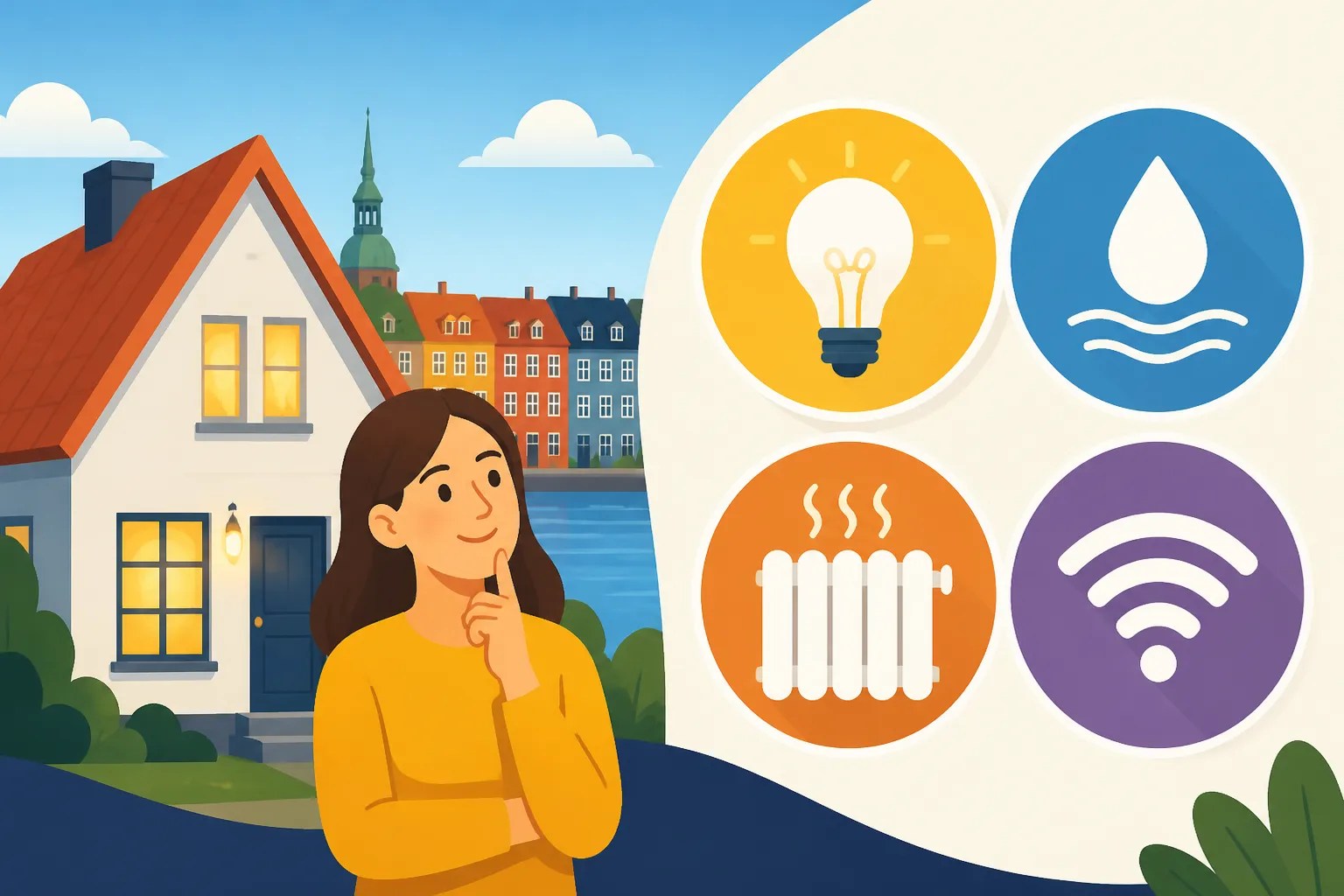
Moving into a new apartment in Denmark often feels like a victory after the grueling hunt for housing, but the triumph is frequently short-lived when you realize you are standing in a dark room with no internet, no heat, and a stack of Danish-language documents. This guide solves the complex administrative puzzle of setting up your electricity, water, heating, and internet, ensuring you don't spend your first week in the dark or face massive "back-pay" bills six months down the line.
The CPR Number Requirement and the Administrative Foundation
Before you even think about which internet provider has the fastest fiber or which green energy company to support, you must understand the "Catch-22" of Danish utilities. Almost every service provider in the country requires a Central Person Register (CPR) number to create an account. For many new arrivals, this is a source of immense frustration because you cannot get a CPR number without a permanent address, yet setting up the utilities at that address technically requires the number. It is a circular logic that can leave you feeling stranded.
When you first arrive, you are likely in a state of administrative limbo. You have the lease, but your yellow health card hasn't arrived. In this phase, it is vital to check your rental contract, specifically the Typeformular A10: Understanding the Standard Danish Lease Agreement. Most modern leases will state whether the landlord handles the registration for you or if you are responsible for contacting the providers directly. If the responsibility falls on you, you must act within the first few days of your "indflytningsdato" (move-in date) to avoid being cut off or placed on a default, expensive tariff.
If you are struggling with the initial setup because your CPR registration is still processing, you might find it easier to book a mid-term stay through a platform like Spotahome. These types of serviced or managed apartments often include utilities in the monthly rent, which bypasses the need for you to navigate the Danish utility market while you are still waiting for your MitID and CPR number to be finalized. For those moving into a traditional "unfurnished" rental, however, you will need to be prepared to provide your move-in date and your meter readings as soon as you have your keys.
The registration process is now almost entirely digital. Once you have your MitID, you will manage these accounts through portals or apps. If you are still in the dark about your digital identity, reading up on Sundhed.dk and MitID: Navigating Denmark’s Digital Health Portals can help you understand the broader digital infrastructure you are now a part of. Even though that guide focuses on health, the MitID system is the universal key for utility portals as well.
Electricity Setup: Navigating the Liberalized Market
In Denmark, the electricity market is split into two distinct entities: the grid owner (netselskab) and the electricity supplier (el-handelsvirksomhed). You do not get to choose your grid owner; they are determined by your geographic location. They are responsible for the physical cables and the meter in your basement. You do, however, have the freedom to choose your supplier—the company that actually sells you the energy. If you do not choose a supplier, you will be assigned one by default, which is usually the most expensive "standard" rate available.
When choosing a provider, you will be faced with two main types of contracts: fixed price (fastpris) and variable price (variable pris). A fixed-price contract gives you the peace of mind of knowing exactly what each kilowatt-hour (kWh) costs for a set period, usually 6 to 12 months. However, the variable price—where the rate fluctuates hourly based on the "Nord Pool" power exchange—is statistically cheaper over the long term. This is because fixed rates include a "risk premium" that the company charges to protect themselves against price spikes.
I personally recommend the variable rate, especially if you can move your heavy energy usage, like laundry or dishwashing, to the middle of the night when prices are often near zero or even negative. You can track these prices through various apps. When you sign up, you will need to provide the "aftagenummer," a unique 18-digit ID for your electricity meter. This number should be in your move-in report. If you are confused about how to manage these initial administrative steps, it might be worth Understanding CPR Registration and Your Healthcare Entitlement as the timelines for your CPR often dictate when you can finally finalize these private contracts.
Most Danish apartments come "empty," meaning there are no light fixtures. You will see wires hanging from the ceiling. Do not be alarmed; this is standard. You are expected to buy your own lamps and "roset" (the plastic cover) and install them yourself. If you are not handy, you may need to hire a "handyman." Be sure to take a photo of your electricity meter the second you walk into the apartment for the first time. This reading is your baseline. If the previous tenant didn't pay their final bill, having this photo is your only defense against being charged for their usage.
Heating in Denmark: The Magic of Fjernvarme
Heating is perhaps the most unique aspect of Danish utility life. Most people living in urban areas like Copenhagen, Aarhus, or Odense are connected to "Fjernvarme" (District Heating). This is a highly efficient system where excess heat from power plants or waste incineration is pumped as hot water through a massive network of underground pipes directly into your radiators. It is eco-friendly and generally reliable, but the billing can be a massive shock to expats who are used to "pay-as-you-go" systems.
District heating is usually billed via "Aconto" payments. This means the utility company estimates your annual usage based on the previous tenant's habits or the size of the apartment. You pay a fixed amount every month or quarter. At the end of the year, they read the meters on your individual radiators and perform a "Varmeregnskab" (heating reconciliation). If you used less than the estimate, you get a refund. If you used more, you get a "nachregning"—a back-payment bill that can sometimes total thousands of kroner.
To avoid a "nachregning," you need to understand how to use Danish radiators. They typically have a thermostatic valve with numbers from 1 to 5. Instead of turning one radiator to 5 and leaving the others off, it is much more efficient to turn all radiators in the apartment to 2 or 3. This ensures an even heat distribution and prevents the system from working overtime to compensate for cold spots. Also, beware of the "dark side" of Danish insulation: mold. Because Danish windows are often double or triple-glazed, moisture gets trapped. You must "lufte ud" (ventilate) by opening all windows for five minutes twice a day, even in the dead of winter.
If your apartment is not on district heating, it likely uses a gas boiler or an electric heat pump. Gas is significantly more expensive and volatile in price. If you are looking for a place and see "naturgas" listed as the heating source, budget an extra 30-50% for your winter bills compared to district heating. For more on the costs of living and how to budget for these seasonal spikes, see the Cost of Living in Denmark 2026: Budgets for Singles and Families guide.
Water and Sewerage: Understanding the "Green" Costs
Water in Denmark is among the most expensive in the world, not because the water itself is rare, but because the taxes and sewerage fees are incredibly high. The Danish philosophy is to make wasting water financially painful. Much like heating, water is often billed as an "Aconto" payment through your landlord or the local water utility (like HOFOR in Copenhagen). You are not just paying for the water that comes out of the tap; you are paying a "drainage fee" for every drop that goes down the sink.
One thing that surprises many expats is the "hardness" of the water. Danish water is pulled from underground limestone aquifers, meaning it is packed with calcium (kalk). This will wreak havoc on your appliances. Your electric kettle will have white flakes within a week, and your showerhead will clog regularly. You must become friends with "citronsyre" (citric acid) or "eddikesyre" (vinegar acid) to descale your appliances monthly. If you don't, your washing machine will use more electricity to heat the water through the lime scale, driving up your power bill.
In some older apartment buildings, water is included in the rent (omkostningsbestemt leje). However, this is becoming rarer as landlords install individual meters to encourage conservation. Check your Renting in Denmark: Complete Guide for Expats (2027) to see which category your lease falls into. If you have your own meter, keep an eye on it. A running toilet in Denmark can cost you 5,000 DKK over a few months if left unchecked.
The quality of the water, however, is exceptional. There is absolutely no need to buy bottled water in Denmark. The tap water is often higher quality than expensive bottled brands and is perfectly safe for infants. If you are moving with children, you might be interested in the Family Health in Denmark: Pregnancy, Maternity, and Pediatric Care guide, as the high mineral content of the water is something local nurses sometimes discuss regarding formula preparation.
Setting Up High-Speed Internet (Bredbånd)
Denmark is one of the most digitally connected countries on earth, but getting your home internet set up can take surprisingly long—sometimes up to two or three weeks if a technician needs to visit. There are three main ways internet is delivered: Fiber (Lynhurtigt bredbånd), COAX (via the cable TV plug), and DSL (via the old telephone socket). Fiber is the gold standard, offering symmetrical speeds (the same speed for uploading and downloading), which is essential if you work from home or do a lot of video calls.
Before you sign a contract, use a comparison site like Tjekbredbaand.dk to see which providers can deliver to your specific address. Major players include YouSee, Hiper, Fastspeed, and Norlys. Be aware that many apartment buildings have a "collective agreement" with a provider like YouSee. This can be a double-edged sword; it is often cheaper, but you might be forced to pay for a basic cable TV package you don't want. Always ask the "ejendomskontor" (building manager) if there is a preferred provider.
While you wait for your home internet to be installed, do not rely on your foreign SIM card, as data roaming caps can be hit quickly. I highly recommend using Airalo to grab a local Danish eSIM. It is a lifesaver for those first 14 days when you are trying to navigate Google Maps, translate your lease, and set up your bank account without a stable Wi-Fi connection. Once your home fiber is live, you can switch back to a standard Danish mobile plan.
The installation process usually involves the company mailing you a router. If your apartment already has the correct "stik" (plug), it is "plug and play." If not, a technician will come. They are generally very punctual, but you must be home. If you miss the appointment, you will likely be charged a "forgæves kørsel" (futile trip) fee of around 500-800 DKK. For those working in the tech sector, having a stable connection is the first step toward Job Hunting in Denmark: Strategies for English-Speaking Expats.
Digital Billing: E-Boks and Betalingsservice
Once your utilities are active, you will rarely receive a paper bill. In fact, many companies charge a "paper fee" of 50 DKK or more just to send you a physical invoice. Instead, your bills will arrive in your digital mailbox, either E-Boks or Mit.dk. It is vital that you check these regularly. If you miss a bill, the "rykkergebyr" (reminder fee) is legally capped at 100 DKK per letter, and they add up fast.
The best way to handle Danish utilities is to set them up on "Betalingsservice." This is a direct debit system. Once you receive your first bill (either in E-Boks or via email), it will contain a "BS-nummer" and a "Kundenummer." You enter these into your online banking app, and from then on, the money is deducted automatically every month. This is the only way to truly "set and forget" your utilities. Most Danes use this for everything from their gym membership to their Private Health Insurance (Sygeforsikring "danmark"): Is It Worth It? premiums.
If you change banks, you must remember to move your Betalingsservice agreements. It doesn't happen automatically. Many expats find the Danish banking system a bit of a hurdle at first, so reading Opening a Bank Account in Denmark: Document Checklist and Delays is a great way to prepare for the requirements of setting up your NemKonto, which is where your utility refunds will eventually be paid.
Comparison of Utility Types and Providers
| Utility | Common Connection Types | Major Providers | Typical Billing Cycle |
|---|---|---|---|
| Electricity | Grid + Supplier | Andel Energi, OK, Vindstød, Barry | Monthly (Variable) or Quarterly |
| Heating | District Heating, Gas, Heat Pump | HOFOR, Fjernvarme Fyn, E.ON | Quarterly (Aconto) |
| Water | Municipal Mains | Local Utility (e.g., HOFOR, Aarhus Vand) | Quarterly or Bi-Annually |
| Internet | Fiber, COAX, DSL | YouSee, Hiper, Fastspeed, Telenor | Monthly |
Final Practical Tips for the Move-In Phase
When you first get your keys, you will likely be overwhelmed. However, there are two things you must do before you bring in a single box. First, perform the "Indflytningssyn" (Move-in inspection) with the landlord. You have 14 days to report defects, but for utilities, you need to verify the meter readings immediately. Take clear, timestamped photos of the electricity, water, and heating meters.
Second, check your "Aconto" amounts. If you are a single person moving into an apartment previously occupied by a family of four, your Aconto heating and water payments will be way too high. You can often call the utility company and ask them to lower the estimate so you aren't essentially giving the utility company an interest-free loan for a year. Conversely, if you are a family moving into a student's old flat, ask to raise the Aconto so you don't get a massive bill in April.
For those still in the planning phase, knowing How to Find a GP Accepting New Patients in Copenhagen or other cities is just as important as knowing who your electricity provider is. Getting your life "systematized" in Denmark is all about tackling these small administrative hurdles one by one. If you are feeling overwhelmed, remember that once the initial setup is done, the Danish system is incredibly efficient and mostly runs on autopilot.
If you are a student, remember that you might be eligible for certain subsidies or "Boligstøtte" (housing support) that can help cover these costs. Check the State Educational Grant (SU): How International Students Qualify section for more details on student finances. Utilities are a significant part of your "budgeted" life in Denmark, so understanding them early is the key to a stress-free transition.
Disclaimer
This guide is provided for informational purposes only and represents the experiences and research of veteran expats in Denmark. Utility regulations, providers, and prices can change frequently. While we strive to keep this information up to date for 2026, you should always verify specific terms and conditions with your individual service providers and refer to your official rental contract for legally binding agreements. The author is not a legal or financial advisor.