Paying with Cash: Are Supermarkets Legally Required to Accept It?
When you first step off the plane at Kastrup or arrive at Aarhus Central Station, you might have a wallet full of Danish Krone notes tucked away for emergencies. However, you will quickly notice that almost nobody around you is using physical money, leading to a frantic concern: will the local Netto even take my cash? This guide explains the complex legal requirements and cultural realities of using cash in Danish supermarkets today.
The Reality of Cash in a Digital Kingdom
Denmark is frequently cited as one of the most cashless societies on the planet. For those of us who moved here from countries where "cash is king," the transition is often jarring. I remember my first week in Copenhagen, standing in a supermarket line with a 200-krone note, feeling an odd sense of guilt as the teenager behind the counter had to actually open the till—a drawer that looked like it hadn't been touched in days.
The social pressure to pay digitally is immense. Most Danes rely entirely on MobilePay and Cashless Denmark: Surviving Without Physical Cash, and seeing someone count out coins can sometimes elicit a polite but impatient sigh from the queue behind you. However, social etiquette and the law are two different things. While the country is sprinting toward a digital-only future, there are still robust protections in place for those who prefer, or need, to use physical currency.
If you are just arriving and haven't had the chance to set up your local finances, you might find yourself relying on international transfer services like Wise to get your initial funds into a usable format. While Wise is fantastic for moving money between borders, having physical cash on hand is often the first step for expats waiting for their residency paperwork to clear.
The Danish Cash Rule: What the Law Actually Says
The legal framework governing cash in Denmark is known as "Kontantreglen" (The Cash Rule), which is part of the Danish Payment Services Act. In simple terms, the law states that any retailer that accepts "remotely operated payment instruments" (like credit cards or MobilePay) is also obligated to accept cash. But as with everything in the Danish bureaucracy, there are significant caveats that you need to understand to avoid being stuck at the register with a full basket of groceries and no way to pay.
The 06:00 to 22:00 Rule
The most critical part of the legislation for supermarket shoppers is the time restriction. Legally, supermarkets and other retail stores are only required to accept cash between the hours of 06:00 and 22:00. This is a safety measure designed to protect staff from the risk of robberies during late-night or early-morning shifts.
If you are shopping at a 24-hour supermarket or a late-night kiosk after 10:00 PM, they have every legal right to refuse your coins and notes. In certain areas designated as "high-crime zones" by the police, this window can be even narrower, with stores allowed to stop accepting cash as early as 8:00 PM. As an expat, it is always wise to keep a backup digital payment method if you are doing a late-night run for milk or snacks.
Exceptions to the Rule
Not every business falls under the mandatory cash acceptance rule. The law distinguishes between "manned" and "unmanned" points of sale. For example, if you are using an automated self-service petrol station or a vending machine, these are often exempt because there is no human present to handle the transaction.
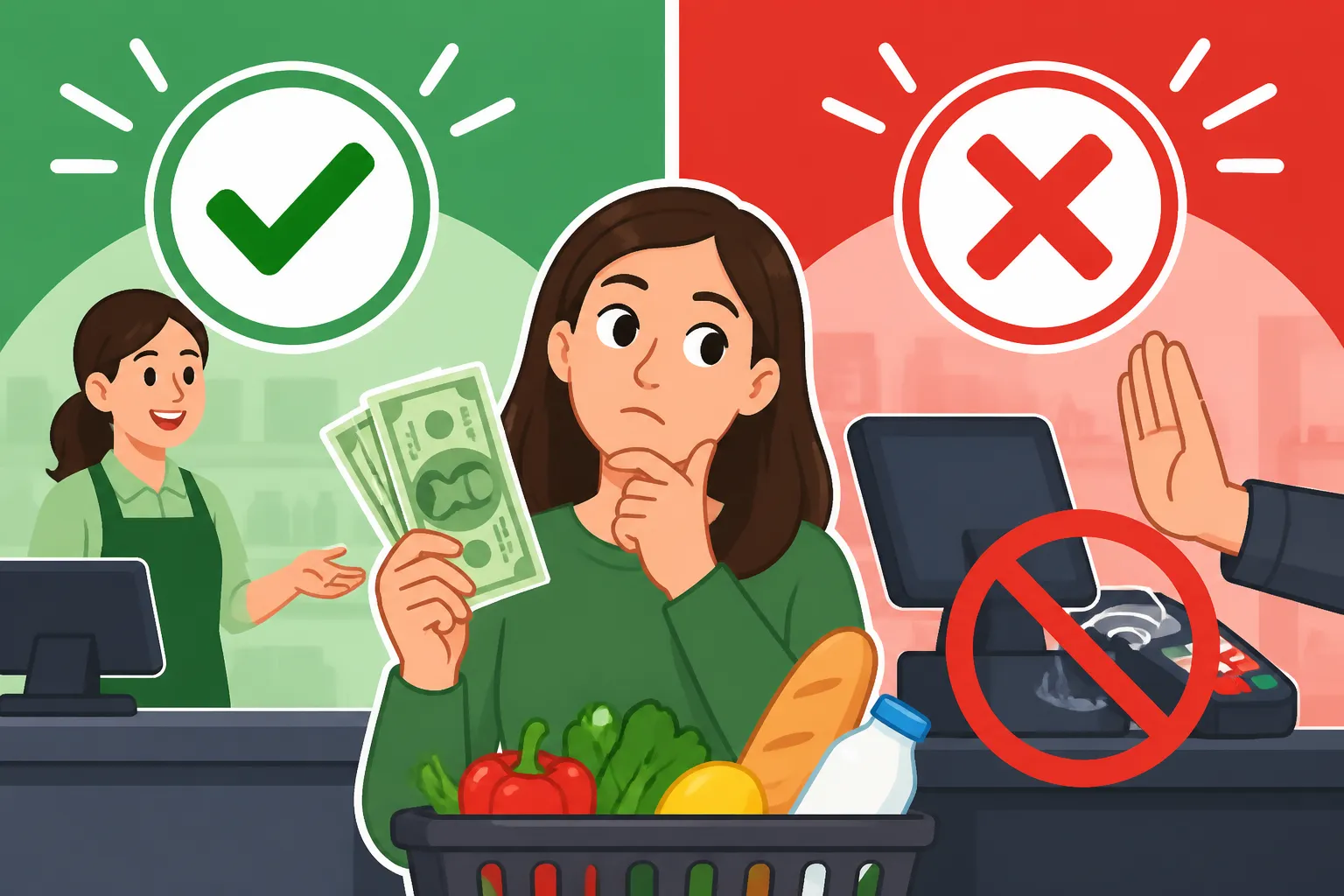
In a supermarket context, this gets tricky with the rise of "self-scan" checkouts. While the store itself must accept cash, they are not required to make every single checkout lane cash-compatible. You will often find that the self-service kiosks are "card only," and you will be directed to a manned till if you wish to pay with Krone. If you are still waiting for your local cards, you should also look into Are There Any ATMs Left in Denmark? Where to Find Cash to ensure you aren't carrying around massive denominations that are hard to break.
Why Supermarkets are the Last Bastion of Physical Money
Supermarkets like Netto, Rema 1000, Føtex, and Lidl remain the most reliable places to use cash in Denmark. Unlike small boutiques or high-end cafes that sometimes try to "stretch" the rules by claiming they don't have change, supermarkets are large enough to maintain the infrastructure required for cash handling.
Legal Obligations for Grocery Stores
Supermarkets are considered "essential" retail, and the Danish Consumer Ombudsman (Forbrugerombudsmanden) keeps a very close eye on them. If a supermarket were to unilaterally decide to stop accepting cash during the day, they would face significant fines. This is because a portion of the population—including the elderly, children, and certain vulnerable groups—does not have access to digital payment tools.
As a foreigner, this is your safety net. Until you have gone through the process of Opening a Bank Account in Denmark: Document Checklist and Delays, you can rest assured that your local supermarket will accept your cash for your daily needs. Just be aware that they may ask for smaller denominations if you are trying to pay for a 20-krone pack of gum with a 500-krone note.
Self-Service vs. Manned Tills
The friction point for many expats is the "Self-Scan" area. In modern Danish supermarkets, these lanes are designed for speed. Almost all of them are exclusively digital. If you have a basket full of items and only have cash, do not enter the self-scan area unless you see a specific machine with a coin slot and a bill recycler. These are becoming increasingly rare. Always head to the manned checkout where a cashier is present; they are legally required to facilitate your cash payment during the standard daytime hours.
The Challenges of Using Cash as an Expat
While you can pay with cash, the system is increasingly designed to make it inconvenient. This is part of a broader nudge toward digitalization. For those managing complex international lives, perhaps even dealing with Taxes for Expats to ensure they remain compliant with their home country while living in the Nordics, the move to digital is often a matter of better record-keeping.
Getting Change and the Coin Problem
Danish currency includes 1, 2, 5, 10, and 20 krone coins, along with the 50 øre coin. If you pay with large notes, you will quickly find your pockets weighed down by heavy coins. Many expats find this frustrating because once you have the coins, it’s even harder to spend them without feeling like you’re holding up the line.
Furthermore, you should be aware of The 1000 DKK Note Phase-Out: What to Do with Old Danish Cash. Denmark is officially phasing out the 1000-krone note. If you arrive with these in your possession, you may find that supermarkets are increasingly hesitant or even legally permitted to refuse them as they approach the deadline for total withdrawal from circulation.
Banking and Depositing Cash
If you have extra cash and want to put it into a bank account, you will encounter the next hurdle. Most "physical" bank branches in Denmark are now "cash-free." They do not have tellers who take money. You must use an ATM (Kontanten) that specifically allows for deposits. This requires a Danish debit card, which brings us back to the necessity of Using MitID for Banking: Security, Device Registration, and App Setup to manage your accounts. Using Wise can help you bridge the gap by allowing you to spend in DKK via a digital card while you wait for your permanent Danish bank setup.
Payment Methods Comparison Table
To help you decide when to use cash versus digital options, here is a quick breakdown of the payment landscape in a typical Danish supermarket:
| Payment Method | Accepted in Supermarkets? | Best Use Case | Downsides |
|---|---|---|---|
| Cash (Krone) | Yes (06:00 – 22:00) | Immediate arrivals, small purchases | Heavy coins, slow queues, safety limits |
| Dankort | Yes (Always) | Every day Danish life | Requires CPR and Danish bank account |
| MobilePay | Yes (Mostly) | Splitting bills, quick shopping | Requires Danish phone number & MitID |
| Visa/Mastercard | Yes (Always) | Tourists and new expats | Potential foreign exchange fees |
| Wise Card | Yes (Always) | Expats needing mid-market rates | Digital only (no cash-back at till) |
Practical Tips for Navigating Money in Denmark
Even though supermarkets must accept your cash, your life will be significantly easier if you adapt to the local digital ecosystem as quickly as possible. The Cost of Living in Denmark 2026: Budgets for Singles and Families is high, and managing that budget is much simpler when you can track every øre through an app rather than a pile of receipts.
When You Actually Need Cash
Despite the digital dominance, there are a few niche scenarios where cash is still helpful:
- Flea Markets (Loppemarked): While many sellers use MobilePay, some older sellers or children at neighborhood sales still prefer coins.
- Small Hot Dog Stands (Pølsevogn): Most take cards now, but in rural areas, cash can still be a lifesaver.
- Coin-Operated Lockers: Some older gyms or museums still require a 10 or 20 krone coin to lock your bag.
Transitioning to Digital
Once you receive your CPR number, your first priority should be getting The Dankort: Denmark’s National Debit Card and Why You Want One. This is the national payment heart of the country. Unlike international Visa or Mastercards, which sometimes incur higher processing fees for small merchants (though supermarkets usually absorb these), the Dankort is accepted everywhere with zero friction.
If you are a student or a young professional, you might also compare Traditional Banks vs. Digital Banks (Lunar): Which is Best for Expats? to see which offers the easiest path to a card that eliminates your need for physical cash entirely. Digital banks like Lunar often have a faster onboarding process for foreigners than the legacy institutions like Danske Bank or Nordea.
Ultimately, the answer to the supermarket question is a resounding "Yes"—but with the heavy asterisk of the 10:00 PM cutoff. Denmark is a society built on trust and efficiency; while the law protects your right to use cash, the culture will continue to nudge you toward your phone or your card. Embrace the digital shift, but keep a 100-krone note in your phone case just in case the systems go down—even in a digital utopia, technology occasionally has a "bad day."
Disclaimer
This guide is for informational purposes only and does not constitute legal or financial advice. Laws regarding payment services and cash acceptance in Denmark can change. Always check the latest regulations from the Danish Consumer Ombudsman (Forbrugerombudsmanden) or the Ministry of Industry, Business and Financial Affairs for the most up-to-date legal requirements.