Alternative Medicine in Denmark: Chiropractic, Acupuncture, and Subsidies
When you arrive in Denmark with a nagging back injury or chronic tension, you might be surprised by the "wait and see" approach often favored by local GPs. I remember sitting in a cold waiting room in Aarhus, desperate for something more than a recommendation for rest and Panodil. This guide explores how to access and subsidize chiropractic care, acupuncture, and other alternative therapies within the Danish system.
Understanding the Danish Approach to Alternative Medicine
The Danish healthcare system is world-class, but it is deeply rooted in evidence-based Western medicine. This creates a specific cultural and administrative divide that can be jarring for expats coming from countries where osteopathy or naturopathy are integrated into primary care. In Denmark, the system is tiered: some treatments are partially subsidized by the state, while others are entirely private, requiring you to navigate a complex web of certifications to ensure you are seeing a qualified professional.
The Divide Between Public and Private Care
Most expats are familiar with the "free" nature of the public system, but when it comes to alternative medicine, the term "free" rarely applies. Treatments like chiropractic care and certain types of physiotherapy sit in a grey zone where the state provides a partial subsidy, provided you have your CPR number and a valid health card. However, other therapies like acupuncture, reflexology, and homeopathy are viewed as purely private endeavors. You will often find yourself paying out-of-pocket at the point of service, even if you are used to these being covered by national health schemes elsewhere.
The frustration for many of us lies in the gatekeeping. To get a subsidy for even the most basic physical therapy, you often need a referral from your GP. If you are still waiting for your residency paperwork to clear, you might find yourself in a difficult position. This is where Expat Health Insurance: Coverage Before You Get Your CPR Number becomes vital, as it allows you to bypass the public system’s requirements during those first few months. During my first winter here, I realized that the public system moves slowly for non-emergency musculoskeletal issues, making private alternatives not just a luxury, but a necessity for maintaining my quality of life.
How the Yellow Card Factors Into Alternative Treatments
Your The Yellow Health Card (Sundhedskort): Your Key to Danish Healthcare is your golden ticket for many things, but its power is limited in the realm of alternative medicine. For chiropractic care, the card acts as a mechanism for an automatic discount. When you visit a chiropractor who has an agreement with the public health insurance (sygesikringen), you don't actually need a referral from your GP to get the state subsidy; the clinic simply scans your card, and the discount is applied to your bill instantly.
For other treatments, the yellow card serves as your identification but doesn't offer a direct financial benefit. For instance, if you seek acupuncture for migraine relief, the state typically won't chip in. Understanding these nuances is essential so you aren't hit with a 800 DKK bill you expected to be covered. It is always worth checking Healthcare in Denmark for Foreign Residents: Complete System Guide (2027) to see how the yellow card interacts with different medical specialists across the regions.
The Role of GP Referrals and the Gatekeeper System
In Denmark, your General Practitioner (GP) is the gatekeeper for almost everything. While you can go to a chiropractor without a referral, seeing a physiotherapist for a subsidized rate requires your doctor to agree that it is medically necessary. This can be a point of contention for many expats who are used to direct access. Newcomers with persistent pain, such as neck pain, may need to make a firm case to their GP that it requires more than advice like "better posture" before a referral is granted.
This "gatekeeper" model is designed to keep costs down for the state, but it can feel dismissive when you are in pain. It’s important to understand The Role of the GP: Why You Cannot Go Directly to a Specialist before you start booking appointments. If you find the public route too restrictive, many expats opt for international plans like Cigna Global, which often allow for direct access to specialists and alternative practitioners without the need to plead your case to a local GP first.
Chiropractic Care in Denmark
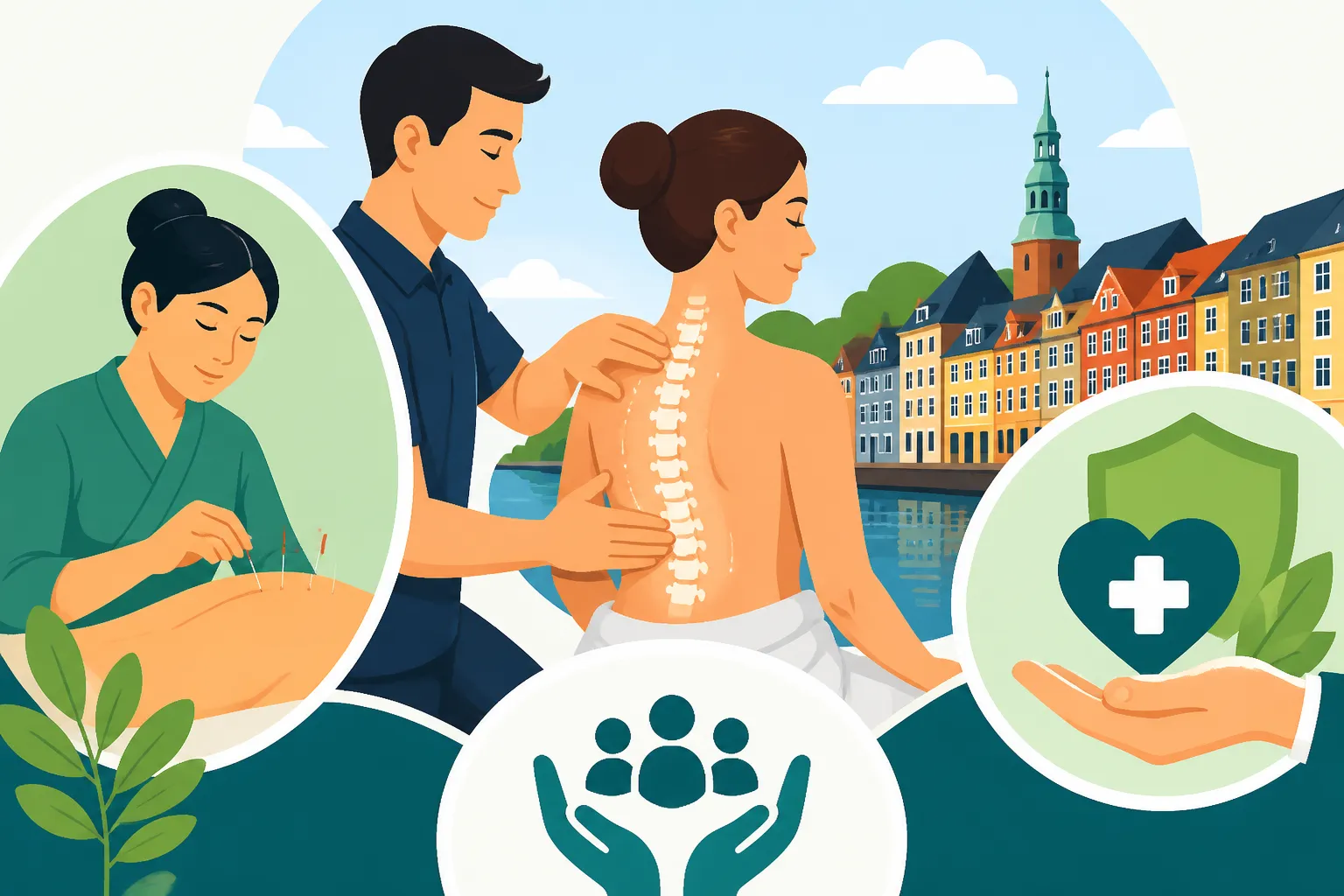
Chiropractic care is perhaps the most "mainstream" of the alternative therapies in Denmark. Unlike in some other European countries, Danish chiropractors are highly regulated and must hold a Master’s degree in clinical biomechanics from the University of Southern Denmark. They are considered primary healthcare providers, meaning they can diagnose, treat, and even refer you for X-rays or hospital imaging if needed.
The Status of Chiropractors in the Public System
Because chiropractors are integrated into the public system, the quality of care is exceptionally high and standardized. When you walk into a clinic like Københavns Kiropraktor Center or a local practice in Odense, you are entering a medical facility that communicates directly with the national health database. This integration means your treatment notes can, with your permission, be viewed by your GP, ensuring a joined-up approach to your health.
However, the "integration" only goes so far. While the state recognizes their expertise, it only covers a percentage of the fee—usually around 20% to 30% for standard treatments, and slightly more for specific diagnostic exams. You are still responsible for the "egenbetaling" (co-payment). For many of us, this is a surprising expense in a country known for "free" healthcare. If you are transitioning between jobs or waiting for your permit, having a flexible plan like SafetyWing can help cover these unexpected out-of-pocket costs for musculoskeletal injuries.
Subsidies and Out-of-Pocket Costs
Navigating the costs of chiropractic care requires a bit of math. A first-time consultation usually costs between 500 and 700 DKK before the subsidy is applied. Subsequent treatments might hover around 350 to 500 DKK. The state subsidy is deducted automatically if the chiropractor has a "ydernummer" (provider number), which almost all of them do.
To further reduce these costs, many residents join Private Health Insurance (Sygeforsikring "danmark"): Is It Worth It? which is a member-owned insurance group. They provide fixed-amount reimbursements for each chiropractic session. Between the state subsidy and the "danmark" reimbursement, your final out-of-pocket cost can drop significantly. I personally found that being a member of "danmark" was the only way to make regular maintenance adjustments affordable on a mid-range Danish salary.
Finding a Clinic in Major Cities
Finding a chiropractor is relatively easy, but finding one that fits your specific needs and speaks fluent English (though most do) takes a bit more effort. In Copenhagen, clinics are plentiful in Nørrebro and Vesterbro, often located in beautiful old buildings that lack elevators—something to keep in mind if you have a mobility issue. In Aarhus, many expats head to clinics near the university, which are accustomed to dealing with an international clientele.
When searching for a provider, look for the term "Kiropraktor." You can use the Sundhed.dk portal to find a list of registered providers in your municipality. This is the most reliable way to ensure the clinic is part of the subsidy scheme. For more localized advice, you might check Finding Medical Care in Denmark: GPs, Specialists, and Referrals to understand how to navigate these local directories effectively.
Acupuncture and Traditional Chinese Medicine
Acupuncture has gained significant traction in Denmark over the last decade, moving from the fringes into both private clinics and even some public hospital settings, particularly for pain management and maternity care. However, the regulatory landscape is different from chiropractic care, as anyone can technically call themselves an acupuncturist if they don't use the protected titles.
Regulated vs. Unregulated Practice (RAB Scheme)
To protect patients, Denmark uses the RAB (Registreret Alternativ Behandler) scheme. This is a voluntary but highly regarded certification for alternative practitioners. An RAB-certified acupuncturist must meet specific education requirements and adhere to ethical standards and insurance mandates. When you are looking for a practitioner, always check if they have the RAB title.
This certification is not just about safety; it’s also about money. Most private insurance companies, including "danmark," will only reimburse your treatments if the practitioner is RAB-certified. I learned this the hard way when I visited a lovely but uncertified clinic in Frederiksberg and realized I couldn't claim a single krone back. Always ask, "Er du RAB-registreret?" before your first needle is placed.
Integrated Acupuncture in Public Hospitals
One of the most progressive aspects of the Danish system is the use of acupuncture in public hospitals, particularly in labor wards. Many midwives are trained in basic acupuncture to help with pain relief during childbirth. This is provided free of charge as part of your birth plan. You can read more about these options in Giving Birth in Denmark: Pain Relief Options and Postpartum Care.
Outside of the maternity ward, some pain clinics within the public hospital system also offer acupuncture as a secondary treatment for chronic pain or the side effects of chemotherapy. However, getting a referral for this is notoriously difficult and usually requires you to have exhausted all other conventional medical options first. For most of us, if we want acupuncture for stress, fertility, or general wellness, we have to look to the private sector.
Private Insurance Coverage Options
If you rely on acupuncture for chronic condition management, your best bet is a combination of local and international insurance. Companies like Cigna Global often have "well-being" modules that can be added to your policy, specifically covering alternative therapies like acupuncture or Traditional Chinese Medicine (TCM). This is particularly useful for expats who don't qualify for "danmark" due to pre-existing conditions.
Local private insurance through your employer (like PFA or Danica) also frequently includes a set number of "alternative" sessions per year. These corporate packages are a godsend if you are dealing with office-related ailments like "mouse arm" or tension headaches. It’s always worth checking your employee handbook or the Using the Medicinkortet App: Managing Your Prescriptions Digitally resources to see how your digital health profile interacts with these private providers.
| Treatment Type | GP Referral Required? | State Subsidy Available? | "danmark" Reimbursement? | Typical Cost (DKK) |
|---|---|---|---|---|
| Chiropractic | No | Yes (Automatic) | Yes | 350 – 600 |
| Acupuncture | No | No (Usually) | Yes (If RAB) | 500 – 800 |
| Physiotherapy | Yes (for subsidy) | Yes (Partial) | Yes | 300 – 500 |
| Osteopathy | No | No | Sometimes | 600 – 900 |
| Reflexology | No | No | Yes (If RAB) | 400 – 700 |
Physiotherapy and Osteopathy
While physiotherapy is firmly rooted in the public system, osteopathy is often viewed as a more "holistic" alternative. Both are popular in Denmark, especially among the active, bike-riding population of the major cities.
Getting a GP Referral for Subsidized Physio
Physiotherapy is where the Danish system can feel most bureaucratic. If you have a sports injury, you can't just walk into a clinic and expect a discount. You must first book an appointment with your GP, explain the injury, and hope they issue a digital referral. Once the referral is in the system, it is valid for a certain number of sessions at any clinic that has a contract with the public health insurance.
The demand for subsidized physiotherapy is incredibly high. You might find that the best clinics have a waiting list of several weeks for patients with a referral, while "private pay" patients can be seen the next day. This is a common frustration that you can learn more about in Physiotherapy in Denmark: Getting GP Referrals and Managing Costs. If you are in acute pain, you might choose to forgo the subsidy just to get on the table sooner.
Osteopathy: The Private Alternative
Osteopathy has seen a surge in popularity in Denmark, particularly for those who feel that traditional physiotherapy is too focused on isolated exercises rather than the whole body. However, osteopaths do not receive state subsidies. You will pay the full price for every session, which can be quite steep—often 700 to 900 DKK per visit.
Many osteopaths in Copenhagen and Aarhus are also trained as physiotherapists, which allows them to bridge the gap between the two philosophies. If you find a practitioner with both titles, you might be able to use a physio referral for the "manual therapy" portion of your treatment, though this depends heavily on how the clinic bills their services. For those without a CPR number yet, SafetyWing can be a vital fallback for these costs if the treatment is related to an acute injury sustained after arrival.
Specialized Clinics for Athletes and Expats
Denmark is a nation of runners and cyclists, so there is no shortage of high-end sports clinics. Places like Kaiser Sport & Ortopædi in Copenhagen are fantastic but expensive. These clinics often employ a multi-disciplinary team, including physiotherapists, osteopaths, and even specialized podiatrists. For an expat used to high-touch concierge medicine, these private clinics will feel the most familiar, even if they sit outside the standard public healthcare loop.
Financial Support and Insurance for Complementary Therapies
The cost of staying healthy in Denmark can add up quickly if you move beyond what the yellow card covers. Strategy is key here: you need to know which insurance products to stack to minimize your "egenbetaling."
Sygeforsikring "danmark" Subsidies
I cannot stress enough how important "danmark" is for anyone living here long-term. It is a unique, member-owned insurance that provides small but frequent reimbursements for everything from dental checkups to chiropractic adjustments. There are different "groups" (levels) of membership. Group 5 is the most common for basic coverage, while Group 1 and 2 offer more for those who know they will need extensive physical therapy or alternative care.
The catch is that you generally have to be healthy when you join. If you already have chronic back pain, they may exclude that specific condition from your coverage. This is why many expats join the moment they get their CPR number, even if they don't need it yet. It’s a foundational part of managing costs, as explained in Private Health Insurance (Sygeforsikring "danmark"): Is It Worth It?.
Role of Private International Insurance
For many of us, the local system’s limitations are a dealbreaker. If you want the freedom to see an acupuncturist in Hellerup or a chiropractor in Skagen without a referral and without waiting for months, international private medical insurance (IPMI) is the way to go. Cigna Global offers comprehensive plans that can be tailored to include "Outpatient and Complementary Therapies," which covers many of the treatments discussed in this guide.
These plans are particularly valuable because they provide "first-krone" coverage or much higher reimbursement limits than the local "danmark" insurance. They also offer the peace of mind of English-language customer service, which can be a relief when you are trying to decipher a Danish medical bill. If you are a freelancer or a digital nomad, this kind of coverage is often more practical than trying to fit into the rigid Danish public-private hybrid.
Using Employer-Provided Health Insurance
If you are working for a medium-to-large Danish company, you almost certainly have a "Sundhedsforsikring" (Health Insurance) through a provider like Mølholm, PFA, or Danica. These policies are a massive perk. They often cover 10-12 sessions of physiotherapy, chiropractic care, or even massage and reflexology per year, completely free of charge.
The best part is that these private insurances usually have their own network of clinics where you can get an appointment within 24 to 48 hours. I’ve found that many of my Danish colleagues don't even bother with the public system for musculoskeletal issues; they go straight through their employer’s insurance. Make sure you ask your HR department for your "forsikringspolice" and see which alternative treatments are included.
Practical Tips for Navigating the System
Navigating the wellness landscape in Denmark requires a bit of local know-how. From the apps you use to the way you talk to your practitioner, the cultural nuances matter.
Language Barriers in Wellness Clinics
While almost every chiropractor and physiotherapist in Denmark speaks excellent English, the receptionists and booking systems might not always be as bilingual. In smaller towns outside the main hubs of Copenhagen, Aarhus, and Odense, you might encounter websites that are only in Danish. Using a browser translator is usually enough to navigate the booking calendar.
During your treatment, don't be afraid to ask for a "medical summary" in English if you need to share it with insurance or a doctor back home. Most practitioners are happy to oblige, though some might charge a small fee for the administrative time. If you find yourself struggling with the terminology, Healthcare in Denmark for Foreign Residents: Complete System Guide (2027) offers a great glossary of Danish health terms to keep on your phone.
Booking and Communication Apps
The Danish healthcare system is incredibly digital. You will likely use the "Min Læge" app for communicating with your GP, but for alternative medicine, many clinics use a system called "Compliment" or their own online booking portals. You will usually need your MitID to log in and confirm your identity.
When you arrive at a clinic, you will often see a touch-screen terminal near the entrance. You must scan your yellow health card here to "check in." This notifies the practitioner that you have arrived and, crucially, it registers the visit with the state for subsidy purposes. It feels a bit impersonal at first, but it is the standard "velkomst" (welcome) in Danish healthcare.
Dealing with "The Danish Way"
Finally, be prepared for the Danish medical philosophy, which tends to be less interventionist than in the US or UK. Whether it’s a chiropractor or an acupuncturist, they will often give you "homework"—exercises or lifestyle changes—and expect you to take an active role in your recovery. There is a strong cultural emphasis on self-reliance and "active" health.
If you are feeling overwhelmed by the administrative side of things, remember that everyone goes through it. From getting your first MitID to understanding why your "free" healthcare still costs 400 DKK for a back adjustment, it’s all part of the expat journey in Denmark. Stay patient, keep your receipts, and don't hesitate to invest in a good private insurance plan to smooth out the bumps.
Disclaimer
The information provided in this guide is for informational purposes only and does not constitute medical or legal advice. Healthcare regulations and subsidy rates in Denmark are subject to change. Always consult with a qualified medical professional and your insurance provider to confirm coverage and treatment options specific to your situation.