Why You Must Scan Your Yellow Card in the Waiting Room
You walk into a Danish doctor’s office, sit down in a quiet, minimalist waiting room, and wait for your name to be called. Twenty minutes pass, then forty, and you realize people who arrived after you are already heading inside. I remember my first month in Aarhus, sitting in a basement clinic for nearly an hour before a nurse finally asked if I had "remembered to say hello to the machine." This guide solves the mystery of the arrival terminal and explains why that piece of yellow plastic is the most important thing in your wallet.
The Ritual of the Arrival Terminal
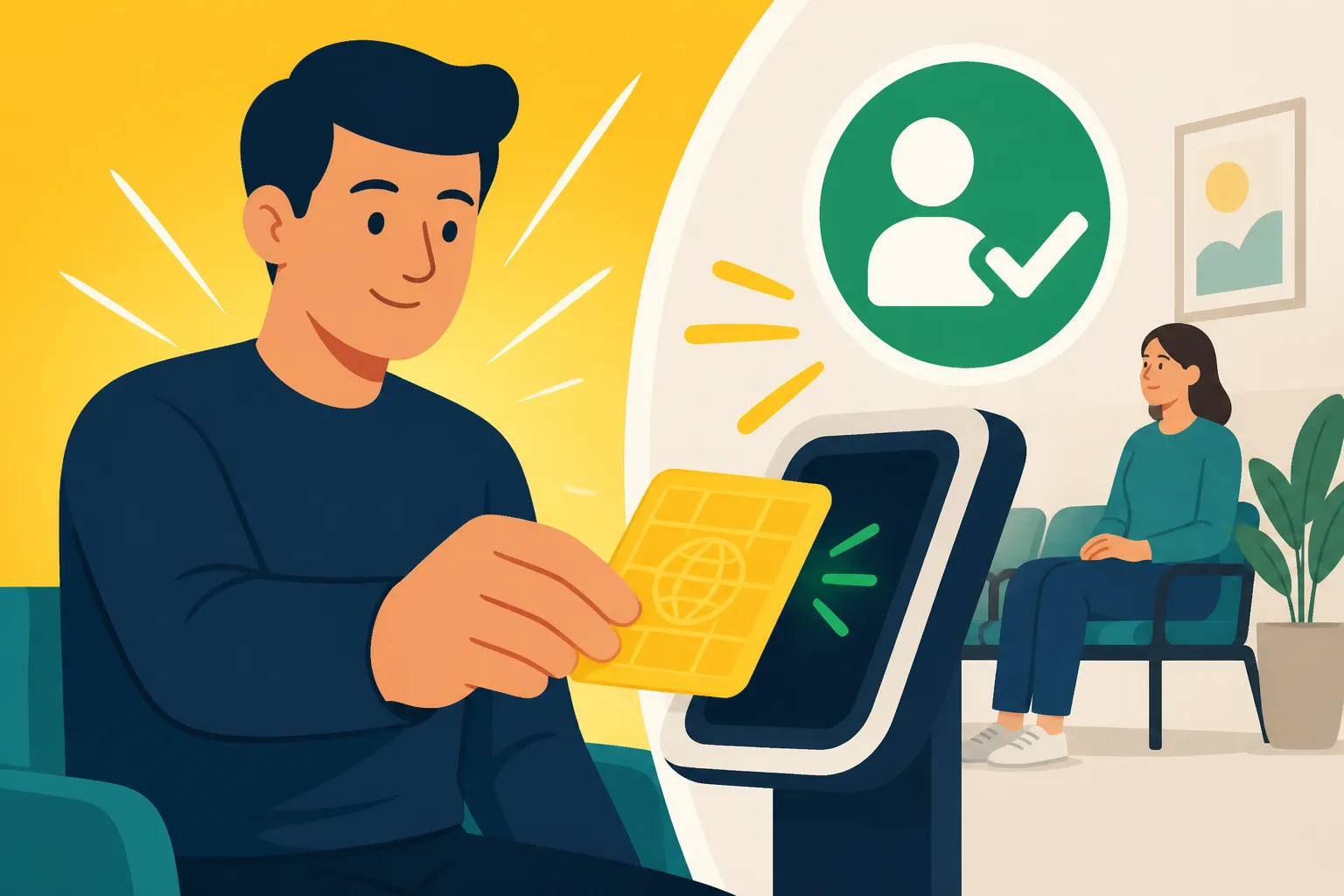
When you enter a General Practitioner (GP) clinic or a hospital department in Denmark, you will rarely be greeted by a receptionist sitting behind a glass window. Instead, you will see a small, often wall-mounted terminal with a red laser light or a glass slot. This is the "ankomstterminal," and it is the gatekeeper of your entire medical experience. You must take your physical health card and slide the magnetic strip through the reader, or if you are using the digital version, scan the QR code from your phone.
This isn't just a polite way of saying you’ve arrived; it is a formal registration into the clinic’s workflow. In the Danish system, the doctor’s computer screen only highlights your name once that scan is complete. Until then, you are essentially a ghost in the waiting room. Many expats miss their appointments because they assumed the "Danish way" was just to sit and wait patiently. If you don't scan, the doctor’s system marks you as a "no-show" after five or ten minutes, and they will likely move on to the next patient or take a coffee break, assuming you forgot the appointment.
Understanding The Yellow Health Card (Sundhedskort): Your Key to Danish Healthcare is the first step in mastering life here. It is your ID for everything from the library to the doctor. If you are tech-savvy, you should also look into How to Download the Sundhedskort App on Your Phone, which allows you to scan into the waiting room using your smartphone. However, always keep the physical card in your wallet as a backup; I’ve had my fair share of moments where the clinic's scanner couldn't read my phone screen because of a glare or a cracked protector.
Why the Scan Matters for the Doctor’s Bottom Line
To understand why clinics are so strict about this, you have to understand the administrative side of Healthcare in Denmark for Foreign Residents: Complete System Guide (2027). Danish GPs are private contractors who operate under a collective agreement with the public health authorities. They are paid in two ways: a fixed capitation fee for every patient registered at their clinic and a fee-for-service for every consultation or procedure they perform.
The act of scanning your card provides the "proof of visit" required for the doctor to settle their account with the Region. When the scanner beeps, a digital timestamp is created. This timestamp is the doctor's evidence that you were physically present, allowing them to bill the state for the time they spend with you. Without that scan, the clinic might struggle to justify the payment for your consultation, which is why the staff can sometimes seem a bit frustrated if they have to register you manually.
Furthermore, this data flows into the national health record system. It helps the government track wait times, clinic capacity, and patient traffic. It is a highly efficient, data-driven model that reduces the need for administrative staff, which is why you see so few receptionists. By scanning your card, you are effectively doing the job of a front-desk clerk, keeping the system lean and ensuring that public funds are allocated correctly based on actual patient visits.
What Happens if You Forget to Scan
The consequences of forgetting to scan range from mild annoyance to actual financial penalties. Most commonly, you will simply sit there indefinitely. Danish doctors are famous for their punctuality; if your appointment is at 10:15, they often expect to be talking to you by 10:17. If you haven't scanned by 10:20, they will assume you aren't coming.
If you eventually realize your mistake and walk up to the desk, you might find that your slot has been given away. In busy cities like Copenhagen or Aarhus, missing your slot could mean waiting weeks for a new appointment. Some clinics also have a policy of charging a "no-show fee" for missed appointments, especially for specialized treatments or long consultations. While the public system is free at the point of use, these administrative fees are a way to discourage waste in a high-demand environment.
If you find yourself frequently losing track of these details, it might be worth investigating Finding Medical Care in Denmark: GPs, Specialists, and Referrals to see if a different clinic with a more traditional setup might suit you, though "traditional" is becoming increasingly rare. If you ever misplace your card during a move or a hectic week, you need to know What to Do If You Lose Your Yellow Health Card in Denmark immediately, because you cannot access any non-emergency services without it.
The Transition Period: Health Insurance Before the CPR
One of the most stressful times for a new arrival is the gap between landing in Denmark and receiving that physical yellow card in the mail. This process can take anywhere from two to six weeks after you have your CPR registration meeting. During this "gray zone," you don't have a card to scan, and you aren't yet fully integrated into the digital system.
For non-EU expats, this period can be particularly risky. If you have an urgent non-emergency issue, you can't just walk in and use the public system easily. This is where many of us rely on international providers like SafetyWing or Cigna Global. SafetyWing is often a go-to for the initial move because it is flexible and covers those early weeks while you are waiting for your residence permit to process. Cigna Global tends to be the choice for those who want a higher tier of private care that mirrors the "Group 2" health insurance experience in Denmark, providing more direct access to specialists.
You can read more about managing this risk in our guide on the First 90 Days: Health Insurance Requirements for Non-EU Expats. Having a policy from SafetyWing ensures that if you trip on a cobblestone street in Vesterbro before your yellow card arrives, you aren't stuck with a massive bill. Once your CPR is active, you are covered by the state, but that gap is real, and the administrative hurdles of Expat Health Insurance: Coverage Before You Get Your CPR Number are something every veteran expat has had to navigate.
Using the Digital Health Portal
Scanning your card at the GP is just the entry point to a much larger digital ecosystem. Once you have scanned in and seen the doctor, the results of that visit, including blood tests, prescriptions, and referrals, are uploaded to a central database. This is why the scan is so critical; it links your physical presence to your digital identity.
| Component | Purpose | Access Method |
|---|---|---|
| Physical Yellow Card | Arrival registration and ID | Magnetic strip reader |
| Sundhedskort App | Digital version of the card | QR code scanner |
| Sundhed.dk | Central portal for all medical records | MitID login |
| Min Læge App | Communication with your specific GP | MitID login |
By scanning in, you enable the doctor to pull up your records instantly on their screen. They can see what the specialist said last month or what medications you were prescribed by the emergency room. This level of integration is why Sundhed.dk and MitID: Navigating Denmark’s Digital Health Portals is a topic you need to master early on. It saves you from having to repeat your entire medical history every time you see a new clinician. If you are using Cigna Global as a supplement to your public care, you can often bridge the gap between private specialist reports and your public GP's records by sharing these digital summaries.
Etiquette in the Danish Waiting Room
The waiting room is a social microcosm of Denmark. It is generally very quiet. People don't often talk to strangers, and phone calls are strictly frowned upon. When you scan your card, the terminal will often display a message like "Vær venlig at tage plads" (Please take a seat).
In some modern clinics, the terminal will even tell you which "Venteværelse" (waiting area) or specific room number you should head toward. Pay close attention to the screens on the wall. Unlike many other countries where a nurse comes out and shouts your name, many Danish clinics use a digital calling system. Your name or a set of initials will appear on a monitor with an arrow pointing to a specific door. If you aren't looking at the screen because you're buried in your phone, you might miss your turn.
This emphasis on autonomy and digital communication can feel cold at first, but it is actually a sign of respect for your time and privacy. If you have chosen a GP through the standard process, you might find more info on How to Choose and Change Your General Practitioner (GP) in Denmark if your current clinic's digital setup feels too impersonal. Personally, I grew to love the efficiency; I scan, I sit, I see my name, I go in. No friction, no paperwork.
When the Yellow Card Isn't Enough
While scanning your yellow card gets you through the door for most things, it is important to remember what the public system does not cover. Dental care, for instance, is a separate world. You still scan your card at the dentist's office, but the "free" aspect disappears for adults. You will be billed for almost everything, though the state provides small subsidies that are automatically calculated when you scan.
If you are looking for more comprehensive coverage, many expats look into Dental Care in Denmark: Costs, Subsidies, and Private Insurance Options. Some also choose to join Private Health Insurance (Sygeforsikring "danmark"): Is It Worth It? to get reimbursements for things like glasses, dental work, and physiotherapy. Even with private insurance from Cigna Global or membership in "danmark," you still use your yellow card as the primary key to register your arrival at any health facility in the country.
SafetyWing also remains relevant for expats who travel frequently outside of Denmark. While your yellow card gives you access to the Danish system, and the Blue EHIC card covers you in the EU, SafetyWing provides that extra layer of travel medical insurance for trips back home or to other continents where Danish coverage simply doesn't reach.
Troubleshooting the Scanner
Every now and then, the system fails. Perhaps your card is ten years old and the magnetic strip has been scratched by your keys. Or maybe the clinic's internet is down. If you scan and the machine gives you a red light or a "System Fejl" message, do not just sit down.
In this specific scenario, you must find a staff member. Even if there isn't a receptionist, there is usually a small bell or an office door where you can knock. Tell them your name and that the "scanneren virker ikke" (the scanner isn't working). They will manually check you in. If you don't do this, the doctor will still see you as a "no-show" on their screen, regardless of the hardware failure.
Living in Denmark requires a mix of following the digital rules and knowing when to politely speak up when the tech fails. It is a balance of being a "good citizen" who scans their card and being a proactive expat who ensures they aren't forgotten in a quiet basement waiting room.
Summary of the Scanning Process
- Enter the clinic and locate the "Ankomstterminal."
- Slide your physical yellow card or scan the QR code from the Sundhedskort app.
- Wait for the confirmation message on the screen (usually "Ankomst registreret").
- Check the wall monitors for your name or room assignment.
- If the machine fails, notify a staff member immediately.
- Keep your phone on silent and respect the quiet atmosphere of the waiting area.
By following these steps, you ensure that your visit is legally recorded, your doctor is paid, and your medical history is kept up to date. It is a small gesture—a simple beep of a machine—but it is the heartbeat of the Danish healthcare system.
Disclaimer
The information provided in this guide is for informational purposes only and does not constitute legal or professional medical advice. Healthcare regulations and digital systems in Denmark are subject to change. Always consult official government resources such as Borger.dk or Sundhed.dk for the most current requirements and procedures. The author is an expat sharing personal experiences and research, not a representative of the Danish health authorities.