Will I Receive Folkepension if I Only Work in Denmark for 5 Years?
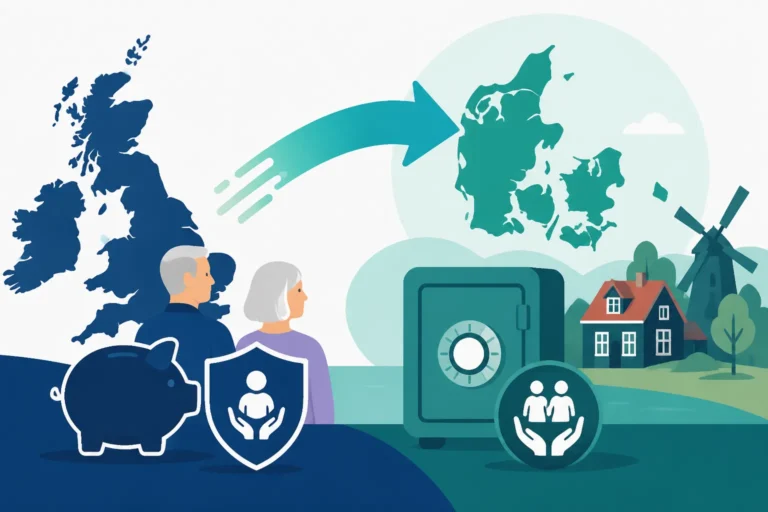
Many expats arriving in Denmark see a massive chunk of their salary disappear into taxes and wonder if they’ll ever see a return on that investment if they leave after a few years. It is a common anxiety that if you don’t stay for decades, your contributions to the state pension are effectively forfeited. This guide explains how the Danish Folkepension works for short-term residents and why those five years actually do count for something.
Understanding Folkepension and the Residency Principle
The Danish state pension, known as Folkepension, operates on a principle that is fundamentally different from many other national systems. In many countries, your pension is strictly a "pay-in" system where your benefits are directly proportional to the specific amount of currency you contributed over your working life. In Denmark, while there are elements of that in private and labor-market schemes, the Folkepension is primarily based on how long you have lived in the country between the age of 15 and the statutory retirement age.
For most foreigners, the first point of confusion is the distinction between residency and employment. You do not necessarily have to be working every single day of those five years to "earn" your pension rights; you simply need to be a legal resident. However, for most of us, residency and work are tied together by our visas. If you have spent five years here on a work permit, you have successfully met the minimum threshold to claim a portion of the state pension later in life. This is a relief for many who worry that a "short" stint in Scandinavia results in a total loss of tax-funded benefits.
The system is designed to be inclusive but proportional. To understand where you stand, you should first look at the Danish Pension System: Folkepension, ATP, and Employer Contributions to see how the various "pillars" of the Danish retirement model interact. The Folkepension is the first pillar—the social safety net provided by the state to everyone who meets the residency criteria.
The Three-Year Minimum Rule
Before we get excited about your five-year stay, we have to address the "floor" of the system. In Denmark, the general rule is that you must have lived in the country for at least three years between the age of 15 and your retirement age to be eligible for any Folkepension at all. Since you are planning to stay (or have stayed) for five years, you have safely cleared this hurdle.
If you were to leave Denmark after only two years, you would generally not be entitled to a Danish state pension unless you are an EU/EEA citizen or covered by a specific social security agreement. For those who stay beyond the three-year mark, the right to a "fractional" pension is locked in. This means that even if you move back to your home country or head off to a new adventure in another part of the world, Denmark "remembers" those years.
Work vs. Residency for Non-EU Citizens
For those of us coming from outside the European Union, the rules can feel a bit more rigid. While residency is the key metric, your legal status as a resident is usually contingent on your employment. If you are here for five years, the Danish authorities view this as five years of "accrued rights." It is vital to keep your documentation in order. When you eventually reach retirement age—which is currently climbing toward 67 and beyond depending on your birth year—you will need to prove these years of residence.
New arrivals are often told that even though the Taxes in Denmark Explained: A-Skat, AM-bidrag, and Marginal Rates seem high, part of what you are buying is this future security. Even five years of residency creates a legal obligation for the Danish state to pay you a pro-rata share of the pension, provided you haven't "broken" the eligibility through specific legal disqualifications.
The 5-Year Scenario: Calculating Your Pro-Rata Share
So, how much will you actually get? The Folkepension is calculated based on what is called "full residency." To get a "full" Danish state pension, you typically need to have lived in Denmark for 40 years (for those reaching retirement age before 2025) or a higher number for younger generations (it is now moving toward 9/10ths of the time from age 15 to retirement).
If you live in Denmark for only five years, you will receive a pro-rata pension. This is essentially a math problem: you take the number of years you lived in Denmark and divide it by the number of years required for a full pension. If the requirement for your generation is 40 years, and you stayed for 5, you would be entitled to 5/40ths (or 12.5%) of the basic pension amount.
The Basic Amount vs. The Pension Supplement
It is important to distinguish between the two parts of the Folkepension. There is the "Basic Amount" (Grundbeløb) and the "Pension Supplement" (Pensionstillæg). The Basic Amount is generally what you can take with you abroad. The Pension Supplement is means-tested and often depends on your total income and whether you continue to live in Denmark or another EU/EEA country.
For an expat who worked here for five years and then moved back to, say, the United States or Australia, you should realistically only count on receiving the pro-rata portion of the Basic Amount. While it won't buy you a villa in Tuscany, it is a guaranteed, inflation-adjusted payment from one of the most stable economies in the world. When you start calculating your future, you might want to look at Understanding Your Danish Payslip (Lønseddel): Deductions Decoded to see how much was being carved out for these types of social protections.
The Impact of EU/EEA Aggregation
If you are an EU citizen, the five years you spent in Denmark don't exist in a vacuum. Under EU social security coordination rules, your years of work in different EU countries are "aggregated." This means that if you worked 5 years in Denmark, 10 years in Germany, and 20 years in Spain, all these countries will talk to each other when you retire.
Each country will pay you a pension proportional to the time you spent there, but the fact that you spent time in other EU states helps you meet the minimum eligibility "vesting" periods in countries that might have stricter rules than Denmark’s three-year limit. Even if you only spent a few years here, the digital trail through your NemKonto and MitID: The Core of Danish Digital Finance (2027) and your CPR number ensures that these years are logged in the European-wide system.
| Years in Denmark | Entitlement Status | Estimated Proportion of Full Pension |
|---|---|---|
| Under 3 Years | Generally No Entitlement | 0% |
| 3 Years | Minimum Threshold Met | 7.5% (approx) |
| 5 Years | Confirmed Pro-Rata | 12.5% (approx) |
| 10 Years | Significant Pro-Rata | 25% (approx) |
| 40+ Years | Full Pension | 100% |
Non-EU Expats and Social Security Agreements
If you are a non-EU expat, your ability to "export" your Danish pension depends heavily on whether your home country has a bilateral social security agreement with Denmark. Denmark has such agreements with many countries, including the US, Canada, India, Australia, and several others. These agreements are designed to ensure that workers aren't penalized for moving between borders.
If an agreement exists, it usually stipulates that Denmark will pay your pro-rata Folkepension directly to you in your home country. If no agreement exists, it can be much harder, or even impossible, to receive the Folkepension if you live outside the EU. This is a "hidden" frustration that many expats don't realize until it's too late. You can check the status of your years by logging into Sundhed.dk and MitID: Navigating Denmark’s Digital Health Portals which often links to your broader "Borger" profile where residency data is stored.
Maintaining Your Records
I cannot stress this enough: keep your final payslips and your "årsopgørelse" (annual tax assessment) from SKAT for every year you live here. While the system is highly digital, errors can happen over a 30-year horizon. If you are a US citizen, for example, you may need to provide proof of your Danish residency to the Social Security Administration back home to ensure you aren't hit by the Windfall Elimination Provision (WEP). Using a service like Taxes for Expats can be incredibly helpful in these scenarios, as they specialize in the complex overlap between Danish and foreign tax liabilities.
When the time comes to actually claim the pension, you will likely be dealing with Udbetaling Danmark, the agency responsible for public payments. They are the ones who will verify your five years of residence. It helps if you have kept a record of your Preliminary Tax Assessment (Forskudsopgørelse): Avoiding Tax Debt history, as it proves you were a registered taxpayer during that period.
Currency and International Transfers
One practical hurdle of receiving a Danish pension while living abroad is the currency conversion. The Danish Krone (DKK) is pegged to the Euro, but it is not the Euro. If you are receiving a monthly pension payment into a bank account in India or the US, your traditional bank will likely take a massive spread on the exchange rate.
Using a platform like Wise is often the smartest way to handle these international flows. You can set up a "borderless" account that can receive DKK and then convert it at the mid-market rate when you need it. This ensures that the pro-rata pension you worked five years for actually ends up in your pocket rather than being swallowed by bank fees. Wise is particularly useful because it provides you with local banking details that can sometimes be used to satisfy the "local account" requirements of international pension offices.
ATP: The "Other" Pension You Earned
While the Folkepension is residency-based, there is another pension you definitely earned during those five years: the ATP (Arbejdsmarkedets Tillægspension). This is a mandatory supplemental pension that almost every employee in Denmark pays into. Unlike the Folkepension, ATP is a "contribution-based" scheme.
Every month you worked, a small amount was deducted from your salary, and your employer contributed twice that amount. Over five years, this builds up into a modest but real pot of money. The great thing about ATP is that it is much easier to claim regardless of where you live in the world. Even if you don't qualify for a Folkepension due to residency rules, you will almost always be entitled to your ATP.
How to Track Your ATP Balance
You can see your accrued ATP balance by logging into Borger.dk with your MitID. It will show you exactly how much you can expect to receive annually once you hit retirement age. For a five-year stay, the amount might be something like 2,000 to 5,000 DKK per year. It's not a fortune, but it's yours.
If you're curious about how this appeared on your monthly checks, re-read Understanding ATP Livslang Pension on Your Lønseddel. It is one of the few parts of the Danish system that feels like a traditional private pension. If you have moved between several countries, you might also be looking into Transferring a UK Pension (QROPS) to the Danish System or similar transfers; however, ATP is generally not transferable—it just stays in Denmark, waiting for you to turn 67.
Leaving Denmark and the "Cash Out" Question
One of the most common questions I get from people leaving after five years is: "Can I just take the cash now?" For the Folkepension, the answer is a hard no. It is a future benefit, not a savings account. For the ATP, the answer is also generally no; it remains in the fund until you reach retirement age.
However, if you had a private pension through your employer (like PFA, Danica, or PensionDanmark), you can often cash those out when you leave the country, though you will be hit with a massive 60% flat tax by the Danish government. For many, it is better to leave the money invested in Denmark or see if it can be transferred. Check our guide on Leaving Denmark: Can You Cash Out Your Danish Pension? for the specific tax implications of that 60% "exit" tax.
Practical Steps to Take Before You Leave
If you are approaching the end of your five-year stint, you need to "future-proof" your pension rights. The Danish bureaucracy is efficient, but it isn't psychic. You need to ensure your departure is registered correctly so that the five-year "clock" is officially recorded in the state archives.
First, ensure your address history is correct in the CPR registry. This is the primary evidence Udbetaling Danmark will use in 30 years to decide if you stayed for 4.8 years or 5.2 years. Second, make sure your Opening a Bank Account in Denmark: Document Checklist and Delays is settled so that any final tax refunds can be processed through your NemKonto.
Closing the Loop with SKAT
Before you hop on that plane, you must file a final tax return. If you don't, SKAT might assume you are still a tax resident, which can lead to nightmare scenarios of "global income" taxation. Using a professional service like Taxes for Expats can ensure that you have officially severed your tax ties while preserving your social security credits. They can help you navigate the "Expat Tax Scheme" if you were on it, and ensure your Preliminary Tax Assessment (Forskudsopgørelse): Avoiding Tax Debt is closed out correctly.
Finally, keep your Wise account or a similar international-friendly account active. When you are 67 and living in a different country, you don't want to be scrambling to open a Danish bank account just to receive a few hundred kroner a month. Having a multi-currency account ready to go will make the future version of you very happy.
Summary of Action Items for 5-Year Expats
- Download Your Data: Get your residency overview and ATP statement from Borger.dk.
- Save Tax Records: Keep digital copies of every "Årsopgørelse" for your five-year stay.
- Check Bilateral Agreements: Verify if your home country has a social security treaty with Denmark.
- Update Your Contact Info: Ensure the Danish authorities have a non-Danish email or a way to reach you (though MitID/e-Boks is usually the standard).
- Consult a Pro: If your salary was high or you have complex investments, talk to Taxes for Expats to ensure your departure doesn't trigger unexpected liabilities.
Living in Denmark for five years is a significant chapter of your life. While the immediate costs of the welfare state are high, the pro-rata Folkepension is a small "thank you" from the Danish state for your contribution to their society. It may not be the cornerstone of your retirement plan, but it is a piece of the puzzle that you have rightfully earned.
Disclaimer
This guide is for informational purposes only and does not constitute legal, financial, or tax advice. Pension rules in Denmark, including retirement ages and residency requirements, are subject to legislative changes. Always consult with Udbetaling Danmark or a qualified tax professional regarding your specific circumstances.