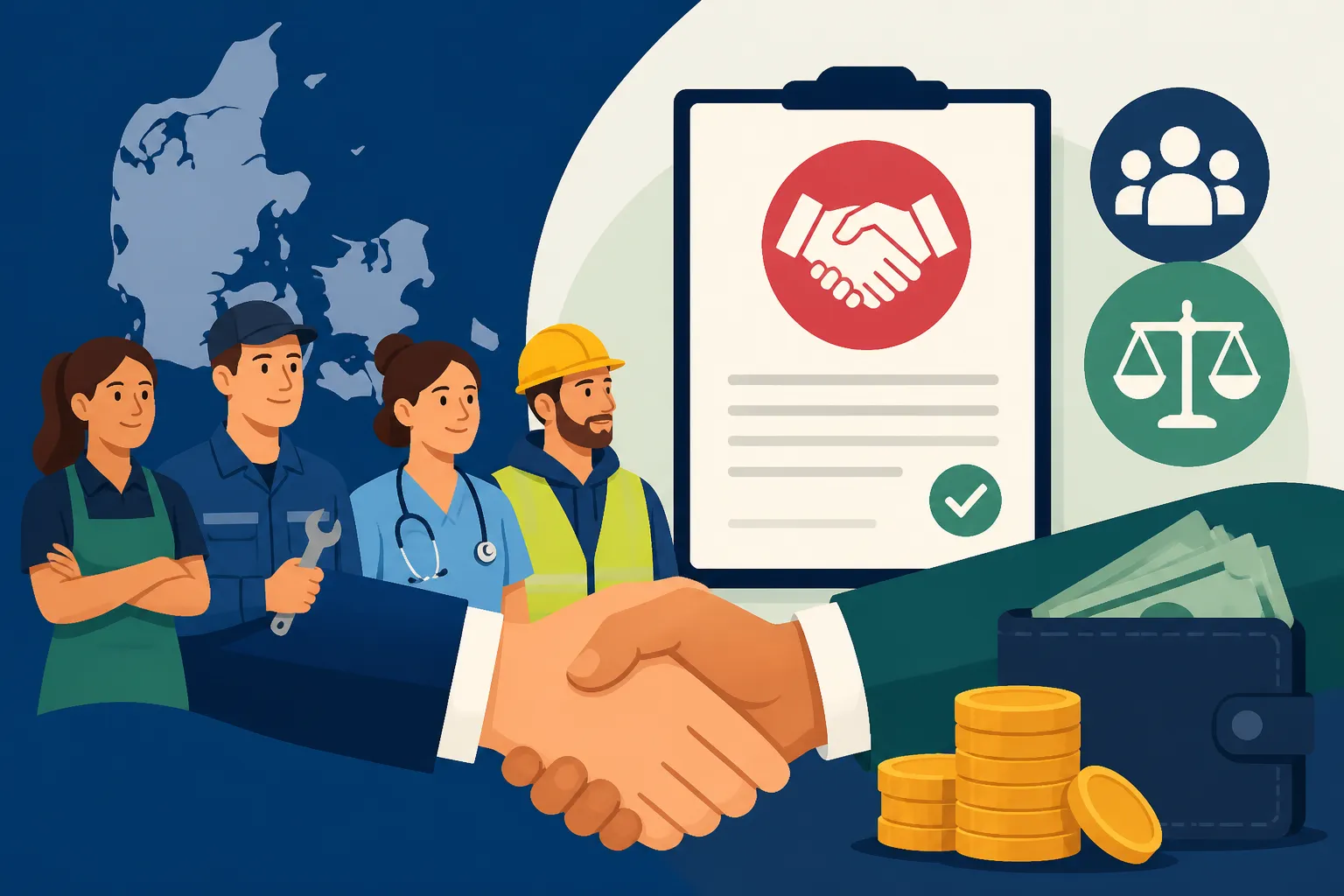
Minimum Wage in Denmark: Collective Agreements (Overenskomst) Explained
Searching for a specific minimum wage figure in Denmark often leads to a confusing silence from official government websites. I remember sitting in a small cafe in Aarhus during my first month here, scouring the internet for a "legal floor" to ensure my first contract wasn't a total ripoff, only to find absolutely nothing. This guide finally demystifies how pay is actually calculated in Denmark through the unique system of collective agreements, or Overenskomst.
The Great Myth of the Statutory Minimum Wage
When you first arrive in Denmark, one of the biggest shocks is realizing there is no national minimum wage law. Unlike the United States, the UK, or Germany, the Danish Parliament does not set a floor for what an employer must pay you. If you go looking for a "Minimum Wage Act," you will come up empty-handed. This is not an oversight; it is the foundational pillar of the Danish labor market.
Why Denmark Does Not Have a National Minimum Wage
The absence of a legal minimum wage is a deliberate choice intended to keep the government out of the relationship between workers and employers. Instead, wages are determined by the "Danish Model," where the two sides of industry—unions and employer associations—negotiate the terms of employment without political interference. For an expat, this can feel incredibly precarious. We are used to having a law to fall back on. However, the Danish system relies on the power of the collective.
In my experience, this lack of a legal floor actually leads to higher wages than in countries with statutory minimums. Because unions are strong, they negotiate hourly rates that usually far exceed the minimums found in neighboring countries. The catch, of course, is that you have to be working in a sector or for a company that is covered by these agreements. If you aren't, your salary is purely a matter of individual negotiation, which is where many foreigners get into trouble.
The Role of Trade Unions and Employer Associations
The Danish labor market is a high-stakes dance between two giants. On one side, you have trade unions like 3F (for hospitality and construction), HK (for retail and office work), and IDA (for engineers). On the other side, you have employer associations like Dansk Industri (DI) or Dansk Erhverv. Every few years, these groups sit in a room and hash out an Overenskomst.
This agreement covers everything: hourly rates, overtime pay, pension contributions, and even how much extra you get for working on a Sunday or a holiday. When you sign a contract, you should look for a clause stating that the employment is governed by a specific Overenskomst. If that clause is there, you are protected by a "minimum wage" that is effectively higher than almost anywhere else in the world. Understanding Trade Unions and A-Kasse: Why Every Expat Must Understand Them is the first step in realizing how your pay is protected in this decentralized system.
Understanding the Danish Flexicurity Model
You will often hear the term "Flexicurity" tossed around in Danish offices. It is a portmanteau of flexibility and security. For employers, it means it is relatively easy to hire and fire people compared to southern Europe. For you, the worker, it means that while your job security might feel lower on paper, your social security and wage protection are incredibly high.
The trade-off for the employer’s right to fire is the high level of unemployment benefits and the wage floors set by collective agreements. This model only works because of the high trust in the system. As a foreigner, it is vital to understand The Danish Flexicurity Model: How Hiring and Firing Actually Works because it dictates the rhythm of your professional life here. You aren't protected by a minimum wage law, but you are protected by a social contract that ensures you aren't exploited—provided you know where to look.
Decoding the Overenskomst Agreements
The word "Overenskomst" will become one of the most important Danish words in your vocabulary. It is the invisible safety net that ensures the barista in Copenhagen can afford rent and the construction worker in Odense gets a fair pension. But how does it actually function on a day-to-day basis?
What is a Collective Agreement Exactly
An Overenskomst is a massive document—sometimes hundreds of pages—that serves as the master template for employment in a specific sector. It isn't just about the base pay. It includes "tillæg" (supplements) for everything imaginable. For example, if you work in a restaurant, the agreement might state a base pay of 130 DKK per hour, but it will also mandate an extra 25 DKK per hour after 6:00 PM and a 100% bonus for working on Christmas Day.
These agreements also mandate the "Arbejdsmarkedspension" (labor market pension). In many Danish jobs, the employer pays an additional 8-10% of your salary into a pension fund, while you contribute about 4%. This is over and above your base salary. When I first started working here, I didn't realize this was part of the "minimum" package. I just looked at the hourly rate. It wasn't until I understood Danish Work Contracts: Permanent vs. Fixed-Term and Essential Clauses that I realized I was actually earning much more than the sticker price.
How to Find Out if Your Workplace is Covered
Not every company in Denmark is part of a collective agreement. While about 80% of the workforce is covered, many startups, small boutiques, and international tech firms opt out. They prefer "individuel forhandling" (individual negotiation). This is where the "minimum wage" disappears entirely. If you are a delivery rider or working for a brand-new startup, you might find yourself in a "gray zone" where the pay is lower than the industry standard.
To check if you are covered, you can simply ask during the interview: "Er virksomheden dækket af en overenskomst?" (Is the company covered by a collective agreement?). You can also check the website of the relevant union. If the answer is no, you need to be much more aggressive in your negotiations. You should use the union’s published wage statistics as your "manual" minimum wage. If you find the language barrier is making these inquiries difficult, using a service like iTalki to practice professional Danish inquiries can be a lifesaver.
Sector-Specific Pay Scales
The "minimum" varies wildly depending on what you do. A cleaner covered by a 3F agreement has a different floor than a retail worker covered by HK. Because there is no single number, the market relies on these benchmarks to keep things fair. If a company tries to pay you 100 DKK per hour in a sector where the Overenskomst says 135 DKK, they aren't technically breaking a national law, but they are "social dumping"—a major taboo in Denmark.
| Sector | Estimated "Minimum" Hourly Rate (2026) | Common Overenskomst |
|---|---|---|
| Hospitality (Waiter/Bar) | 130 – 145 DKK | 3F / HORESTA |
| Retail (Shop Assistant) | 125 – 140 DKK | HK Handel |
| Cleaning Services | 135 – 150 DKK | 3F Private Service |
| Construction (Unskilled) | 155 – 170 DKK | 3F Byggegruppen |
| Office / Administration | 145 – 160 DKK | HK Privat |
Note: These are estimates based on standard agreements; actual rates depend on specific years of experience and location.
Hidden Realities of Your Danish Paycheck
Once you have secured a wage that feels fair, the next hurdle is the "netto" reality. The number on your contract is never the number that hits your bank account. In Denmark, the gap between "brutto" (gross) and "netto" (net) is significant, and for an expat, it can be a source of major stress.
AM-bidrag and A-Skat Explained
Every single person working in Denmark pays the 8% AM-bidrag (Labor Market Contribution). This is taken off the top before any other deductions. Then comes the A-Skat (income tax). Depending on your municipality and your earnings, your effective tax rate could be anywhere from 36% to 52%. This is why a "high" hourly wage of 150 DKK might feel surprisingly tight at the end of the month.
I learned the hard way that you must keep your "Forskudsopgørelse" (preliminary tax assessment) updated. If you don't, the state might default you to a 55% tax rate just to be safe. It’s a terrifying experience to open your first payslip and see half of it gone. To avoid this, you should dive deep into Taxes in Denmark Explained: A-Skat, AM-bidrag, and Marginal Rates as soon as you get your CPR number. For more complex situations, especially if you have assets or income in your home country, seeking professional advice from Taxes for Expats is highly recommended.
Understanding Your Danish Payslip (Lønseddel)
A Danish payslip looks like a mathematical puzzle. It includes your base pay, your holiday pay (feriepenge), your pension, and various tax deductions (fradrag). The "fradrag" is your best friend—it’s the portion of your income that is tax-free. You get a deduction for working, a deduction for commuting, and even a deduction for paying into a union.
Understanding Your Danish Payslip (Lønseddel): Deductions Decoded is essential to ensure your employer is actually following the Overenskomst. If your payslip doesn't show a pension contribution and you know you're in a covered sector, something is wrong. I spent hours my first year comparing my slips to my colleagues' just to make sure I wasn't being shortchanged because of my expat status.
The Role of Holiday Pay (Feriepenge)
In Denmark, you don't just get paid for the hours you work; you also accrue 12.5% of your salary as holiday pay. This is mandated by the Holiday Act, regardless of whether you have a collective agreement or not. This money is saved up and paid out when you actually take your vacation.
For many expats, this feels like a hidden "savings account" that they can't access. It can make your monthly take-home pay feel lower than it should be. However, when you finally take that three-week break in July, you’ll be grateful for the FerieKonto system. It’s a vital part of the Danish "minimum" compensation package that ensures even the lowest-paid workers can afford a proper holiday.
Protecting Your Rights and Negotiating Your Salary
Since there is no government inspector checking every small business for a minimum wage, the responsibility for enforcement falls on you and your union. This is a very "Danish" way of doing things—proactive and communal.
Joining a Trade Union as an Expat
In your home country, unions might be seen as political or only for manual laborers. In Denmark, they are for everyone, from the CEO to the dishwasher. If you are being underpaid according to the Overenskomst, the government will not help you. You must go to your union. They have the legal right to take the employer to a labor court to claw back your missing wages.
I cannot stress enough how important it is to join a union as a foreign worker. We are statistically more likely to be underpaid or exploited because we don't know the rules. Being a member gives you access to lawyers who specialize in these collective agreements. You should check Understanding the A-Kasse (Unemployment Insurance Fund) System as well, as these two often go hand-in-hand to provide both wage protection and a safety net if you lose your job.
How to Handle Underpayment and Disputes
If you suspect your hourly rate is below the industry standard, the first step is to talk to your The Role of Tillidsrepræsentant (Union Representative) in Your Office. Every workplace with a collective agreement usually has a "Tillidsmand"—a colleague elected to represent the workers' interests. They are the bridge between you and management.
They can tell you exactly which agreement applies to you and if your "tillæg" (bonuses) are being calculated correctly. If you don't have one at your office, call your union headquarters. Do not try to fight this alone as a newcomer. The system is designed for collective action, not individual combat. When I had a dispute over overtime pay at a previous job, it was my union rep who handled the uncomfortable meetings while I just focused on doing my job.
Negotiating Beyond the Base Salary
If you find yourself in a sector without an Overenskomst—common in tech and high-level consulting—you are in the "Wild West." Here, your minimum wage is whatever you are brave enough to ask for. In Danish culture, we value modesty (Janteloven), but the workplace is an exception. You are expected to know your market value.
When negotiating, don't just focus on the DKK per hour. Ask about the "6th holiday week" (feriefridage), free lunch (kantineordning), and internet allowance. These are standard "soft" benefits in Denmark that can add thousands of kroner in value to a contract that might otherwise look average. For a deeper dive into these tactics, read Negotiating Salary in Denmark: Why Pension Matches Matter More Than Cash. If you feel your Danish isn't quite ready for a high-stakes negotiation, a few sessions on iTalki focusing on "business negotiation" can give you the linguistic confidence to stand your ground.
Navigating the Cultural Nuances of Danish Work Life
Understanding the "minimum wage" is as much about culture as it is about numbers. The way Danes talk about money—or don't talk about it—can be a minefield for the uninitiated.
Flat Hierarchies and Wage Transparency
Denmark has one of the lowest levels of wage inequality in the world. This is by design. The gap between the lowest-paid worker and the highest-paid manager is much smaller than in the US or Asia. This creates a culture of Danish Work Culture: Flat Hierarchies, Hygge, and Direct Communication where you can often guess what your colleagues are making just by looking at the collective agreement.
While it's still a bit taboo to ask someone "What is your exact salary?", it is perfectly normal to ask, "Which pay scale (løntrin) are you on?". This transparency is your greatest tool. It prevents the "expat discount" where foreigners are paid less than Danes for the same work. Use this cultural openness to your advantage to ensure you are meeting the local standard.
The Impact of Language on Your Earning Potential
While many jobs in Copenhagen and Aarhus are English-speaking, your "minimum" ceiling is often dictated by your Danish skills. In many collective agreements, there are specific roles or "responsibility levels" that you simply cannot reach without a functional level of Danish.
If you find yourself stuck at the entry-level "minimum" pay, the best investment you can make isn't a new degree, but a language course. Improving your Danish opens up the higher "løntrin" (pay steps) in the collective agreements. Even if your daily work is in English, being able to chat in the "Fredagsbar" or understand the nuances of a union meeting can significantly boost your professional standing. Practicing with a tutor on iTalki can help you bridge that gap between "basic survival Danish" and "professional bargaining Danish."
Final Steps for a Secure Start
Before you sign that contract, take a breath. Check for the Overenskomst. Calculate your after-tax income using local tools. And most importantly, join a union. The Danish system is incredibly rewarding, but it requires you to be an active participant. There is no government nanny watching your paycheck; there is only you, your colleagues, and the collective strength of the Danish Model.
Disclaimer
The information provided in this guide is for informational purposes only and does not constitute legal or financial advice. While we strive to keep our data current, the Danish labor market and collective agreements are subject to frequent negotiations and changes. Always consult with a professional legal advisor, your trade union, or the Danish authorities (SIRI or the Ministry of Employment) before making decisions regarding employment contracts or tax liabilities. Underpayment disputes should always be handled through official union channels or legal counsel.