How to Invoice Domestic Clients Legally with a Danish CVR Number
Ah, the wonderful world of invoicing in Denmark! If you’ve just started your freelance gig or launched your own little business here, you've probably quickly realized that while the Danes love their digital efficiency, they also have a very specific way of doing things, especially when it comes to financial paperwork. It’s easy to feel lost in a sea of new rules and unfamiliar terminology when all you want to do is get paid for your hard work. This guide is here to untangle the complexities of invoicing domestic clients legally with your shiny new Danish CVR number, making sure you stay on the right side of SKAT (the Danish tax authority) and your clients.
Demystifying the CVR and Its Role in Your Danish Business
Before you even think about sending out that first invoice, understanding what your CVR number truly represents is absolutely fundamental to operating a legal business here. It’s more than just a registration number; it's your business's identity in the Danish system.
What Exactly is a CVR Number?
The CVR number, short for Central Virksomhedsregister (Central Business Register), is a unique eight-digit identification number assigned to every legally registered business entity in Denmark. Think of it as your business’s social security number. It's issued by the Danish Business Authority (Erhvervsstyrelsen) when you register your company, whether you're a sole proprietor (enkeltmandsvirksomhed), a limited company (ApS), or any other official business type. This number is publicly accessible via the CVR website, allowing anyone to look up basic information about your business, like your company name, address, and legal status.
For many expats, setting up as an enkeltmandsvirksomhed is the most common first step. This structure is relatively simple to establish and allows you to conduct business under your own name, with your CVR number linked directly to you as an individual. However, it's crucial to understand that even as a sole proprietor, your business finances are considered separate from your personal income for tax reporting, even if legally you and the business are the same entity. This distinction is vital for proper invoicing and accounting later on. If you're just starting, getting your head around Freelancing and CVR Registration: Setting Up a Business in Denmark can be incredibly helpful to lay the groundwork.
When You Must Have a CVR for Invoicing
This is where many new business owners, especially those coming from countries with less stringent reporting, can get tripped up. In Denmark, if you're providing services or selling goods that constitute a business activity, you generally need a CVR number to invoice. This is particularly true when you are invoicing other businesses (B2B). When your client is a registered Danish business, they will expect your CVR number to be prominently displayed on your invoice. This isn't just a formality; it's necessary for their own accounting and VAT (MOMS) deductions.
The critical threshold to be aware of is turnover. If your business expects to have a taxable turnover (salg) of more than DKK 50,000 within a 12-month period, you are legally required to register for VAT (MOMS) and, by extension, get a CVR number if you don't already have one. Even if you don't hit this threshold, you might choose to register for a CVR and MOMS voluntarily. Why would you do that? Because it allows you to deduct VAT on your business expenses, which can be a significant saving, especially if you have high startup costs. If you’re unsure, getting some initial advice from a firm like Taxes for Expats can really clarify your obligations based on your specific business model.
If you don't have a CVR and are providing services, you're likely operating under what's called 'B-income' (B-indkomst). While perfectly legal for certain types of income (like hobby activities, ad-hoc small jobs for private individuals, or board member fees), it doesn't involve issuing formal invoices with a CVR and MOMS. Instead, the payer usually reports your income to SKAT, or you report it yourself on your tax return. However, once you start invoicing other businesses regularly or your income grows, moving from B-income to a CVR-registered business is usually the necessary and most compliant step. You'll find a lot more detail on this in B-Income (B-indkomst) vs. A-Income (A-indkomst) for Side Hustles.
Understanding the Difference: B-income vs. Operating a CVR-Registered Business
Let's expand on this a bit, as it's a common area of confusion.
B-income (B-indkomst): This refers to income you receive where no tax (A-skat) or labour market contribution (AM-bidrag) has been deducted by the payer. It's essentially income from activities that are not part of a formal employment relationship, and for which you typically don't have a CVR number. Examples include:
- Small, one-off jobs for private individuals.
- Certain freelance assignments that are very irregular and low volume.
- Royalties or fees from specific agreements.
If you receive B-income, you are responsible for declaring this income to SKAT yourself via your forskudsopgørelse (preliminary tax assessment) or årsopgørelse (annual tax assessment). You won't issue a "CVR invoice" in these scenarios. Instead, you might send a simple bill or agreement, but it won't have your CVR or MOMS. The key here is that it's typically for non-VAT registered activities and often for clients who are private individuals, not businesses.
Operating a CVR-Registered Business: This implies a more formalized and continuous commercial activity. When you have a CVR number, you are expected to:
- Issue proper invoices that include your CVR number.
- If you're VAT-registered (and you will be if your turnover exceeds DKK 50,000 or you voluntarily registered), you must charge MOMS on your taxable sales and submit regular MOMS returns to SKAT.
- Keep meticulous business records.
- Manage your business income and expenses separately from your personal finances.
Choosing between managing B-income or registering for a CVR depends entirely on the nature and scale of your work. If you're serious about freelancing or building a client base, especially with other businesses, obtaining a CVR is almost always the way to go. It projects professionalism and simplifies tax handling for your business clients. For a deeper dive into the overall tax landscape, Taxes in Denmark Explained: A-Skat, AM-bidrag, and Marginal Rates is an essential read.
Crafting the Perfect Danish Invoice: Legal Requirements and Best Practices
Once you have your CVR number and understand your obligations, the next step is to create invoices that are legally sound and professionally presented. Danish invoices aren't just pieces of paper; they are legal documents that form the basis of your income reporting, your client's expense deductions, and your VAT calculations.
The Mandatory Elements for SKAT
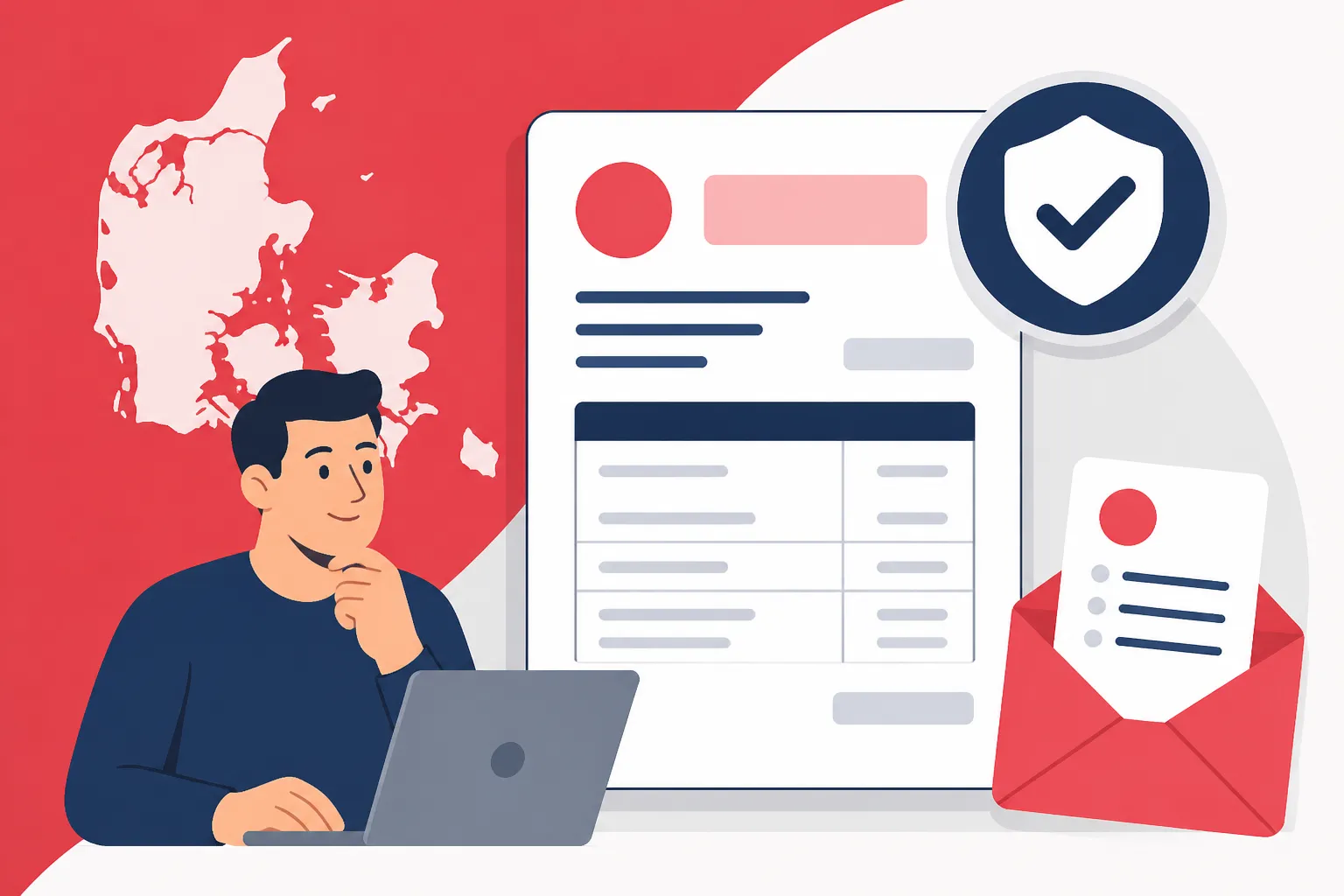
SKAT is very clear about what needs to be on an invoice. Missing even one key piece of information can cause headaches for both you and your client. Here’s a detailed breakdown of the mandatory fields:
- Unique Invoice Number (Fakturanummer): Every invoice you issue must have a unique, sequential number. This is crucial for your own bookkeeping and for SKAT's auditing purposes. It usually starts at 1 and goes up from there, or incorporates a date (e.g., 2026-001).
- Date of Issue (Fakturadato): The date the invoice was created and sent.
- Your Company's Legal Name and Address: This should be the exact name and address under which your CVR is registered.
- Your CVR Number: As discussed, this is non-negotiable for CVR-registered businesses. It should be clearly visible.
- Your Client's Legal Name and Address: If your client is a business, include their official company name and registered address.
- Your Client's CVR Number (if applicable): If you're invoicing another Danish business, their CVR number is usually also included. While not strictly mandatory for your invoice, it's good practice and often expected.
- Description of Goods/Services Provided (Varebeskrivelse/Ydelse): This needs to be clear and specific enough for anyone (including SKAT) to understand exactly what was provided. Avoid vague terms. For example, instead of "Consulting," write "Marketing Strategy Consultation (3 hours)" or "Website Development (Phase 1, specific features)."
- Quantity and Unit Price: If applicable, clearly state how much of a product was sold or how many hours of a service were rendered, along with the price per unit.
- Total Amount Excluding VAT (Nettobeløb): The subtotal before MOMS is added.
- VAT Amount (Momsbeløb): The exact amount of MOMS charged.
- VAT Rate (Momssats): Clearly state the percentage, which for most goods and services in Denmark is 25%. If you provide different services with different VAT rates, you need to show them separately.
- Total Amount Including VAT (Totalbeløb): The final amount your client needs to pay.
- Payment Due Date (Betalingsdato/Forfaldsdato): Clearly specify when the payment is expected. Standard terms are often 8, 14, or 30 days.
- Your Bank Account Details (Bankoplysninger): Include your NemKonto details, typically the registration number (reg.nr) and account number (kontonr). Remember that for your business income, this should ideally be linked to a business bank account, although for sole proprietorships, a personal NemKonto can be used if it's the account registered for your business income. Learn more about Getting a NemKonto for Your Business (Erhvervskonto) for proper setup.
Here’s a table summarizing the invoice elements:
| Category | Mandatory Elements for a Danish Invoice | Notes |
|---|---|---|
| Header Info | Unique Invoice Number (Fakturanummer) | Sequential and unique for each invoice. |
| Date of Issue (Fakturadato) | Date the invoice is created. | |
| Your Details | Your Company's Legal Name | As registered with the CVR. |
| Your Company's Address | Registered address. | |
| Your CVR Number | Essential for all CVR-registered businesses. | |
| Client Details | Client's Legal Name | Full legal name of the individual or company. |
| Client's Address | Full address. | |
| Client's CVR Number (for B2B) | Good practice to include for business clients. | |
| Service/Goods | Clear Description of Goods/Services (Varebeskrivelse/Ydelse) | Specific and unambiguous. |
| Quantity/Hours & Unit Price (if applicable) | Details on how the total was calculated. | |
| Financials | Total Amount Excluding VAT (Nettobeløb) | Subtotal before tax. |
| VAT Amount (Momsbeløb) | The precise amount of VAT charged. | |
| VAT Rate (Momssats) | Typically 25% in Denmark. Must be stated clearly. | |
| Total Amount Including VAT (Totalbeløb) | The final amount due. | |
| Payment Terms | Payment Due Date (Betalingsdato/Forfaldsdato) | Clear deadline for payment. |
| Your Bank Account Details (Bankoplysninger: Reg.nr & Kontonr) | Where the client should transfer the money. | |
| Optional Info | Payment Reference (Referencenummer) | Helps identify the payment. |
| Your Logo | Professional touch. | |
| Contact Person (for both your company and client, if applicable) | Useful for larger organizations. | |
| Any special terms, conditions, or references to a prior agreement | For clarity and legal protection. |
Navigating VAT (MOMS) for Domestic Clients
VAT, or Moms in Danish (Meromsætningsafgift), is a consumption tax that applies to most goods and services in Denmark. As mentioned, if your taxable turnover exceeds DKK 50,000 within a 12-month period, you are legally obligated to register for MOMS. Once registered, you must charge MOMS on most of your domestic sales.
The standard MOMS rate in Denmark is a hefty 25%. This means if you charge a client DKK 1,000 for a service, you must add DKK 250 in MOMS, making the total DKK 1,250. You then collect this DKK 250 from your client and periodically remit it to SKAT. The good news is that you can also reclaim MOMS on your business expenses, offsetting what you owe. This is why keeping impeccable records of both your sales and purchases is critical.
If your annual turnover is below the DKK 50,000 threshold, you are generally not required to register for MOMS. In this case, you do not charge MOMS on your invoices, and you cannot reclaim MOMS on your expenses. Your invoices should clearly state that you are not MOMS-registered and therefore not charging MOMS. This is important to avoid confusion and ensure your clients understand why no MOMS is added. Many freelancers start below this threshold, and it's perfectly fine. Just make sure you track your income carefully. Freelancer Taxes: Moms (VAT) Registration and B-Income Deadlines provides an excellent overview of these specific tax deadlines and requirements.
Choosing Clear Payment Terms and Methods
Beyond the mandatory information, think about the practicalities of getting paid.
- Payment Terms: Clearly stating your payment terms (e.g., "Payment due 14 days net," or "Betalingsfrist 14 dage") is essential. Be realistic. For larger projects, you might consider requesting a partial upfront payment. If payments are consistently late, you have the right to charge interest (renter) after the due date, though it's usually best to establish this in your initial agreement.
- Payment Methods: Bank transfer (bankoverførsel) is the most common method for business payments in Denmark. Ensure your NemKonto details (reg.nr and kontonr) are clearly visible. For smaller amounts or very quick payments, some businesses (and many private individuals) might use MobilePay, but for formal B2B invoices, bank transfer is the standard. If you want to know more about the cashless nature of Denmark, check out MobilePay and Cashless Denmark: Surviving Without Physical Cash. You can also specify an optional payment reference (f.eks. "Att: [Client Contact Name]" or a project number) to help your client categorize your payment.
Remember, clear communication around these points from the start can prevent misunderstandings and improve your cash flow.
Beyond the Invoice: Compliance, Record-Keeping, and Common Pitfalls
Issuing a legal invoice is a significant step, but it's part of a larger ecosystem of compliance and financial management in Denmark. Don't let your guard down once the invoice is out!
Why Meticulous Record-Keeping Isn't Optional
SKAT has a strong focus on accurate bookkeeping. As a CVR-registered business, you are legally obliged to keep meticulous records of all your invoices issued, expenses, and bank statements for at least five years from the end of the financial year they relate to. This means:
- Copies of all sales invoices: Keep digital copies (PDFs) of every invoice you send out.
- Receipts for all business expenses: Scan and save all your receipts, whether for office supplies, software subscriptions, travel, or professional development. These are crucial for reclaiming MOMS and for deducting expenses from your taxable income.
- Bank statements: Regularly reconcile your bank statements with your invoices and expenses.
Many expats find that using accounting software makes this process much smoother. Programs like Dinero or Billy are popular in Denmark and often have English language options. They automate invoice generation, help with MOMS calculations, and simplify annual reporting. Investing in good software early on can save you immense stress, time, and potential fines down the line. It's not just about compliance; it's about having a clear overview of your business's financial health. When tax season rolls around, having everything neatly categorized will be a lifesaver, especially when it's time to do your Annual Tax Assessment Notice (Årsopgørelse): Claiming Deductions.
Dealing with Different Client Types: Businesses versus Individuals
The client you are invoicing also influences some aspects of your process:
- Invoicing Other Danish Businesses (B2B): As detailed above, this is where all the mandatory CVR and MOMS information is paramount. Your business clients rely on your compliant invoice for their own record-keeping and MOMS deductions. Accuracy here is key to maintaining good client relationships.
- Invoicing Private Individuals (B2C): If you're a CVR-registered business and selling to a private individual within Denmark, you still issue a formal invoice with your CVR number and MOMS (if you are MOMS-registered). The main difference is that the client's CVR number is obviously not applicable. The invoice still needs to be fully compliant for your records, even if the private client doesn't need it for MOMS reclamation. However, sometimes for very small, infrequent jobs for private individuals, especially if you are not MOMS-registered, you might simply issue a less formal bill, or receive B-income payment without a formal invoice. Always make sure you understand your specific obligations.
Seeking Professional Assistance for Your Danish Tax Obligations
Let’s be honest, navigating the Danish tax system can feel like learning a new language, even for Danes! For expats, it’s even tougher, especially with language barriers and different cultural approaches to finance. This is where professional help becomes invaluable.
Consider engaging with an accountant (revisor) who specializes in small businesses or freelancers, particularly those with international clients or expat owners. They can help with:
- Ensuring your invoices are fully compliant.
- Managing your MOMS returns correctly.
- Advising on deductible expenses.
- Preparing your annual tax return (årsopgørelse).
- Offering strategic advice on your business structure and tax optimization.
While there's a cost involved, the peace of mind and the potential savings from correct deductions and avoiding penalties often make it well worth the investment. You might find it useful to check out Finding an English-Speaking Accountant (Revisor) for Your ApS to get started on that search.
Another practical tip for smoothing client communication, especially if you deal with smaller local businesses or individuals, is to make an effort to understand some basic Danish business terms. Even if you conduct your main business in English, showing you're making an effort goes a long way. Services like iTalki can be fantastic for picking up specific vocabulary related to finance or your industry, helping you feel more confident in client interactions or even just understanding official correspondence from SKAT. While Denmark is very English-proficient, a little Danish can open more doors and reduce potential misunderstandings.
Ultimately, invoicing legally with a Danish CVR number isn't just about ticking boxes; it's about establishing trust, ensuring fair payment, and building a sustainable business here in Denmark. It might seem daunting at first, but with clear processes, good record-keeping, and knowing when to ask for help, you'll be sending out those compliant invoices like a seasoned Dane in no time!
Disclaimer
The information provided in this article is for general guidance only and does not constitute professional financial, accounting, or legal advice. While we strive to keep the information up-to-date and accurate, regulations and laws in Denmark are subject to change. Always consult with a qualified professional, such as an accountant or legal advisor, for advice tailored to your specific situation.