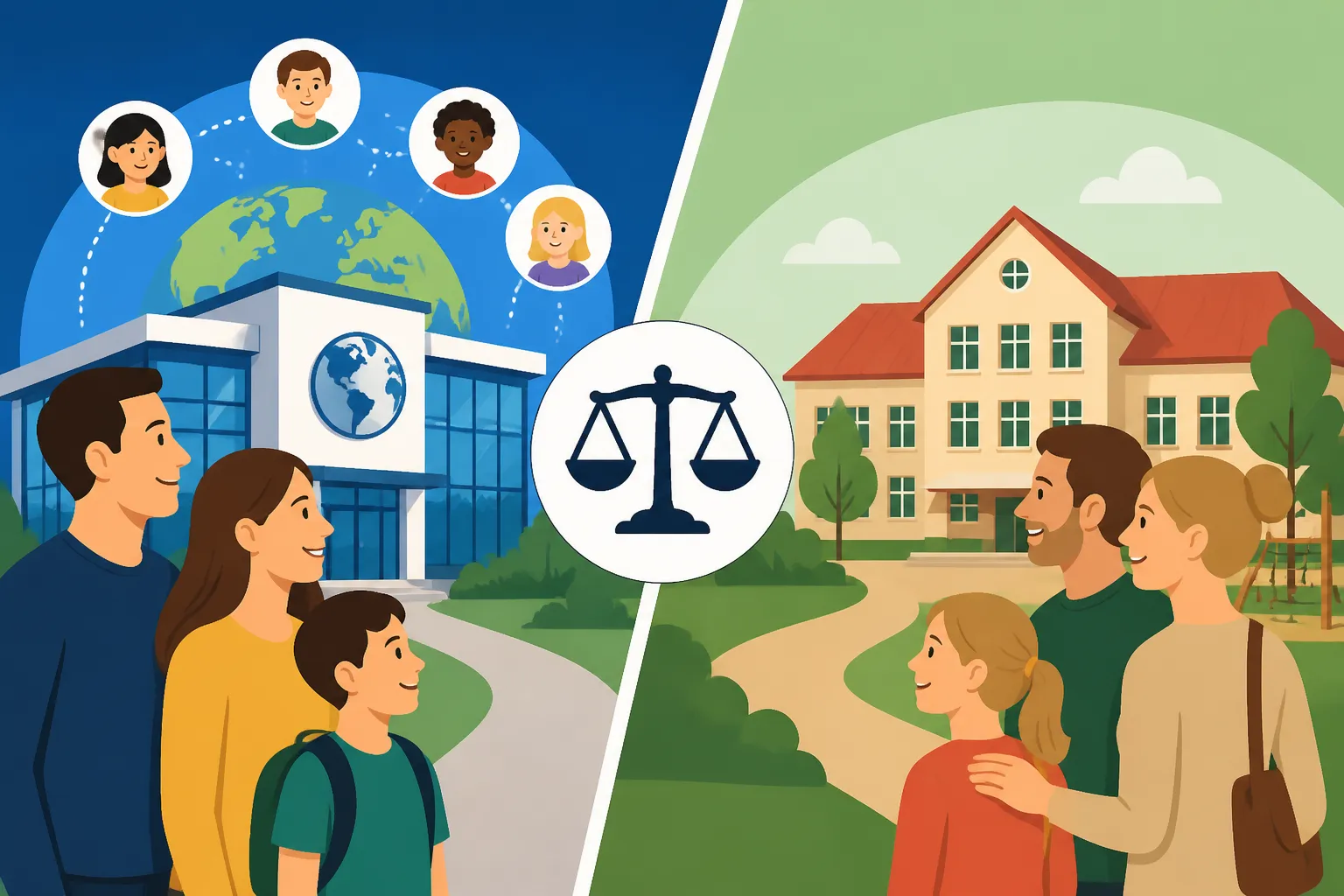
Finding International Schools vs. Public Danish Folkeskole
Alright, let's talk about one of the biggest head-scratchers for expat families moving to Denmark: where on earth do you send your kids to school? It's a decision loaded with anxiety, cultural differences, and, let's be honest, often a hefty price tag. You're trying to figure out if your child will thrive learning Danish from scratch in a public school or if an international school, with its familiar curriculum, is the safer (and pricier) bet. This guide is here to walk you through the nuances of both the Danish folkeskole system and the international school landscape, helping you make an informed choice that feels right for your family's unique journey in Denmark.
The Initial Education Shock: Understanding Your Options
When you first arrive in Denmark, perhaps still reeling from the chaos of Renting in Denmark: Complete Guide for Expats (2027) or trying to sort out your The CPR Registration Rule: Why Your Address Matters, the education system can feel like yet another complex puzzle. You’re likely coming from a country with a very different approach to schooling, and the Danish way can take some getting used to. It’s not just about language; it’s about philosophy, structure, and expectations.
The Danish Education Philosophy: What to Expect
The core of the Danish public school system, known as the folkeskole, is built on principles of equality, holistic development, and social cohesion. Unlike many systems that prioritize early academic pressure and standardized testing, the folkeskole focuses heavily on well-being, collaborative learning, and fostering democratic values from a young age. Children are encouraged to be independent thinkers, engage in group projects, and develop strong social skills. This means you might find less emphasis on rote memorization, formal exams in earlier grades, and grades might not be given until much later than you're accustomed to. The idea is to reduce stress and allow children to develop at their own pace.
This can be a significant contrast to what you might find in many international schools. These institutions often follow curricula from specific countries (like the British, American, or German systems) or the globally recognized International Baccalaureate (IB) program. Their primary aim is usually academic rigor, preparing students for university entrance worldwide, and maintaining a consistent educational journey for highly mobile expat families. While they certainly foster a sense of community, the underlying pedagogical approach often leans more towards traditional academic achievement and individual performance compared to the folkeskole's broader, more integrated approach to development. It's a fundamental difference that will shape your child's daily experience.
Early Childhood Education: Vuggestue and Børnehave Basics
Before formal schooling even begins, it’s worth understanding the Danish approach to early childhood education, which sets the stage for the folkeskole. Most Danish children attend vuggestue (crèche) from around 9-12 months until they are about three years old, and then move on to børnehave (kindergarten) until they start 0. klasse (kindergarten/reception year) at age six. These aren't just babysitting services; they are deeply integrated into the welfare state and are designed to promote social, emotional, and physical development through play. Academic learning in a formal sense is largely absent.
The emphasis in vuggestue and børnehave is on outdoor play, creativity, independence (like dressing themselves, helping to set tables), and learning to be part of a group. You won't find children doing worksheets or learning to read at three years old. Instead, they're building friendships, exploring nature, resolving conflicts, and developing motor skills. This play-based learning approach continues into 0. klasse in the folkeskole, where children spend significant time integrating socially before more formal lessons begin in 1. klasse. If you're coming from a country where early academics are pushed, this can feel like a dramatic shift, but it’s a deliberate cultural choice here, focused on creating well-rounded, resilient individuals. For more on this, check out our guide on Childcare in Denmark: Vuggestue (Crèche) and Børnehave (Kindergarten).
Diving Deep into the Danish Folkeskole System
Choosing the folkeskole is often seen as the ultimate integration step for expat families. It's a deeply ingrained part of Danish society, offering a direct pathway into the language and culture. But it also comes with its own set of challenges and unique features that are essential to understand.
Structure and Curriculum of the Folkeskole
The folkeskole encompasses ten years of compulsory education, from 0. klasse (kindergarten year, typically for 6-year-olds) to 9. klasse. Some schools offer an optional 10. klasse, which can be beneficial for students who need extra preparation before moving on to youth education (like gymnasium – high school – or vocational schools). The curriculum is broad, covering traditional subjects like Danish, mathematics, English (starting early, often 1st or 2nd grade), history, science, and physical education. However, it also includes subjects like Christian studies (often taught from a cultural rather than religious perspective), cooking, crafts, and music, emphasizing a well-rounded education.
A hallmark of the folkeskole is project-based learning and group work. Students are often tasked with collaborative projects, encouraging teamwork and problem-solving. Teachers act more as facilitators, guiding students rather than lecturing extensively. The learning environment is generally informal, with a strong focus on dialogue between students and teachers. There's also a significant emphasis on extracurricular activities and after-school programs, known as SFO (Skolefritidsordning), which provide a safe and stimulating environment for children outside of school hours. These programs are seen as an extension of the school's social mission, further embedding children in local community life.
Advantages and Disadvantages of Folkeskole for Expat Children
For many expat families, the folkeskole offers compelling advantages. The most significant, of course, is that it's free. This immediately removes a massive financial burden compared to international schools. More importantly, it provides unparalleled immersion in Danish language and culture. Younger children, especially those under 10, often pick up Danish surprisingly quickly, becoming fluent within a year or two. This fluency is a golden ticket for long-term integration, enabling them to make local friends, understand Danish humor, and navigate daily life with ease. It's also an excellent way for the whole family to connect with the local community, from school events to parent-teacher conferences.
However, the folkeskole path isn't without its hurdles. The language barrier is often the biggest initial challenge. While younger children adapt, older children (especially those 10+) might find the transition significantly more difficult and emotionally taxing. They might feel isolated initially, struggling to understand lessons and make friends. The different teaching methods can also be a shock. If your child thrives on structured, exam-focused learning, the Danish emphasis on group work and less formal assessment might feel less academically rigorous or even confusing. Parental involvement in curriculum choices is also far less common than in some other systems, as the national curriculum provides the framework. Furthermore, for children moving frequently between countries, a folkeskole education might not align seamlessly with curricula abroad, potentially complicating future transitions if you plan to leave Denmark.
Navigating Enrollment and Support Systems
Enrolling your child in a folkeskole is generally straightforward once you have your The Yellow Health Card (Sundhedskort): Your Key to Danish Healthcare and your CPR number and have registered your address. Children are automatically assigned to the local public school in their catchment area based on their registered address. The municipality (kommune) is responsible for this process. After you've completed your CPR registration at the Citizen Service Centre (Borgerservice), the municipality will typically contact you regarding school placement, or you can reach out to them directly. It’s a very local system, meaning your home address directly determines your child's school.
For expat children, especially those without prior Danish language skills, municipalities are supposed to provide language support. This often comes in the form of extra Danish lessons within the school or, in some cases, an initial period in a reception class (modtageklasse) specifically for newcomers, though these are more common in larger cities and for older students. However, the quality and availability of this support can vary significantly between municipalities and even between individual schools within the same municipality. It’s crucial to inquire about these support systems when you’re looking at specific schools in your area. The school itself plays a vital role in integrating new students, often assigning a "buddy" or ensuring teachers are aware of the child's language needs. This localized approach underscores why getting your Understanding CPR Registration and Your Healthcare Entitlement sorted and your address registered is such a foundational step for any family considering the folkeskole.
Exploring International School Options in Denmark
For families who anticipate frequent international moves, have children with specific educational needs not met by the folkeskole, or simply prefer an English-speaking environment, international schools offer a compelling alternative. These schools provide a more familiar framework but come with their own set of considerations.
Types of International Schools and Curricula
Denmark hosts a range of international schools, primarily concentrated in the larger cities, each offering different curricula. The most widespread is the International Baccalaureate (IB) program, which offers a continuous educational path from the Primary Years Programme (PYP), through the Middle Years Programme (MYP), to the Diploma Programme (DP) for high school. IB schools are popular for their globally recognized curriculum and focus on developing critical thinking and international-mindedness. Examples include Copenhagen International School (CIS), Aarhus International School, and Rygaards International School.
Beyond the IB, you'll find schools following national curricula from other countries. For instance, there are British schools (e.g., Rygaards has a British section), American schools, and schools offering German or French curricula. These cater specifically to families who intend to return to their home country’s education system or wish to maintain that specific educational tradition. Each type of school typically has its own admissions process, age requirements, and often entrance exams. It's really worth researching the specific curriculum offered by each school to see if it aligns with your family's long-term educational goals and your child's learning style.
Key Considerations: Cost, Location, and Availability
Let's address the elephant in the room first: international schools in Denmark are expensive. We're talking significant annual tuition fees, often ranging from DKK 50,000 to over DKK 150,000 per child, per year. On top of this, you might face application fees, enrollment fees, building fund contributions, and costs for uniforms, field trips, and school meals. These costs can quickly add up, making it a serious financial commitment for many families. Very few scholarships are available, and employer-sponsored education packages are becoming less common, so budget planning is paramount.
Location is another crucial factor. As mentioned, most international schools are located in or very near major cities such as Copenhagen, Aarhus, Odense, Esbjerg, and Ikast. This means your choice of where to live might be heavily influenced by the proximity to your desired school. If you're considering Where to Live in Denmark: Copenhagen, Aarhus, Odense, and Aalborg, keep in mind that living close to these schools can often mean higher housing costs, or at least a longer commute. Finding suitable housing in these areas can also be competitive. When searching for rentals, using platforms like Spotahome, while broad, can give you an idea of available properties in school-friendly neighborhoods, but you'll need to do your homework to confirm the local dynamics. Availability is also a concern; many popular international schools have waiting lists, sometimes extending years, particularly for younger grades. It's highly advisable to apply early, often even before you've finalized your move to Denmark.
Advantages and Disadvantages of International Schools
The advantages of international schools are clear for many expat families. The primary benefit is English-language instruction (or other specific foreign languages), which eliminates the initial language barrier and allows children to transition smoothly into their new environment without academic disruption. They also offer a familiar curriculum, which provides continuity for children who have moved between different countries and makes re-entry into education systems elsewhere relatively seamless. The student body is typically very diverse, exposing children to a wide range of cultures and perspectives, fostering an international mindset. Facilities are often state-of-the-art, and class sizes can sometimes be smaller than in folkeskole.
However, there are significant drawbacks. The most obvious is the prohibitive cost, which can be a barrier for many families. Another key point is the potential for less integration into Danish society. While students learn about Denmark, their daily interactions are primarily with other international students and teachers, often leading to what some refer to as the "expat bubble." This can make it harder for children to learn Danish fluently and fully immerse themselves in local culture, potentially leading to challenges if the family plans a long-term stay in Denmark. For example, if your child hopes to attend a Danish university, they will still need to achieve a high level of Danish proficiency. Finally, due to their limited number, international schools might not be an option if you choose to live outside the major urban centers, further restricting your housing choices.
Making the "Right" Choice: Factors to Weigh
Deciding between a folkeskole and an international school isn't a simple right or wrong answer. It’s a deeply personal decision that hinges on various aspects of your family's situation, future plans, and your child's individual personality.
Age of Your Child and Length of Stay
The age of your child is arguably one of the most critical factors in this decision. Generally, younger children (under 8-10 years old) tend to adapt much more easily to the folkeskole. Their brains are incredibly flexible, and they absorb new languages like sponges. They'll often become functionally fluent within a year, making friends and participating fully in school life. For these younger ones, a folkeskole can be a fantastic route to deep integration and a truly Danish childhood.
For older children (10+ or especially teenagers), the transition to a folkeskole can be significantly more challenging. They face not only a new language but also a new social hierarchy, different teaching methods, and potentially a curriculum gap. Academically, it can be a steep uphill battle to catch up in Danish-taught subjects while simultaneously learning the language. Socially, navigating pre-teen and teenage years in a foreign language can be isolating. If you're only planning a short-term stay (1-3 years) in Denmark, an international school often provides more stability and continuity, particularly for older children, as it allows them to continue in a familiar academic environment and language, easing their eventual transition to the next country. For longer stays, or if you envision permanent residency, the benefits of folkeskole for even older children might outweigh the initial struggle, provided they have strong support at home.
Language, Integration, and Future Plans
Consider your family's overall commitment to integration. Do you want to truly "go native," learn Danish yourselves, and become deeply embedded in Danish society? If so, sending your child to a folkeskole is a powerful statement of that intent and a significant catalyst for your own Social Integration: Making Friends and Understanding Danish Etiquette. Your child will bring Danish home, explain cultural nuances, and open doors to local friendships and networks. This can be an incredibly rewarding experience, but it requires patience and a willingness to embrace the new. Resources like Learning Danish: Sprogcenter, FVU, and the Importance of the Language will become indispensable for both you and your child.
Conversely, if your family's trajectory involves moving to another country in a few years, or if you foresee your children attending university in a non-Danish speaking country, an international curriculum might offer more consistent academic preparation. A Danish folkeskole education, while excellent, is geared towards the Danish education system and its pathways to higher education. While most subjects will have English equivalents, the specific ways subjects are taught and assessed might not perfectly align with university entrance requirements in, say, the US or UK. Weighing these long-term academic and life goals is crucial.
Financial Implications and Commuting
The financial difference between the two options is stark. Choosing the folkeskole frees up a substantial amount of money that can be used for other family needs, travel, or savings. International school tuition is a major expenditure, akin to a second mortgage for many families. It's not just the tuition; think about potential school bus fees, extra-curricular activity costs, and the higher cost of living that often comes with living in areas close to these schools in major cities.
Commuting also plays a role. While folkeskole children are typically placed in their local neighborhood school, international schools might require a longer commute, depending on where you live and where the school is located. Denmark has an excellent Public Transport in Denmark: Rejsekort, Trains, and Commuting network, but daily long commutes can be tiring for children and add to the family's overall stress. You'll need to factor in not just the monetary cost of transport, but also the time commitment and the impact on your child's day. For families who rely on digital tools for communication or navigation during commutes, services like Airalo could be useful for ensuring connectivity, though the school itself will be the primary focus.
Practical Steps and What to Expect
Once you've weighed the pros and cons and have a leaning, it's time to get down to the practicalities of application and integration. This involves different processes for each school type and an ongoing commitment to supporting your child.
Application Processes and Deadlines
For the Danish folkeskole, the application process is generally passive for you. Once you have your The CPR Registration Rule: Why Your Address Matters and are registered at your official address, your child will be automatically assigned to the local school in that catchment area. The municipality will then inform you of the placement. It’s always a good idea to contact your local municipality's education department (Børne- og Ungeforvaltningen) once you've settled, especially if you have an older child who might need extra language support, just to confirm the process and ask about available resources.
For international schools, the process is far more active and often starts much earlier. You'll typically need to:
- Research schools and curricula: Identify schools that fit your child’s age, your budget, and your educational philosophy.
- Submit an application: This usually involves an online form, application fee, previous school reports, possibly letters of recommendation, and passport copies.
- Entrance exams/assessments: Many schools, especially for older students, require academic assessments in English and math to ensure the child can cope with the curriculum.
- Interviews: Some schools conduct interviews with the child and/or parents.
- Acceptance and enrollment: If accepted, you’ll typically need to pay a non-refundable enrollment fee and sometimes a deposit to secure the spot.
Deadlines vary widely. Some schools have rolling admissions, while others have strict application periods for the following academic year. Given the competition and potential waiting lists, applying as early as possible – even 6-12 months in advance – is highly recommended. Don't underestimate the paperwork and coordination involved; having your essential documents, like residence permits and CPR numbers (or applications in process), ready is crucial for both pathways.
Settling In: Supporting Your Child's Transition
Regardless of whether you choose folkeskole or an international school, the transition to a new country and a new school environment is a huge adjustment for any child. Patience, empathy, and consistent emotional support from you are paramount. Celebrate every small victory, whether it's understanding a new Danish phrase or making a new friend.
If your child is in a folkeskole:
- Encourage Danish practice: Watch Danish children's TV shows, read simple Danish books, and use any opportunity for them to practice the language.
- Engage with the school: Even if you don't speak fluent Danish, attend school events, parent-teacher meetings, and show interest in their schoolwork. Many schools have English-speaking staff or can arrange translators for important conversations.
- Connect with other expat families: Find others whose children are in folkeskole to share experiences and strategies.
- Embrace Danish after-school life: Enroll them in local sports clubs or youth groups (Foreningsliv: Joining Danish Clubs and Associations to Mingle) – this is a fantastic way to make local friends and practice Danish informally.
If your child is in an international school:
- Foster connections: Encourage them to connect with classmates from diverse backgrounds. These friendships can be a huge source of support.
- Maintain cultural ties: Ensure they feel connected to your home culture and language, especially if you plan to move again.
- Still encourage Danish learning: While not essential for school, basic Danish will significantly enhance their daily life experience in Denmark, from ordering food to navigating shops.
- Be aware of the "expat bubble": Actively seek out opportunities for your family to engage with Danish culture and locals outside of the school community, for a more rounded experience.
In both scenarios, regular check-ins with your child about how they're feeling, what challenges they're facing, and what they enjoy about school are essential. Their well-being during this significant life change should always be the top priority.
| Feature | Danish Folkeskole | International School |
|---|---|---|
| Cost | Free (municipally funded) | Very high tuition fees (DKK 50,000 – 150,000+ annually) |
| Language of Instruction | Primarily Danish | Primarily English (or other specific foreign language) |
| Curriculum | Danish national curriculum, holistic, project-based | IB (PYP, MYP, DP), British, American, German, French curricula |
| Integration | High integration into Danish society and language | Lower integration into Danish society, "expat bubble" potential |
| Age Suitability | Excellent for younger children (under 8-10), challenging for older | Good for all ages, especially older children and short-term stays |
| Teacher-Student Ratio | Varies, generally higher than international schools | Often lower, allowing more individual attention |
| Location | Ubiquitous, every neighborhood has one | Concentrated in major cities (Copenhagen, Aarhus, etc.) |
| Future Pathways | Danish high schools/universities, vocational training | International universities globally |
| Cultural Exposure | Deep immersion in Danish culture and norms | Exposure to diverse international cultures |
| Application Process | Automatic based on CPR address registration | Active application, fees, entrance exams, waiting lists |
Disclaimer
The information provided in this guide is intended for general informational purposes only and does not constitute legal or professional advice. While we strive to provide accurate and up-to-date information, educational policies, school fees, and admission processes can change. We strongly recommend verifying all details with the relevant school authorities and municipal education departments. Your specific situation may require personalized advice.