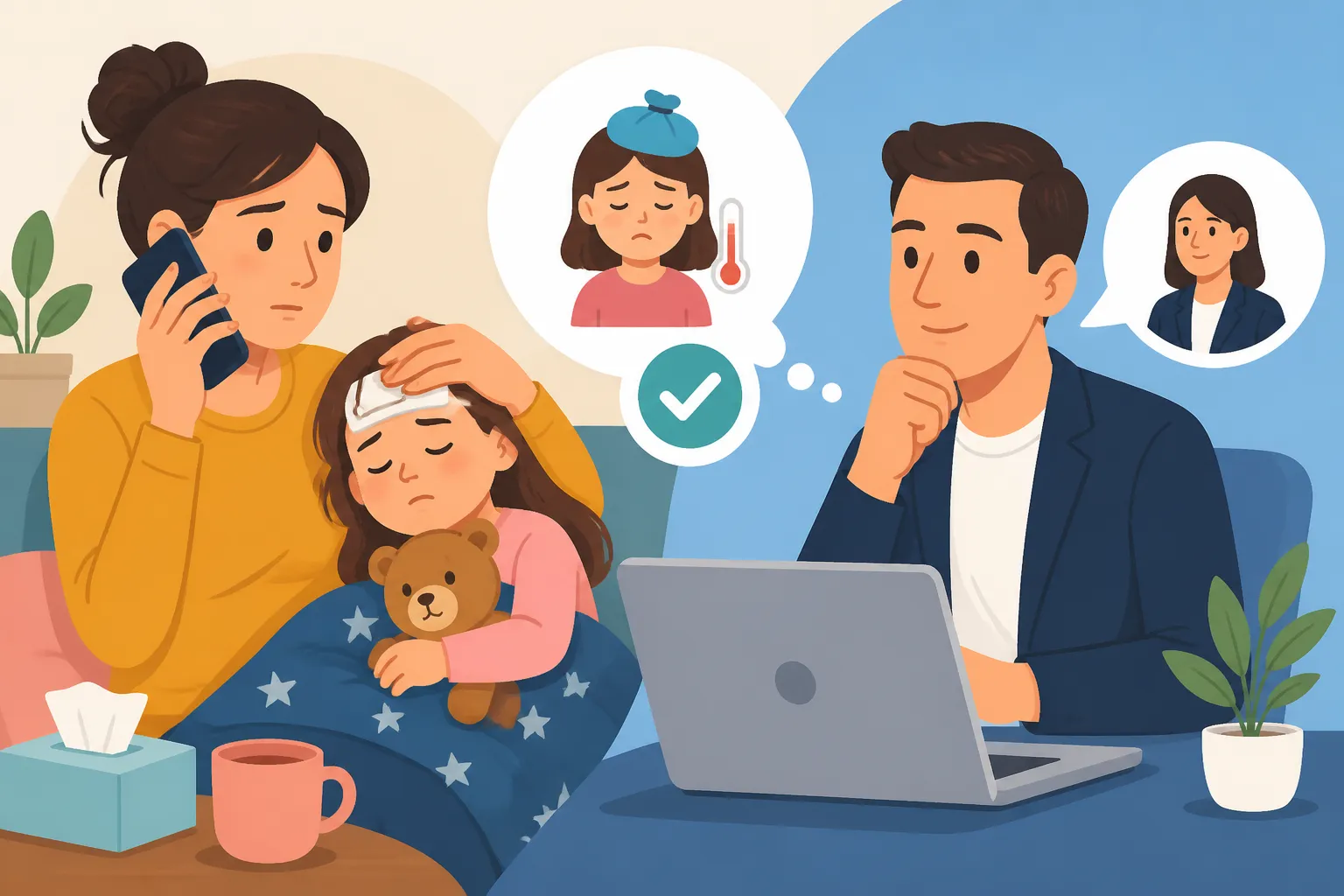
Childcare Sickness Days (Barns 1. Sygedag): How to Inform Your Boss
There's nothing quite like the sudden panic that hits when your child wakes up with a fever or a hacking cough, and your first thought (after comforting them, of course) is, "Oh no, work!" As an expat in Denmark, navigating the local rules around childcare sickness days can feel like deciphering ancient runes, especially when you're still getting to grips with the language and workplace norms. This guide is here to shed light on "Barns 1. Sygedag" – your right to take time off when your little one is unwell – and crucially, how to properly inform your boss without causing a ripple.
Understanding Barns 1. Sygedag – Your Right as a Parent
Let's be honest, in many countries, the idea of just telling your boss your child is sick and you won't be in, without a doctor's note on day one, sounds like a recipe for a stern talking-to. But Denmark operates differently, often with a strong focus on work-life balance and family welfare. Understanding "Barns 1. Sygedag" is fundamental to exercising this right confidently.
What Exactly is "Barns 1. Sygedag"?
In Danish, "Barns 1. Sygedag" literally translates to "child's first day of sickness." It's a specific, legally supported (though often formalized through collective agreements or contracts) right that allows parents to stay home with a sick child on the first day of their illness without losing pay. This isn't just a casual courtesy; it's an acknowledgment that children get sick, often suddenly, and parents need to be there for them.
It's a distinct concept from your own personal sick days. When you use "Barns 1. Sygedag," you're not depleting your personal sick leave allowance, which is a common misunderstanding among newcomers. The core idea is to provide immediate flexibility when a child unexpectedly falls ill, preventing parents from having to scramble for last-minute childcare or, worse, sending a sick child to school or daycare. This benefit usually applies when the child's illness requires your presence, meaning they can't attend their usual childcare institution or school, and you need to care for them. It applies to biological children, adopted children, and often step-children or children of a cohabiting partner, provided they reside with you.
Eligibility and Conditions for Using Barns 1. Sygedag
While the spirit of "Barns 1. Sygedag" is widely accepted, the specific entitlements can vary based on your employment. It's not a universal statutory right automatically granted by the general Danish employment law, Funktionærloven (Salaried Employees Act), for example. Instead, it's typically enshrined in collective agreements (overenskomst) between trade unions and employer associations, or explicitly stated in individual employment contracts. This distinction is crucial for expats, as you might assume a right exists based on common practice, only to find your specific contract doesn't cover it.
Most collective agreements covering salaried employees in Denmark, such as those within the public sector or larger private companies, do include provisions for paid "Barns 1. Sygedag." If your workplace has such an agreement, then you're generally covered. The common conditions are:
- Age of the Child: Typically, the child must be under a certain age, often 14 years old. Some agreements extend this to 18 if the child has a chronic illness or disability requiring parental care.
- Need for Care: The child must be genuinely ill and require your care and presence at home. This isn't for mild sniffles where they could still attend school.
- Residence: The child must reside at your address in Denmark.
- Your Employment: You must be employed under terms that grant this right, usually full-time or part-time, as defined by your collective agreement or contract.
It's vital to check your specific employment contract or consult your HR department to understand your exact entitlements. For instance, smaller companies not bound by a collective agreement might have their own policies, which could range from offering the benefit voluntarily to not offering it at all, or offering it unpaid. This is where clarity early on can save a lot of headaches later.
The Legal Framework and Collective Agreements
As mentioned, Funktionærloven, which covers a large segment of salaried employees, doesn't explicitly guarantee paid "Barns 1. Sygedag." However, it often serves as a baseline, and many collective agreements build upon it to include this benefit. Think of it like this: Funktionærloven provides the floor, and collective agreements raise the ceiling.
These collective agreements are powerful tools in the Danish labor market, negotiated between employer associations (like Dansk Industri or Dansk Erhverv) and major trade unions (such as 3F, HK, IDA, or DJØF). If your workplace is covered by such an agreement, the terms within it, including those for "Barns 1. Sygedag," become part of your employment conditions. It's one of the many reasons why understanding the role of Trade Unions and A-Kasse: Why Every Expat Must Understand Them is so important in Denmark. They often secure benefits that aren't necessarily enshrined in general law.
If you're unsure whether your company is part of a collective agreement, or what specific terms apply to you, the first step is to check your employment contract. Look for mentions of a collective agreement or specific clauses about childcare sickness. If it's not clear, don't hesitate to ask your HR department or, even better, your local union representative if you're a member. They can provide precise guidance on your rights and obligations, ensuring you're fully informed about your Employment Rights: Contracts, Holiday Law, and Maternity Leave as a parent in Denmark.
The All-Important Step: How to Inform Your Boss
So, your child is sick, you know your rights, and now comes the moment of truth: telling your boss. This isn't just a procedural step; it's about clear, timely communication in line with Danish workplace expectations.
Timeliness is Key: When and How to Notify
In Denmark, direct and prompt communication is highly valued, especially concerning absences. When your child is sick and you need to invoke "Barns 1. Sygedag," the absolute golden rule is to notify your employer as early as possible on the first day of absence. This means first thing in the morning, ideally before your usual start time. It's about enabling your team and your boss to adjust schedules and cover your tasks efficiently, rather than leaving them in the lurch.
How you notify them matters too. While a quick text message or email might feel sufficient in some cultures, many Danish workplaces, especially for immediate absences, still prefer a phone call, particularly if it's the first time you're reporting sick. This allows for direct communication, quick clarifications, and demonstrates professionalism. After the initial call, a follow-up email confirming the absence and stating "Barns 1. Sygedag" can be a good idea for documentation. Avoid simply sending a calendar invitation marked "out of office" without prior direct communication; it can be perceived as impersonal and unhelpful.
A hypothetical scenario: It's 6:30 AM, your toddler has a fever, and you're due to start work at 8 AM. Don't wait until 7:55 AM. Call your boss or your direct team leader immediately, or send a very early morning SMS/email if that's the established norm in your team for early notifications. State clearly that your child is sick and you will be using your right to "Barns 1. Sygedag."
What Information You Need to Provide
When you notify your boss, keep it concise but clear. You generally don't need to provide extensive medical details about your child's illness for the first day. A simple statement that your child is sick and requires your care is usually sufficient. You're not typically required to get a doctor's note for "Barns 1. Sygedag," though it's always wise to be prepared if company policy or your agreement stipulates otherwise for longer absences.
Here's what to include:
- Child's Name: Just for clarity, so they know which child it pertains to if you have more than one.
- Reason for Absence: Clearly state "My child is sick, and I will be taking my 'Barns 1. Sygedag' today."
- Expected Duration: For "Barns 1. Sygedag," it's usually just one day. If you anticipate the child might still be unwell the next day, you can mention you will re-evaluate and inform them further.
- Work Implications: Briefly mention if you can check emails periodically (if appropriate for your role and the child's condition) or if you will be completely unavailable. This helps manage expectations.
Example: "Good morning [Boss's Name], unfortunately, [Child's Name] woke up with a fever this morning and is too unwell to go to daycare. I will therefore be taking my 'Barns 1. Sygedag' today to care for them. I will check emails sporadically for anything urgent, but otherwise will be unavailable for work. I will keep you updated if things change for tomorrow."
Navigating Communication with a Danish Boss
For many expats, the directness of Danish communication can be a learning curve. You might feel a pang of guilt or embarrassment reporting your child's sickness, especially if your home culture encourages pushing through or downplaying family obligations at work. However, in Denmark, family welfare is generally respected, and taking "Barns 1. Sygedag" is a normal and accepted right.
Danish work culture, characterized by its flat hierarchies and emphasis on trust, expects you to be responsible and direct. There’s no need to over-apologize or provide elaborate excuses. Just state the facts clearly and what you intend to do. You might feel awkward, but rest assured, your Danish boss has likely either used this right themselves or has colleagues who regularly do. It's part of the implicit social contract.
If you're still feeling a bit shaky about speaking Danish when making such an important call, or want to practice articulating these situations clearly, resources like iTalki can be incredibly useful. Getting comfortable with key phrases and understanding the cultural nuances of such communications can boost your confidence significantly. It's about being able to state your situation clearly and confidently, even if you're not fluent. Remember, the Danish Work Culture: Flat Hierarchies, Hygge, and Direct Communication values honesty and clarity above all else.
Beyond the First Day: What If Your Child Is Still Sick?
While "Barns 1. Sygedag" covers that crucial first day, children, being children, rarely follow a one-day sickness schedule. So, what happens when the fever lingers or the cough doesn't subside? This is where additional steps and options come into play.
Doctor's Notes (Lægeerklæring) for Extended Absence
If your child remains ill beyond the first day and still requires your presence, your employer might (and is generally entitled to) request a doctor's note, known as a lægeerklæring. This is a standard procedure and not an indication of distrust. It serves as official documentation for your extended absence due and helps your employer understand the situation for internal planning and potentially for claiming sickness benefits from the municipality if the absence becomes very long.
To obtain a lægeerklæring, you'll typically need to contact your General Practitioner (GP). Depending on the nature of the illness, this might involve a phone consultation, a video consultation, or an actual visit to the doctor's office. You'll explain your child's ongoing symptoms and the need for a note for your employer. Be prepared that doctors in Denmark generally don't issue notes for minor ailments that don't warrant medical intervention; they're for legitimate illnesses preventing school/daycare attendance.
In most cases, if your employer requests a doctor's note for your child's sickness, they are legally obligated to cover the cost of obtaining it. Make sure to clarify this with your HR department or boss beforehand. For more in-depth guidance on this process, you can refer to our guide on How to Request a Lægeerklæring (Doctor’s Note) for Your Employer. Knowing how to navigate this system ensures you're prepared for longer periods of child sickness.
Options for Long-Term Child Sickness
When one day turns into two or three, or even longer, "Barns 1. Sygedag" won't cover it. You'll need to explore other avenues:
- Plejeorlov (Care Leave for Seriously Ill Children): This is a separate, more extensive type of leave intended for parents caring for children with serious illnesses or disabilities that require long-term hospital stays or intensive home care. This is generally administered through your municipality (kommune) and involves significant documentation. It's not for a common cold, but for truly critical situations.
- Using Personal Vacation Days: Many parents opt to use accumulated vacation days (feriedage) to cover additional days of child sickness, especially if their contract or collective agreement doesn't offer extended paid child sickness leave. You would typically need to agree this with your employer. Remember your rights regarding The Danish Holiday Act (Ferielov): Earning and Spending Vacation Days.
- Working From Home: If your job allows for it and your child's condition doesn't require constant, intensive care, you might be able to work from home. This can be a flexible solution, but it requires agreement with your employer and an honest assessment of whether you can effectively perform your duties while caring for a sick child.
- Partner's "Barns 1. Sygedag" or Leave: If you have a partner who is also employed in Denmark, they might be able to use their own "Barns 1. Sygedag" for the second day of the child's illness, provided their employment terms allow it. This effectively gives you two paid days for the same illness, split between parents. Alternatively, they might take personal leave.
- Sickness Benefit (Sygedagpenge) for Your Sickness: It's important to clarify that Sygedagpenge (sickness benefit) from the municipality is usually for your own illness, not typically for childcare sickness, unless your child's illness is so severe that it renders you unable to work due to stress or direct physical involvement in care (which would then be your sickness). For more on this, consult Sickness Benefit (Sygedagpenge): Your Rights When Off Work Due to Illness.
Understanding Pay During Childcare Sickness Days
This is often the most pressing question for expats: will I get paid? For "Barns 1. Sygedag," the answer is usually yes, you will receive your full salary. This is a common provision within most collective agreements and many individual employment contracts in Denmark. The intention is to remove the financial burden from parents when they need to care for a sick child suddenly.
However, as we’ve discussed, this isn’t a universal right without caveats. If your employment is not covered by a collective agreement, or if your individual contract doesn't explicitly state paid "Barns 1. Sygedag," then the employer might not be obligated to pay you. In such cases, you might be forced to take unpaid leave or use your vacation days.
It’s crucial to look into your specific employment terms. Check clauses regarding "sygdom med løn" (sickness with pay) or specific provisions for childcare sickness. Some collective agreements even offer more than just the first day paid, perhaps two or three days per child per year, or a certain number of total days for all children. This variation highlights why personal research and clarification with HR or your union are indispensable. You might also encounter terms like "Feriedagpenge," which relates to holiday pay, but is a separate concept from paid sick leave, though sometimes used as a fall-back if other paid leave options are exhausted.
Common Pitfalls and Expat-Specific Considerations
Moving to a new country means learning new rules, and sometimes the unspoken ones are the hardest. Childcare sickness days, while a fantastic benefit, come with their own set of potential misunderstandings for expats.
Differences in Company Policies
Even within Denmark, not all companies operate identically. While larger organizations, especially those bound by strong collective agreements, often have well-defined and generous policies for "Barns 1. Sygedag," smaller companies (e.g., startups or very small businesses) might have more flexible, less formal, or even less generous policies. If your workplace isn't covered by a collective agreement, the terms will entirely depend on what's written (or not written) in your individual employment contract.
This is why it's so important to clarify these details upfront, perhaps during the onboarding process or by reviewing your contract thoroughly. Don't assume that just because your Danish colleague has a particular benefit, you automatically do too. Always consult your HR department or, for impartial advice, a representative from your trade union if you are a member. They can help clarify the specific rules that apply to your situation, and perhaps even point you to the relevant clauses in your Danish Work Contracts: Permanent vs. Fixed-Term and Essential Clauses.
Language Barriers and Misunderstandings
The term "Barns 1. Sygedag" itself is a Danish construct. Simply saying "my child is sick" might not immediately convey the full implication of your right to paid leave. Using the correct Danish terminology helps to streamline the communication and ensures everyone understands you are invoking a specific, recognized right.
For expats still grappling with the Danish language, this can be a source of anxiety. You might worry about miscommunicating or appearing unprofessional. This is where preparing a short, clear statement (perhaps even written down) can be a lifesaver. You can even write it in Danish, then translate it into English, and check with a Danish friend or colleague. As mentioned earlier, practicing these specific phrases in Danish with a tutor on platforms like iTalki can build your confidence. Being able to calmly and clearly state, "Mit barn er syg, så jeg tager barns 1. sygedag i dag" (My child is sick, so I am taking child's first day of sickness today) makes a significant difference.
Beyond the initial notification, misunderstandings can arise if your boss asks follow-up questions about doctor's notes or extended leave, and you struggle to grasp their meaning. Having a basic understanding of key Danish healthcare and employment terms can prevent unnecessary stress.
Impact on Your Career and Workload (Perception vs. Reality)
Many expats arrive from cultures where taking time off for family reasons, especially frequently, might be viewed negatively or even impact career progression. You might worry that using "Barns 1. Sygedag" will make you seem less dedicated or reliable in the eyes of your Danish boss or colleagues.
Let me validate that feeling: it's a very real concern for many newcomers. However, the reality in Denmark is often quite different. Danish workplaces generally embrace a culture that prioritizes family life and employee well-being. Using your right to "Barns 1. Sygedag" is typically not seen as a sign of weakness or lack of commitment. On the contrary, attempting to come to work with a sick child at home might be viewed as irresponsible or even a health risk to others in the office.
The expectation is that you manage your work responsibly, communicate clearly about your absence, and make arrangements for coverage if possible. This cultural acceptance is a significant benefit of working in Denmark and something expats should try to internalize rather than fight against. It's part of the Danish Work Culture: Flat Hierarchies, Hygge, and Direct Communication that fosters trust and mutual respect.
Tax Implications of Sickness Benefits (Brief Mention)
While "Barns 1. Sygedag" is usually paid by your employer as part of your normal salary, any longer-term sickness benefits (such as those from the municipality for very extended or serious child-related leave, or even your own personal sickness benefit) would be subject to Danish tax rules. When the municipality pays out benefits, these are generally considered taxable income.
Understanding how these benefits, or any income for that matter, are taxed in Denmark can be complex. You'll encounter terms like A-Skat (A-income tax), AM-bidrag (labor market contribution), and marginal tax rates. It's important to ensure your tax affairs are in order, especially if you're receiving any benefits directly from the municipality. For comprehensive details on this, our guide on Taxes in Denmark Explained: A-Skat, AM-bidrag, and Marginal Rates provides a great starting point. Furthermore, for specialized guidance, particularly on your individual situation, consulting professional services like "Taxes for Expats" can be invaluable to navigate the intricacies of the Danish tax system effectively. It's all part of ensuring you're compliant and financially savvy in your new home.
Disclaimer
Please remember that while this guide provides comprehensive information, it is based on general knowledge and common practices in Denmark. Employment law, collective agreements, and company policies can be complex and are subject to change. Always consult your specific employment contract, your HR department, or your trade union for personalized advice relevant to your unique situation. This content is for informational purposes only and does not constitute legal or financial advice.