Cost of Living in Denmark 2026: Budgets for Singles and Families
Ah, Denmark. The land of hygge, stunning design, and consistently high rankings in global happiness reports. It’s easy to fall in love with the idea of moving here, isn't it? But then you look at a price tag for a cup of coffee or a monthly rent, and that initial enchantment can quickly turn into a bit of a financial panic. Trust me, I’ve been there – that moment when you convert a Danish Krone figure back to your home currency and your jaw drops. This guide is designed to cut through the noise and give you a truly realistic, nitty-gritty breakdown of the cost of living in Denmark, whether you’re flying solo or bringing the whole family.
The Sticker Shock is Real: Understanding Denmark's High Cost of Living
Let's not sugarcoat it: Denmark is one of the most expensive countries in the world. This isn't just a rumour; it's a reality that hits most expats squarely in the wallet, especially when they first arrive. You might arrive with dreams of embracing that work-life balance and clean living, only to find your bank balance looking a little less balanced. It’s a common frustration, and one that many struggle to adjust to. But understanding why things cost what they do is the first step in managing your expectations and your budget.
Why Denmark is So Expensive: Taxes, Wages, and Welfare
The primary driver behind Denmark's high prices is its robust welfare state, funded by a very progressive tax system. What you pay in taxes, both direct and indirect (like the whopping 25% VAT on most goods and services), goes towards providing universal healthcare, free education, generous parental leave, and excellent infrastructure. This means that while the sticker price for many things is high, you're not paying extra for health insurance premiums, university tuition, or basic medical care once you're integrated into the system. It’s a different way of looking at value. For example, when you see the price of a car, know that a significant chunk of that is vehicle registration tax, which can be upwards of 150% for new cars, designed to discourage private car ownership and promote public transport or cycling.
Another factor contributing to higher costs is the high average wage. Danish salaries are generally higher than in many other countries, ensuring that even with high taxes, residents maintain a good standard of living. This higher wage translates to higher labour costs, which then filter down into the prices of goods and services, particularly those that require manual labour or extensive service, such as haircuts, restaurant meals, or home repairs. It's a closed loop, where high wages necessitate high prices, and high prices are absorbed by high wages. This is also why things like electronics might not feel as expensive as, say, a plumber's visit – electronics prices are more globally influenced, while services are very much locally priced.
The "Hygge" Premium: What You Get for Your Money
Beyond the purely financial aspects, there's also what I like to call the "hygge premium." Denmark consistently ranks as one of the happiest countries in the world, and many argue that the quality of life here is exceptionally high. What does that mean in real terms? It means clean cities, low crime rates, excellent public services, and a society that values community and well-being. You’re not just paying for a flat white; you’re paying into a system that ensures a functioning, pleasant society. The access to beautiful, well-maintained public parks, free libraries, and a general sense of safety and trust all contribute to a quality of life that, while intangible, has a very tangible cost.
Think about it: when you send your child to a public childcare institution, you're enrolling them in a system known for its high pedagogical standards and focus on play and development, rather than a bare-bones daycare. When you visit your GP, you’re accessing a streamlined and efficient healthcare system. These are all elements that contribute to a peaceful and less stressful daily existence, which many expats eventually come to appreciate as a significant return on their financial investment. It's a trade-off, and one that takes time to fully grasp and value.
Housing: Your Biggest Expense in Denmark
Without a doubt, housing will be your largest monthly outgoing in Denmark, especially if you're looking to live in or near one of the major cities. The housing market is tight, particularly in Copenhagen and Aarhus, leading to high rents and a competitive search process. Navigating the rental market here can feel like a full-time job in itself, and it often comes with a hefty upfront cost that can surprise newcomers.
Renting an Apartment: Copenhagen vs. Regional Cities
The rental prices vary dramatically depending on location. Copenhagen is, unsurprisingly, the most expensive. A one-bedroom apartment in the city centre could easily set you back DKK 10,000-14,000 (approximately €1,340-€1,880) per month, and often more. Move slightly out to popular areas like Nørrebro or Vesterbro, and while you might find something a little less, it won't be dramatically cheaper. For families, a two or three-bedroom apartment in Copenhagen could range from DKK 15,000-25,000 (approximately €2,000-€3,350) or more. This doesn't usually include utilities, which we'll get to shortly.
If you’re open to living outside the capital, cities like Aarhus, Odense, or Aalborg offer significantly more affordable options. In Aarhus, a one-bedroom apartment might be DKK 7,000-10,000, and a family home could be DKK 12,000-18,000. These regional cities still offer a high quality of life, often with easier commutes and access to nature, making them a very attractive alternative for those looking to stretch their budget further. Always remember that getting your CPR Registration Rule: Why Your Address Matters is intrinsically linked to having a valid, registrable address, which can be a challenge with some short-term or informal rentals.
Deposits, Prepaid Rent, and Hidden Costs
One of the biggest financial hurdles when securing a rental in Denmark is the upfront cost. Landlords typically require a deposit (depositum) equivalent to 1-3 months' rent, plus up to 3 months' prepaid rent (forudbetalt leje). This means you could be looking at paying anywhere from 3 to 6 months' rent before you even move in. So, for that DKK 12,000 Copenhagen apartment, you might need DKK 36,000-72,000 just to get the keys. This is a common and legal practice, so don't be alarmed, but be prepared!
Beyond the rent itself, you’ll almost certainly pay a conto for utilities like heating and water. This is an estimated payment that's reconciled annually, so you might owe more or get a refund depending on your actual consumption. Electricity is usually a separate bill directly from a provider, and internet is also a separate subscription. It’s crucial to understand these additional costs because they can add several hundred to a couple of thousand DKK to your monthly housing budget. Don't forget that most Danish apartments come without light fixtures or even basic kitchen appliances in older units, meaning you might have initial setup costs for those too. Before signing anything, always try to understand Typeformular A10: Understanding the Standard Danish Lease Agreement and specifically look at Section 11 for any tricky clauses.
Buying Property: A Long-Term Consideration
For many expats, buying property in Denmark isn't an immediate goal, given the initial financial outlay and the complexities of the market for foreigners. However, if you plan to stay long-term, it can be a viable option. Property prices have risen steadily, but mortgages (realkreditlån) are often available at competitive rates. Be aware that non-EU citizens typically need to reside in Denmark for at least five years before being eligible to purchase property, though there are exceptions for those with strong ties to the country.
The process of buying property here involves significant transaction costs, including stamp duty and legal fees, which can add a substantial amount to the purchase price. While monthly mortgage payments might sometimes be comparable to, or even less than, rent for a similar property, the upfront capital required for a down payment (typically 5-20% of the purchase price) and the aforementioned fees can be prohibitive. It's a big decision, and one that warrants thorough research into Buying Property in Denmark: Mortgage Options and 20% Down Payments before you even start looking.
Daily Necessities: Groceries, Utilities, and Transportation
Once you’ve got your roof over your head sorted, the next big chunk of your budget will go towards the everyday essentials. This is where many expats feel the pinch most acutely, as the prices for food and services can seem disproportionately high compared to what they're used to.
Supermarket Shopping: Saving Money on Food
Grocery shopping in Denmark can be a significant expense, with food prices generally higher than in many other European countries. A single person might spend DKK 1,500-2,500 (approx. €200-€335) per month on groceries, while a family of four could easily spend DKK 4,000-7,000 (approx. €535-€940) or more. This is where smart shopping really pays off.
Discount supermarkets like Netto, Rema 1000, and Fakta are your best friends. They offer good quality basics at more affordable prices. Føtex and Bilka are larger supermarkets with a wider selection, but generally higher prices, especially for imported goods. Local butchers, fishmongers, and farmers' markets can offer better quality, but often at a premium. Learning to navigate Supermarkets in Denmark: Netto, Rema 1000, and Føtex Compared is an essential skill for any expat trying to save money. Buying seasonal produce, taking advantage of weekly deals, and planning meals are all crucial strategies. Also, keep an eye out for "stop spild af mad" (stop food waste) sections, where items nearing their expiry date are sold at a discount.
Unpacking Utility Bills: Aconto and Annual Adjustments
As mentioned, utilities are usually paid separately from rent. For a typical two-bedroom apartment, you can expect to pay around DKK 800-1,500 (approx. €107-€200) per month for electricity, heating, and water. This figure can fluctuate quite a bit based on your consumption habits, the insulation of your building, and the time of year (Danish winters can be long and cold!).
Many landlords use an a conto system, where you pay a fixed amount each month, and then an annual adjustment is made based on your actual usage. This can sometimes lead to a nasty surprise bill or a pleasant refund. Internet costs generally range from DKK 200-400 (€27-€54) per month, depending on the speed and provider. Don't forget, if you have a TV or streaming services that require a media license, that might be an additional cost, though the old TV license has largely been absorbed into the general tax system. Phone contracts are typically around DKK 100-250 (€13-€34) for basic plans with decent data.
Getting Around: Public Transport and Cycling
Denmark boasts an excellent public transportation system, especially in and around the major cities. Trains (DSB), buses, and the Copenhagen Metro are efficient, clean, and reliable – but they come at a price. A single adult ticket in Copenhagen can cost DKK 24-36 (€3.20-€4.80) depending on the zones. If you're commuting regularly, a Rejsekort (travel card) or a monthly pass (Pendlerkort) is essential. A monthly pass for a few zones in Copenhagen can easily be DKK 400-800 (€54-€107) or more.
However, the true Danish way to get around is by bicycle! Cycling is ingrained in the culture, and it's by far the cheapest and often the quickest way to navigate urban areas. Investing in a good quality used bike (around DKK 1,000-3,000 or €135-€400) is one of the best investments you can make for your Danish life and your wallet. Factor in safety equipment like lights and a good lock, as bike theft, unfortunately, is quite common. You can even consider services like Swapfiets for a monthly subscription to a reliable bike with maintenance included, avoiding the upfront cost.
Taxes and Social Contributions: The Danish Model
This is where Denmark's financial system often causes the most head-scratching for new expats. The tax rates are high, there’s no denying it, but understanding what you're paying for and how the system works is key to managing your finances effectively. It's a system designed for collective well-being, and your contributions fund the robust social safety net that Denmark is famous for.
Understanding Your Payslip: A-Skat and AM-bidrag
When you receive your first Danish payslip (lønseddel), you might be surprised by the deductions. The two main ones you'll see are A-Skat (income tax) and AM-bidrag (Labour Market Contribution). AM-bidrag is a flat 8% contribution levied on your gross salary before any other deductions, and it's mandatory for almost everyone working in Denmark. After this 8% is deducted, your remaining income is subject to A-Skat, which is a progressive income tax.
The A-Skat rate varies depending on your income level, municipality (kommune), and whether you're eligible for any deductions. Marginal tax rates can reach over 50%, meaning a significant portion of any additional income you earn beyond a certain threshold will go to taxes. This system aims to redistribute wealth and ensure everyone contributes to the welfare state. It can feel like a lot is being taken from your paycheck, but remember, this is funding the "free" healthcare, education, and social services that would be paid for out-of-pocket in other countries. Getting a handle on Taxes in Denmark Explained: A-Skat, AM-bidrag, and Marginal Rates is crucial.
Navigating Preliminary Tax (Forskudsopgørelse)
One of the most important concepts to grasp is the forskudsopgørelse, or preliminary tax assessment. This is an estimate of your expected income and deductions for the upcoming year, which you submit to SKAT (the Danish tax authority). Based on this, SKAT calculates your tax card (skattekort) – your employer then uses this to determine how much A-Skat to deduct from your salary each month.
It is absolutely vital to ensure your forskudsopgørelse is as accurate as possible. If you underestimate your income or overestimate your deductions, you could end up with a "restskat" (tax debt) at the end of the year, which means you owe SKAT money. Conversely, if you overestimate your income, you might get a tax refund. As an expat, especially if your income changes or you have foreign assets, keeping your forskudsopgørelse updated is crucial. Many expats find the initial setup confusing, and it's a common source of frustration. For complex situations, particularly involving international income or specific expat allowances, consulting a tax advisor or a service like Taxes for Expats can be incredibly beneficial to ensure compliance and potentially maximize deductions. You definitely want to understand Understanding SKAT: Forskudsopgørelse vs. Årsopgørelse Explained to avoid any nasty surprises.
Expat Tax Schemes: Are You Eligible for the 27% Flat Tax?
For highly skilled workers and researchers, Denmark offers a special expat tax scheme (forskerskatteordningen) that can significantly reduce your tax burden. If you qualify, you can choose to be taxed at a flat rate of 27% on your gross salary (plus AM-bidrag, making it effectively around 32.84%) for up to seven years. This is a massive reduction compared to the standard progressive rates.
However, there are strict eligibility criteria, including a minimum monthly salary threshold (which is adjusted annually – for 2026, it's projected to be around DKK 75,000, but always check the latest figures with SKAT). Not all job roles or salaries qualify, and you generally cannot have been tax-resident in Denmark for certain periods prior to applying. If you are eligible, this scheme can make a considerable difference to your take-home pay and overall cost of living. It's definitely worth investigating if your role and salary meet the requirements, and you can find a comprehensive guide on the Expat Tax Scheme (Forskerskatteordningen): The 27% Flat Tax Guide for more details.
Healthcare, Education, and Childcare: Public vs. Private Costs
One of the cornerstones of the Danish welfare state is the provision of "free" universal services. While this means you don't pay directly at the point of service for many things, it's important to understand the nuances and where your Yellow Health Card (Sundhedskort) coverage might end.
Public Healthcare: "Free" Isn't Quite Free
Once you've received your CPR number and Yellow Health Card, you're entitled to publicly funded healthcare in Denmark. This generally means free consultations with your assigned General Practitioner (GP), free hospital care (including most surgeries and emergency treatment), and subsidies on many prescription medications. It's a huge relief not to worry about huge medical bills for serious illnesses.
However, there are areas where you'll still pay out of pocket. Dental care, for instance, is only partially subsidized for adults and can be very expensive, though children typically receive free dental care until age 18. Eye care (opticians, glasses, contact lenses) is also largely out-of-pocket. Psychologists and physiotherapists often require a GP referral to receive a partial subsidy, otherwise, the full cost is yours. Many expats opt for supplementary private health insurance (like Sygeforsikring "danmark") to cover these gaps or reduce waiting times for certain treatments, especially for things like dental work or seeing a specialist without a GP referral. Even if you're covered by the public system, it's wise to understand the limitations, particularly regarding Dental Care in Denmark: Costs, Subsidies, and Private Insurance Options.
Childcare and Education: Vuggestue, Børnehave, and Schools
If you're moving to Denmark with children, you'll be happy to know that public childcare and schools are highly subsidized. After receiving your CPR number, children are entitled to a spot in municipal childcare. Vuggestue (crèche, for ages 0-2) and børnehave (kindergarten, for ages 3-6) are not free, but the cost is significantly subsidized by the municipality.
Expect to pay around DKK 2,000-4,000 (approx. €270-€540) per month per child for a full-time spot in public childcare, depending on the municipality and the child's age. This can seem like a lot, but it’s often much less than in other Western countries for comparable quality. There are also sibling discounts. Public schools (folkeskole) are entirely free from age 6 to 16. For those preferring an international curriculum, private international schools are available, but their fees can be substantial, ranging from DKK 4,000 to DKK 10,000+ per month per child. A deep dive into Childcare in Denmark: Vuggestue (Crèche) and Børnehave (Kindergarten) will give you a clearer picture.
Mental Health Support: Accessing Psychologists and Therapy for Expats
Navigating mental health care in a new country can be particularly challenging. The public healthcare system does provide access to mental health services, but typically requires a referral from your GP to a psychologist or psychiatrist. With a referral, a portion of the cost for psychologist sessions is covered, making it much more affordable. However, waiting lists for publicly funded therapy can sometimes be long, and finding English-speaking practitioners within the public system might require some effort.
Without a GP referral, or if you prefer a private psychologist, expect to pay DKK 800-1,200 (approx. €107-€160) or more per session. Many expats find it worthwhile to seek out English-speaking therapists privately, especially if immediate support is needed. It's worth researching Mental Health in Denmark: Accessing Psychologists and Therapy for Expats to understand the full scope of your options and how to navigate the system effectively.
Lifestyle and Leisure: Finding Balance in Your Budget
This is where the choices you make can have a huge impact on your budget. Denmark offers a fantastic quality of life, but enjoying it often means adjusting your habits or finding smart ways to enjoy leisure activities without constantly feeling the pinch.
Eating Out and Socializing: The Price of Danish Hygge
Dining out in Denmark is notoriously expensive. A simple meal at an average restaurant could easily be DKK 150-250 (€20-€34) per person, and a full three-course meal with drinks can quickly escalate to DKK 500-1,000+ (€67-€135+) per person. Alcohol also carries high taxes, making a pint of beer around DKK 50-70 (€6.70-€9.40) and a glass of wine even more. This is another area where the high VAT and labour costs really make themselves known.
Because of this, Danes often prefer to socialize at home, sharing meals and drinks – a core part of hygge. If you love eating out, budgeting for it is key, or explore cheaper alternatives like street food markets (Reffen in Copenhagen, Aarhus Street Food), lunch deals, or "early bird" specials. Grabbing a takeaway pizza or a kebab is usually cheaper than a sit-down restaurant meal. You'll quickly learn that Friday bars at work and potluck dinners with friends become your preferred social outings, both for camaraderie and cost-efficiency.
Entertainment and Hobbies: Enjoying Life Without Breaking the Bank
Accessing culture and entertainment can also add up. Cinema tickets are typically DKK 100-130 (€13-€17), and concerts or theatre tickets can be significantly more. Museum entry fees usually range from DKK 80-150 (€10-€20), although many offer free days or student discounts. Fitness memberships are comparable to other Western countries, often DKK 200-400 (€27-€54) per month.
However, Denmark excels in free or low-cost activities. The country is beautiful and very safe, making walking, hiking, and cycling incredibly popular. Public parks are immaculate, beaches are easily accessible, and many cities offer free cultural events, especially during summer. Joining a local sports club (forening) is a fantastic way to integrate, stay active, and often comes with a reasonable membership fee. Libraries are also excellent resources, offering not just books but often workshops, talks, and community events, many of which are free. Embracing the outdoors and community life is key to enjoying Denmark without constantly opening your wallet.
Personal Care and Shopping: Everyday Expenses
When it comes to personal care items, you'll find brands you recognize, but often at higher prices than back home. Toiletries, cosmetics, and over-the-counter medications can be expensive, especially outside of discount supermarkets. Haircuts, manicures, and other personal services also reflect the high labour costs. A basic men's haircut might be DKK 250-400 (€34-€54), and women's much more.
Clothing and electronics prices are generally more aligned with international markets, but designer brands will still carry a premium. Danes are big on quality over quantity, and often invest in well-made items that last. Second-hand shopping is also very popular and is a great way to save money, particularly on furniture, clothing, and children's items. Consider exploring flea markets (loppemarkeder) or online platforms like DBA.dk (Den Blå Avis) for pre-loved treasures.
Budgeting Strategies for Expats: Making Your DKK Go Further
Living in Denmark requires a mindset shift when it comes to budgeting. It's not about cutting corners on quality of life, but rather about adapting to local spending habits and finding smart ways to manage your money in a high-cost environment.
Essential Apps and Digital Tools
Denmark is a highly digitalized society, and embracing its digital tools is not just convenient, it's often essential for daily life and budgeting. Your NemKonto and MitID: The Core of Danish Digital Finance (2027) are foundational, allowing you to interact with public services and manage your bank accounts. MobilePay is indispensable for everyday transactions, from splitting bills with friends to paying for small purchases.
Beyond the essentials, there are apps designed to help you save. Many supermarket chains have their own apps with digital coupons and weekly offers. "Too Good To Go" is a fantastic app that lets you buy surplus food from bakeries, restaurants, and supermarkets at a discounted price at the end of the day, helping both your wallet and the environment. For international money transfers, especially if you're sending money home or receiving funds from abroad, services like Wise (formerly TransferWise) offer competitive exchange rates and lower fees compared to traditional banks. This can make a noticeable difference to your budget when dealing with cross-border finances, ensuring more of your hard-earned DKK makes it to its destination.
Second-Hand Shopping and "Genbrug" Culture
Embracing the "genbrug" (reuse/recycle) culture is not just an eco-conscious choice in Denmark; it's a financial superpower. Danes are excellent at giving items a second life, and the second-hand market is thriving. From clothing and furniture to kitchenware and electronics, you can find incredibly good quality items at a fraction of their new price.
Websites like DBA.dk (Den Blå Avis) are treasure troves for everything imaginable. Facebook Marketplace is also very active in local expat and Danish groups. Beyond online platforms, there are numerous charity shops (genbrugsbutikker) run by organizations like Kirkens Korshær, Røde Kors (Red Cross), and Mission Afrika, which are great for finding affordable clothes, books, and household items. Furniture and home decor are particularly good buys second-hand, as new furniture can be quite expensive. It’s also a great way to furnish your apartment initially without a huge outlay.
Long-Term Financial Planning and Savings
While the immediate focus for many expats is getting by day-to-day, thinking long-term about your finances in Denmark is crucial. Understanding the Danish pension system, including folkepension (state pension) and employer-contributed arbejdsmarkedspension, is essential. These contributions are a significant part of your overall compensation and future financial security.
Consider setting up a budget and tracking your expenses from day one. It helps you identify where your money is actually going and where you can make adjustments. Many Danish banks offer online banking tools that help categorize your spending. While saving might feel challenging with the high cost of living, even small, consistent savings can add up over time. If you’re considering investing, understanding options like the Aktiesparekonto (equity savings account) can offer tax benefits for personal investments. For those planning to stay long-term, it’s worth researching the full scope of your Danish Pension System: Folkepension, ATP, and Employer Contributions and how it integrates with your personal savings goals.
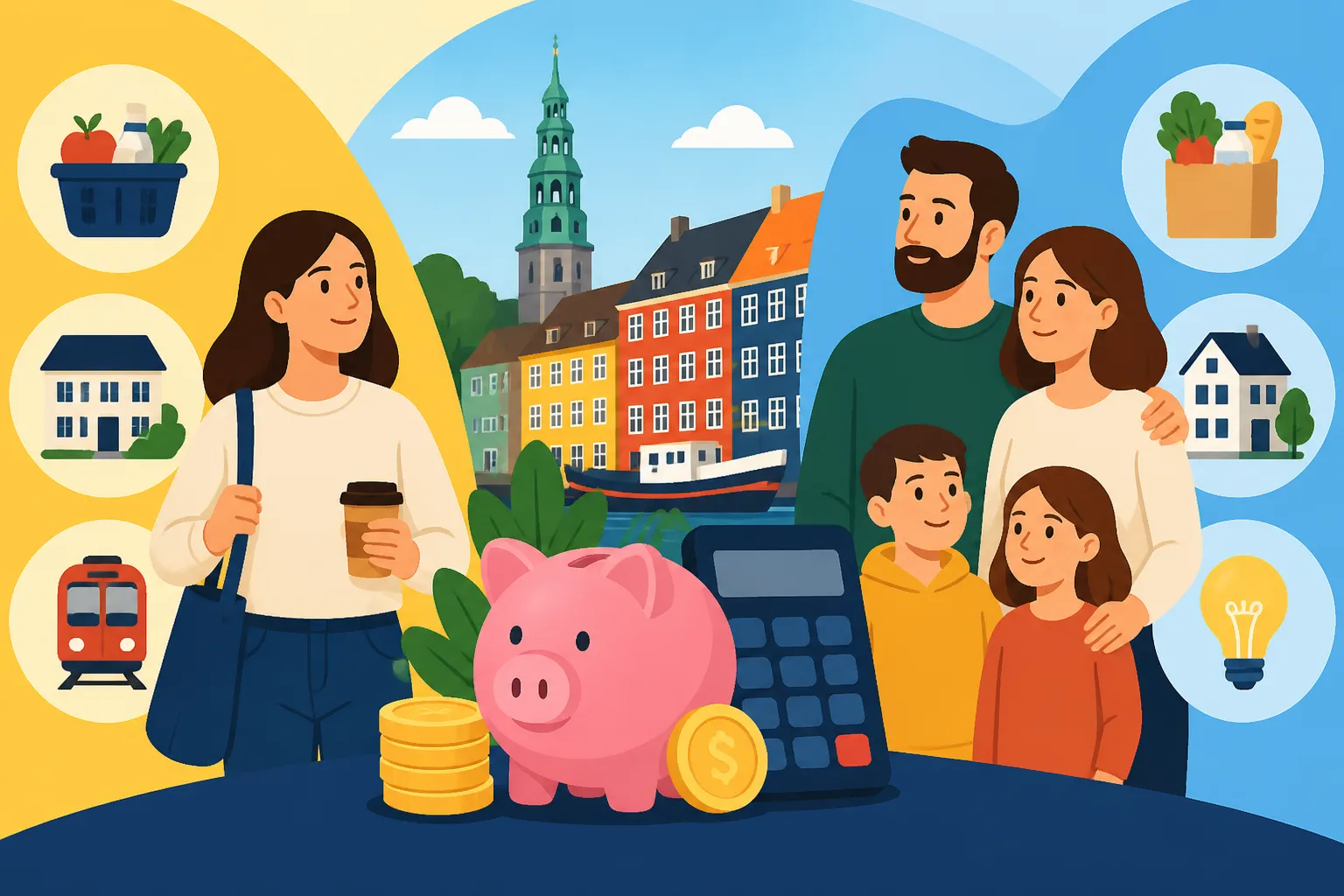
Below is a quick overview of estimated monthly costs for 2026 to help you visualize a budget. Please remember these are general estimates and can fluctuate greatly based on individual choices, lifestyle, and specific location.
| Category | Single Person (Copenhagen) Est. DKK | Single Person (Regional City) Est. DKK | Family of Four (Copenhagen) Est. DKK | Family of Four (Regional City) Est. DKK |
|---|---|---|---|---|
| Housing (Rent) | 10,000 – 14,000 | 7,000 – 10,000 | 18,000 – 25,000 | 12,000 – 18,000 |
| Utilities | 1,000 – 1,500 | 900 – 1,400 | 1,800 – 2,500 | 1,500 – 2,200 |
| Groceries | 2,000 – 3,000 | 1,800 – 2,800 | 5,000 – 7,000 | 4,500 – 6,500 |
| Transportation | 400 – 800 | 300 – 700 | 800 – 1,500 | 700 – 1,300 |
| Childcare/Education | N/A | N/A | 4,000 – 8,000 (x2 kids) | 3,000 – 6,000 (x2 kids) |
| Personal Care/Health | 300 – 600 | 250 – 500 | 600 – 1,200 | 500 – 1,000 |
| Dining Out/Social | 1,000 – 2,000 | 800 – 1,500 | 2,000 – 4,000 | 1,500 – |
Disclaimer
This article is for general informational purposes only and does not constitute professional advice. Laws, prices and regulations vary by location and change over time. Consult a qualified professional for guidance on your specific situation.