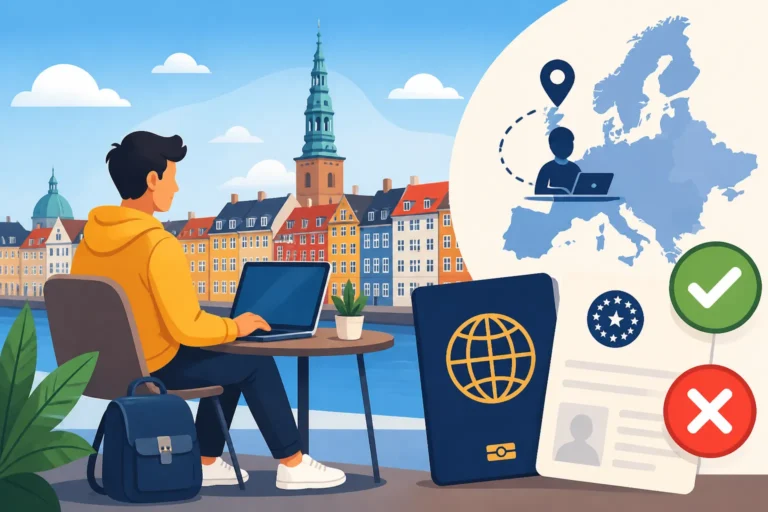
Can I Be a Digital Nomad in Denmark on a Tourist Visa?
It’s a dream many of us share: escaping to a beautiful, well-functioning country like Denmark, setting up our laptop in a cozy café, and working remotely while soaking in the Nordic charm. I hear you, the allure is strong. However, the harsh reality often hits when you realize Denmark’s approach to visas and work is far less flexible than many other places, especially for those hoping to be a "digital nomad" on a standard tourist visa. This guide will meticulously break down why that common fantasy simply isn't a legal reality here, and what your actual options are if you truly want to live and work in Denmark.
The Core Reality: Tourist Visas Are Not Work Permits
Let's be incredibly clear from the outset: a tourist visa, specifically a Schengen visa, is designed for exactly what its name implies – tourism and short-term visits. It is unequivocally not a permit for work, even if that work is remote for a company outside of Denmark. This is where many digital nomads face a rude awakening when trying to navigate the Danish system.
What is a Tourist Visa (Schengen Visa) Actually For?
If you’re a non-EU/EEA citizen, your entry into Denmark for short stays will typically fall under the Schengen visa rules. This visa allows you to visit Denmark and other countries in the Schengen area for up to 90 days within any 180-day period. The purpose of this type of stay is strictly non-remunerated activities. This means you can visit friends and family, enjoy the sights, attend short cultural events, or even participate in brief business meetings – but these business meetings must not involve performing core job functions or earning money from a Danish source. It’s for exploration, for leisure, for being a tourist.
The moment you start opening your laptop to perform actual job duties, answer emails that are central to your employment, or engage in any productive work that generates income, even if that income comes from outside Denmark, you are entering a grey area that the Danish authorities consider a violation of your visa terms. Many people assume that because they aren't taking a job from a Dane, it's fine. This is a profound misunderstanding of Danish immigration law. The focus is on where the work is performed, not where the employer is based. Denmark, much like its Nordic neighbors, has very strict regulations about who can work within its borders and under what conditions, and they do not have a dedicated visa category for digital nomads working remotely for foreign entities. Understanding the nuances of The 90/180 Day Schengen Rule for Non-EU Visitors in Denmark is crucial here, as it defines your limitations, not your freedoms to work.
The Definition of "Work" in a Danish Context
Denmark's definition of "work" for immigration purposes is broad and leaves very little room for interpretation. If you are actively engaged in activities that would typically be performed by an employee or a self-employed individual to earn a livelihood, it is considered work. This applies whether your client is in Copenhagen, California, or Colombia. The key factor is that you are physically present in Denmark while performing these tasks.
Consider a hypothetical scenario: you're a software developer employed by a company in the US. You enter Denmark on a Schengen visa, find a charming Airbnb, and spend your days coding. From the Danish immigration perspective, you are working in Denmark without a valid work permit. This isn't just a minor technicality; it's a serious breach of immigration law. The consequences can range from fines and immediate deportation to future bans from entering the Schengen area. While Denmark hasn't yet caught up with countries that offer specific digital nomad visas, its stance remains firm: if you want to perform work activities in Denmark, you need a work permit that explicitly allows it. There are no subtle loopholes for "digital" work; work is work, regardless of its digital nature or the location of your employer. This is a frustration many expats face, having to quickly adjust their plans or risk serious penalties.
Why Denmark Doesn't Have a Digital Nomad Visa (Yet)
It’s easy to look at other European countries launching exciting digital nomad visas and wonder why Denmark, with its high quality of life and digital infrastructure, hasn't followed suit. The answer lies deep in Denmark's immigration philosophy and its approach to labor markets and social welfare.
Denmark's Immigration Philosophy
Denmark's immigration policy is very much geared towards attracting and retaining individuals who contribute directly to the Danish labor market or who are part of family reunification efforts. The focus is on filling specific labor shortages, attracting highly skilled specialists, or those who can start innovative businesses. They are less interested in individuals who will primarily consume resources or use social infrastructure without directly contributing to the Danish tax base through local employment.
Existing pathways for non-EU/EEA citizens to work in Denmark are typically tied to specific employment conditions:
- The Pay Limit Scheme: This scheme is designed for highly paid professionals who have received a job offer from a Danish employer that meets a substantial annual salary threshold (which in 2026 is around DKK 552,000). The idea is to attract global talent that commands high salaries, signaling a valuable contribution to the economy. Learn more about The Pay Limit Scheme: Meeting the 2026 Salary Requirements if this sounds like a potential avenue for you.
- The Positive List Scheme: This list details specific professions where Denmark experiences a shortage of qualified labor. If your education and experience match a job on this list, and you secure a job offer from a Danish employer, you may qualify for a work permit. This targets very specific needs in the market. Check out The Positive List Scheme: Applying Based on Labor Shortages for more details.
- Start-up Denmark Visa: This is for entrepreneurs with genuinely innovative business ideas that have the potential for significant growth and job creation in Denmark. It’s a rigorous process involving a panel review, not just for anyone wanting to run a small online business. Discover more about Start-up Denmark Visa: Pitching Your Business to Attract a Permit.
These schemes reflect a clear strategy: bring people who are needed by the Danish economy, not just those who want to live here and work independently for foreign entities. The system is designed for active participation in the Danish society and economy, making digital nomadism on a tourist visa incompatible with its underlying principles.
The Practical Implications for Remote Workers
For you, as a hopeful remote worker looking to spend an extended period in Denmark, the practical implication is stark: there is no simple, straightforward, or legal pathway to do so on a tourist visa. You cannot legally conduct your remote work for a non-Danish employer while residing in Denmark under a Schengen visa.
This isn't to say people don't try. Expat forums contain many accounts of individuals taking the risk, working quietly from their apartments. But the risk is real. Border control can be vigilant, and if caught, the consequences can be severe. This includes being denied re-entry at a later date, receiving a formal ban from the entire Schengen area, or facing significant fines. Imagine planning a trip back for a dream job or family event, only to be turned away at the airport because of a past, seemingly innocuous, remote work stint. It's simply not worth the gamble.
The Danish authorities, specifically SIRI (Styrelsen for International Rekruttering og Integration), are generally quite efficient but also very precise in their application of the rules. They prioritize clear-cut contributions to the Danish economy and society. So, while you might be able to attend a brief online meeting on your tourist visa, performing the actual core functions of your employment for weeks or months on end is a direct violation of your visa conditions. It’s a bitter pill to swallow for many, but it’s the reality here.
Exploring Legal Alternatives for Longer Stays or Work
If your heart is truly set on a longer stay in Denmark, or if you simply must work while here, then relying on a tourist visa is not an option. You need to explore legitimate residence and work permits, which require a much more substantial commitment and typically a direct link to the Danish labor market or education system.
Short-Term Business Visits vs. Digital Nomad Work
Let's clarify the fine line between an allowable short-term business visit and prohibited digital nomad work. A business visit on a Schengen visa typically involves activities like:
- Attending conferences, seminars, or workshops.
- Participating in professional meetings with Danish colleagues or clients (e.g., a one-off negotiation, an introductory meeting).
- Conducting market research or exploratory business discussions.
- Training by a Danish entity (if the training is short-term and not primary employment).
Crucially, these activities are usually short in duration and do not involve performing productive work for which you are being paid, especially not work that would typically be done by an employee in Denmark. For instance, attending a sales pitch is fine; spending a month actually doing the sales, cold-calling from Denmark, is not. The rule of thumb is: if you're directly contributing to your employer's revenue stream or providing a service that could be done by someone locally, it’s likely considered work. This distinction is vital for understanding your limitations as outlined in your Danish Visas and Residence Permits: The Complete Expat Guide (2027).
Other Visa Options to Consider (If You Really Want to Work Here)
So, if the digital nomad dream on a tourist visa is a no-go, what can you do if you want to work or stay longer in Denmark? Here are the most common, legal pathways:
- Work Permit through a Danish Employer: This is the most common route. If you find a job with a Danish company, they can sponsor your work permit. This typically falls under the Pay Limit Scheme: Meeting the 2026 Salary Requirements or The Positive List Scheme: Applying Based on Labor Shortages. These require a specific salary threshold or your profession to be on a list of in-demand jobs. Many companies use the Fast-Track Scheme, which can speed up processing times, something you can read more about in SIRI Processing Times 2026: Why Fast-Track is Faster.
- Student Visa: If you enroll in a recognized educational program in Denmark, you can apply for a student visa. This often comes with limited work rights (e.g., 20 hours per week during term time, full-time during holidays), but your primary purpose must be study. You can explore this further in Student Visas in Denmark: Applications, Part-time Work, and Post-Grad.
- Family Reunification/Accompanying Spouse Visa: If your partner has a work permit or is an EU/EEA citizen exercising their treaty rights in Denmark, you might qualify for a dependent visa which often grants full work rights. This is a common route for many expats. Check out Dependent Visas: Bringing Your Spouse and Children on a Work Visa for more information.
- Start-up Denmark Visa: As mentioned, if you have a genuinely innovative business idea with growth potential, this could be an option. However, it’s not for lifestyle businesses or remote work for yourself; it's for creating a scalable business in Denmark.
Each of these options has its own set of strict requirements, processing times, and eligibility criteria. They all involve considerable paperwork and a clear, legitimate purpose for your stay and work in Denmark.
Documents and Translations
When applying for any of the above legitimate long-term visas or residence permits, you will almost certainly need to provide a substantial amount of documentation. This includes proof of education, previous employment, marriage certificates, birth certificates, and more. A critical component of this process is ensuring all non-Danish documents are properly translated and often certified or apostilled.
Danish authorities are very particular about the quality and authenticity of documents. You can't just run your degree certificate through Google Translate and submit it. You will need certified translations from a recognized translator. Services like RushTranslate or Translayte specialize in this, offering certified translations that meet immigration authority requirements. These services are invaluable because they understand the legal standards for official documents, ensuring your application isn't rejected on a technicality.
Comparison of Visa Types for Denmark
| Feature | Schengen (Tourist) Visa | Work/Residence Permit (e.g., Pay Limit, Positive List) |
|---|---|---|
| Purpose | Tourism, visiting family, short non-remunerated business trips | Employment by a Danish company, highly skilled work, specific labor needs, study |
| Permitted Work | NONE (even remote work for foreign employer is generally prohibited) | YES, for the specific employer/role specified in the permit |
| Duration | Up to 90 days within any 180-day period | Typically 1-4 years, renewable |
| CPR Number | No | Yes, essential for nearly all aspects of life in Denmark |
| Healthcare | Limited to emergency care (often with EHIC for EU citizens) or private insurance | Full access to the public healthcare system with a Yellow Card |
| Tax Liability | No Danish tax liability for remote foreign income (but cannot work) | Full Danish tax liability for all income, global income may be taxed |
| Family Inclusion | Not applicable as a basis for family stay | Yes, typically allows accompanying spouse and dependent children to apply for residence |
| Application Complexity | Relatively simple for short stays | Complex, requires extensive documentation, job offer, or specific criteria |
Remember, accuracy in your documentation is paramount. Using reputable translation services like RushTranslate or Translayte for your official papers will save you a lot of headache and potential delays. Always confirm the specific requirements with SIRI for your chosen visa type, as they can change.
The Reality of Remote Work for Foreign Companies While Living in Denmark Legally
Even if you secure a legitimate residence permit (like an accompanying spouse visa or student visa with work rights), the situation for working remotely for a foreign company while physically residing in Denmark can still be complex. While your permit allows you to reside and possibly work, your tax obligations change dramatically.
Once you establish tax residency in Denmark (which typically happens when you get a CPR number and live here for 6+ months), you become subject to Danish tax laws on your worldwide income. This means that income earned from your foreign employer, even if paid into a foreign bank account, must be declared to SKAT (the Danish tax authority) and taxed in Denmark. This can lead to double taxation issues if your home country also taxes your income, although Denmark has double taxation agreements with many countries. Navigating this is crucial, and something you should explore in detail with resources like Cross-Border Taxation: Working in Denmark but Living in Sweden as the principles can often apply, even if you are not commuting. Ignoring Danish tax obligations can lead to significant penalties, another frustration many new expats encounter.
Disclaimer
The information provided in this guide is intended for general informational purposes only and does not constitute legal, financial, or immigration advice. While we strive to keep the information accurate and up-to-date, immigration laws and regulations in Denmark can change frequently and vary based on individual circumstances. We strongly recommend consulting with the official Danish authorities (SIRI, Udlændingestyrelsen) or a qualified immigration lawyer for personalized advice regarding your specific situation. Reliance on any information provided in this guide is solely at your own risk.